
What Is Playmate
Playmate is a face animation generation framework launched by the Guangzhou Quwan Technology team. The framework is based on a 3D implicit space-guided diffusion model and uses a two-stage training framework to precisely control a person's facial expressions and head poses based on audio and instructions, generating high-quality dynamic portrait videos. Playmate is based on a motion disentanglement module and an emotion control module to achieve fine-grained control over generated videos, significantly improving video quality and the flexibility of emotional expression. Playmate has made significant progress in the field of audio-driven portrait animation, providing fine-grained control over emotion and pose, and can generate dynamic portraits in a variety of styles, with broad application prospects.
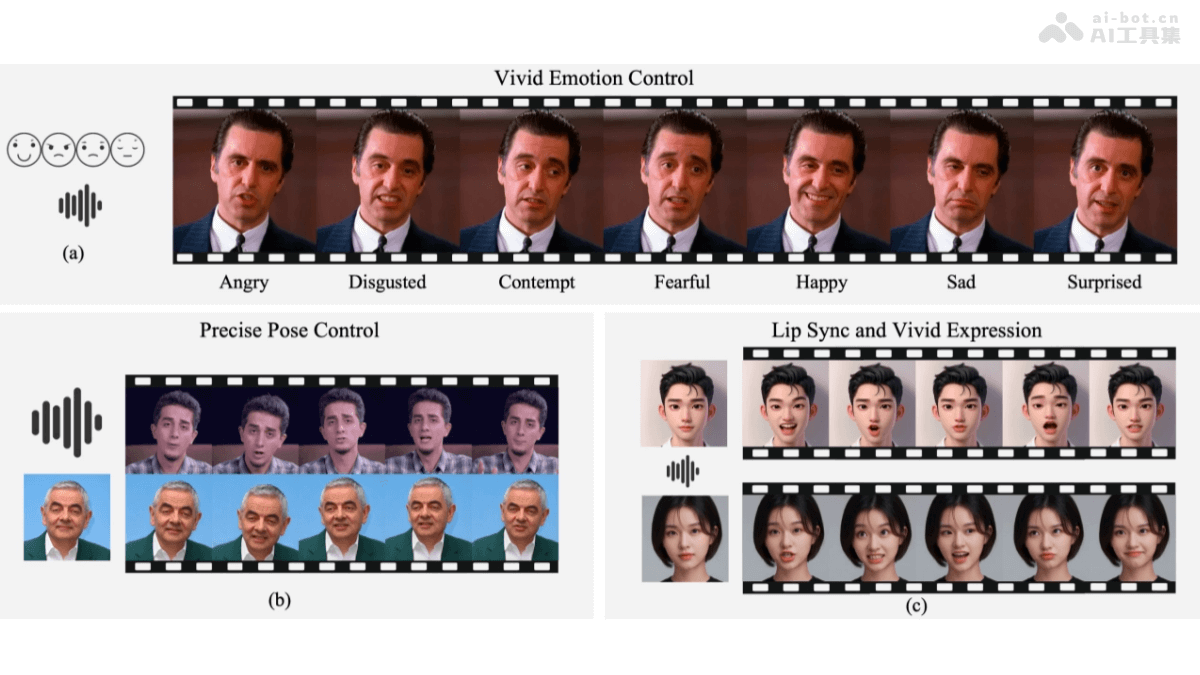
Playmate's Main Features
- Audio-driven: With only a single static photo and a segment of audio, it generates a corresponding dynamic portrait video, achieving natural lip synchronization and facial expression changes.
- Emotion control: Generates dynamic videos with specific emotions according to specified emotional conditions (such as anger, disgust, contempt, fear, happiness, sadness, surprise, etc.).
- Pose control: Supports controlling the pose of the generated result based on a driving image, enabling a variety of head movements and postures.
- Independent control: Achieves independent control over facial expressions, lip movements, and head pose.
- Diverse styles: Generates dynamic portraits in a variety of styles, including realistic faces, animations, artistic portraits, and even animals, with broad applicability.
Playmate's Technical Principles
- 3D implicit space-guided diffusion model: Based on a 3D implicit space representation, it disentangles facial attributes (such as expression, lip movements, head pose, etc.). Based on an adaptive normalization strategy, it further improves the disentanglement accuracy of motion attributes, ensuring that the generated videos are more natural in expression and pose.
- Two-stage training framework:
- First stage: Trains an audio-conditioned diffusion transformer to generate motion sequences directly from audio cues. Based on a motion disentanglement module, it achieves accurate disentanglement of facial expressions, lip movements, and head pose.
- Second stage: Introduces an emotion control module to encode emotional conditions into the latent space, achieving fine-grained emotional control over the generated videos.
- Emotion control module: Implements the emotion control module based on DiT blocks (Diffusion Transformer Blocks), using two DiT block structures to incorporate emotional conditions into the generation process, achieving fine-grained control over emotion. It uses a Classifier-Free Guidance (CFG) strategy to balance the quality and diversity of generated videos by adjusting the CFG weight.
- Efficient diffusion model training: Uses the pretrained Wav2Vec2 model to extract audio features and aligns audio and motion features based on a self-attention mechanism. Based on forward and reverse Markov chains, it gradually adds Gaussian noise to the target motion data, uses a diffusion transformer to predict and remove the noise, and generates the final motion sequence.
Playmate's Project Address
- Project official website:https://playmate111.github.io/Playmate/
- GitHub repository:https://github.com/Playmate111/Playmate
- arXiv technical paper:https://arxiv.org/pdf/2502.07203
Playmate's Application Scenarios
- Film and television production: Generates virtual character animations, special effect enhancement, and character replacement, reducing manual production costs and improving the realism of special effects.
- Game development: Facilitates virtual character generation, interactive story creation, and NPC animation production, enhancing game interactivity and immersion.
- Virtual Reality (VR) and Augmented Reality (AR): Enables natural facial expressions and lip synchronization in virtual character interactions, virtual meetings, and virtual socializing, improving user experience.
- Interactive Media: Applied in live streaming, video conferencing, virtual anchors, and interactive advertising to make content more vivid and engaging, enhancing interactivity.
- Education and Training: Used in virtual teacher generation, simulation training, and language learning to make teaching content more engaging for students and provide realistic training environments.