
What is Playground v3
Playground v3 (PGv3) is the latest text-to-image model launched by Playground Research, based on deeply integrated large language model (LLM) technology, achieving the ability to surpass human designers in graphic design tasks. PGv3 has 24 billion parameters and can accurately understand and generate complex image content, including precise RGB color control and multilingual text generation. The model architecture of PGv3 is a latent diffusion model (LDM), trained based on a variational autoencoder (VAE) and an experiental diffusion model (EDM). It uses a DiT-style model structure, where each Transformer block is the same as the corresponding block in the language model, enhancing prompt understanding and adherence capabilities. PGv3 performs excellently in text prompt adherence, complex reasoning, and text rendering accuracy, especially in design applications such as memes, posters, and logo design, demonstrating extraordinary design capabilities. PGv3 introduces a new benchmark, CapsBench, to evaluate detailed image description performance, advancing the development of image description evaluation methods.
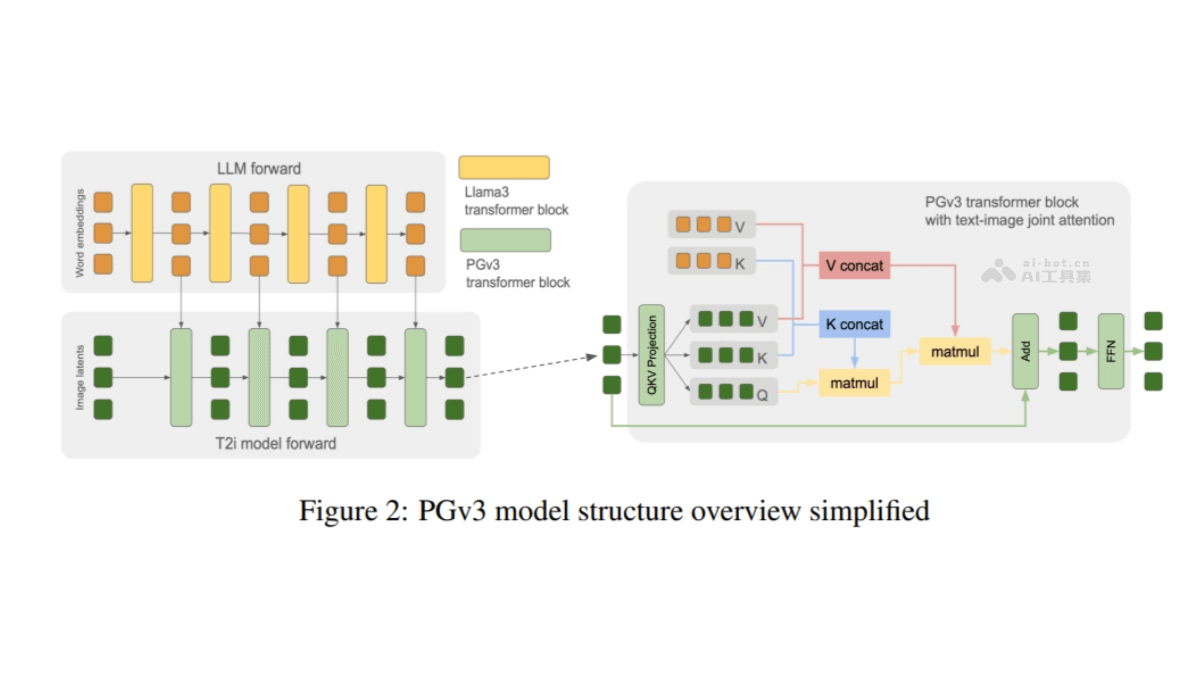
Main features of Playground v3
- Text-to-image generation: Generates corresponding image content based on the text description provided by the user.
- Graphic design: In design applications such as creating memes, posters, and logo design, it demonstrates the ability to surpass human designers.
- RGB color control: Supports precise RGB color control, generating images with specific color requirements.
- Multilingual support: Can understand and generate text in multiple languages, meeting the needs of users in different languages.
Technical principles of Playground v3
- Large language model integration: PGv3 integrates large language models (LLMs), such as Llama3-8B, enhancing text understanding and generation capabilities.
- Deep-Fusion architecture: Based on a brand-new deep fusion architecture, it uses the knowledge of decoder-only large language models for text-to-image generation.
- Variational autoencoder (VAE): Uses VAE to raise the upper limit of image quality and enhance the ability to synthesize details.
- High parameter count: 24 billion parameters enable the model to capture and generate more complex and detailed image features.
- DiT-style model structure: Based on the same structure as the corresponding Transformer blocks in the language model, enhancing prompt understanding and adherence capabilities.
- U-Net skip connections: Uses U-Net skip connections between Transformer blocks to enhance feature transfer.
Project address of Playground v3
- HuggingFace model library:https://huggingface.co/datasets/playgroundai/CapsBench
- arXiv technical paper:https://arxiv.org/pdf/2409.10695
Application scenarios of Playground v3
- Graphic design: Used to create posters, logos, brochures, social media images, and other marketing materials.
- Content creation: Helps content creators quickly generate customized images for articles, blogs, or social media posts.
- Game development: In game design, generates concept art, environmental backgrounds, or character designs.
- Film and entertainment: Generates concept art for movie posters, animated backgrounds, or visual effects.
- Advertising industry: Designs billboards, banner ads, and other advertising materials.
- Education and research: Generate illustrations in teaching materials, or help researchers visualize complex concepts.
- Art Creation: Artists use PGv3 to explore new artistic styles or create digital artworks.