
What Is PlanGEN
PlanGEN is a multi-agent framework introduced by the Google Research team that addresses planning and reasoning for complex problems through multi-agent collaboration, constraint guidance, and adaptive algorithm selection. It contains three key components: the Constraint Agent, the Verification Agent, and the Selection Agent. The agents work collaboratively to form a powerful problem-solving system.
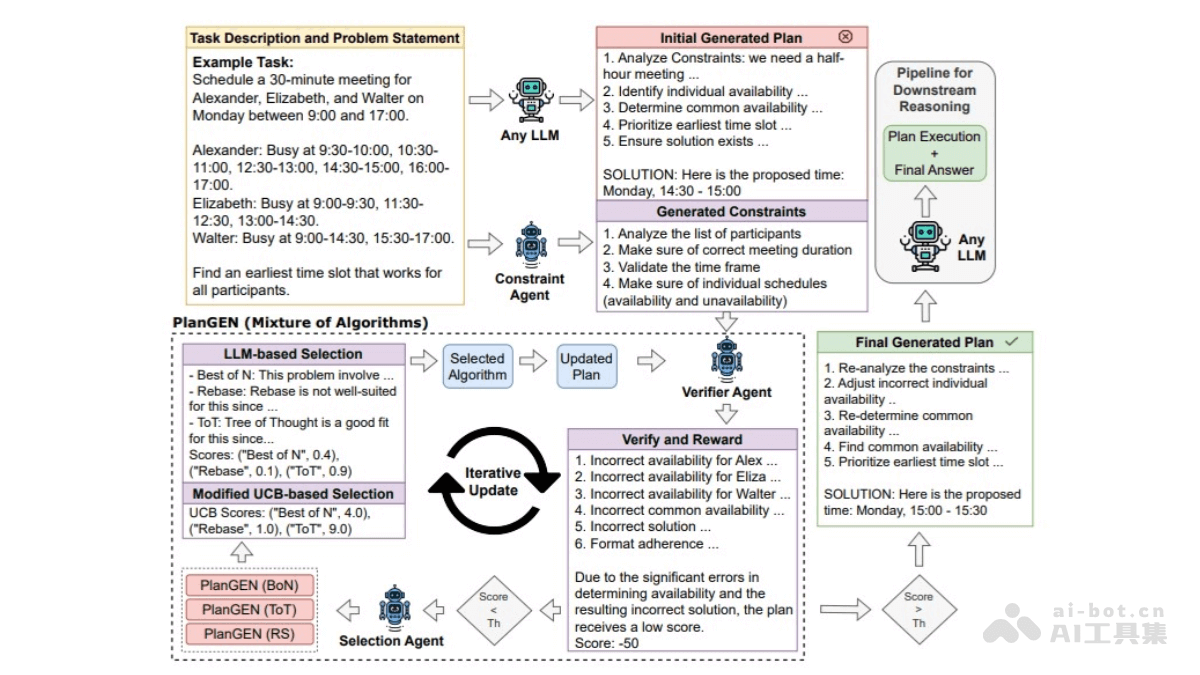
PlanGEN's Main Features
- Multi-Agent Collaboration: PlanGEN contains three key agents that collaborate to complete complex tasks:
- Constraint Agent: Deeply parses the problem description, extracts key constraint conditions, including explicit and implicit constraints.
- Verification Agent: Evaluates plan quality based on constraint conditions, assigns reward scores, and provides precise quality feedback to guide iterative optimization.
- Selection Agent: Dynamically selects the best algorithm according to problem complexity, balancing exploration and exploitation.
- Four Implementation Approaches: PlanGEN provides four different implementation approaches to adapt to problems of different complexity:
- PlanGEN (Best of N): Generates multiple plans in parallel and selects the solution with the highest reward, suitable for planning problems of medium complexity.
- PlanGEN (Tree-of-Thought): Builds a decision tree to gradually explore and evaluate possible solution paths, suitable for complex problems requiring multi-step reasoning.
- PlanGEN (REBASE): Implements an improved depth-first search that allows backtracking from suboptimal paths, suitable for problems with complex constraints and multiple feasible solutions.
- PlanGEN (Mixture of Algorithms): Dynamically selects the most suitable algorithm according to problem characteristics, achieving instance-level adaptability.
- Constraint Guidance and Iterative Optimization: PlanGEN emphasizes constraint-guided iterative verification, extracting problem constraints through the Constraint Agent, evaluating plan quality through the Verification Agent, and performing iterative optimization based on feedback. This ensures that the generated plans not only satisfy the constraint conditions but can also be gradually refined over multiple iterations.
- Adaptive Algorithm Selection: PlanGEN adopts an improved Upper Confidence Bound (UCB) strategy to dynamically select the most suitable reasoning algorithm. It can flexibly switch between different algorithms according to problem complexity and historical performance, balancing exploration and exploitation.
- Model Agnosticism and Scalability: PlanGEN is a model-agnostic framework that can be used in combination with different LLM models. This gives PlanGEN good scalability, allowing it to adapt to different tasks and models.
PlanGEN's Project Address
- arXiv Technical Paper:https://arxiv.org/pdf/2502.16111
PlanGEN's Application Scenarios
- Intelligent Customer Service Systems: PlanGEN can be used to develop high-performance intelligent customer service systems, supporting multi-turn dialogue, accurately understanding user intent, providing personalized replies, and possessing knowledge graph reasoning capabilities.
- Complex Task Planning: PlanGEN performs excellently in complex task planning, such as calendar scheduling, meeting arrangement, and travel planning. PlanGEN (Best of N) generates multiple plans in parallel and selects the optimal solution, suitable for tasks of medium complexity. In complex problems requiring multi-step reasoning (such as mathematical proofs), PlanGEN (Tree-of-Thought) builds a decision tree to gradually explore solutions.
- Autonomous Driving and Drone Swarms: PlanGEN's multi-agent collaboration mechanism is also applicable to autonomous vehicle fleets and drone swarms. Autonomous vehicles achieve cooperative driving through a multi-agent framework, optimizing traffic flow and safety. Drone swarms can be used for tasks such as logistics delivery, farmland monitoring, and natural disaster rescue, improving efficiency through collaborative operations.
- Supply Chain Optimization: In supply chain management, PlanGEN can help respond to sudden changes in market demand or emergencies. Through multi-agent collaboration, retailers, suppliers, and manufacturers can quickly adjust production, transportation, and inventory plans to ensure the stable operation of the supply chain.
- Scientific and Mathematical Reasoning: PlanGEN also shows significant performance in scientific and mathematical reasoning tasks. For example, in the OlympiadBench benchmark, PlanGEN (REBASE) and PlanGEN (Mixture of Algorithms) significantly improve the accuracy of solving mathematical and physics problems through flexible algorithm selection and iterative optimization.