
What is PixWizard
PixWizard is a multi-functional image-to-image visual assistant that performs tasks such as image generation, editing, and translation based on natural language instructions. The system integrates multiple visual tasks through a unified image-text-to-image generation framework, supported by a comprehensive training set containing 30 million data points. PixWizard uses a flow-based Diffusion Transformer (DiT) as its foundation model, introducing structure-aware and semantic-aware guidance to effectively process information from input images. Experimental results show that PixWizard demonstrates strong generation and understanding capabilities across images of various resolutions, and can handle new tasks and instructions not encountered during training, showing good generalization ability.
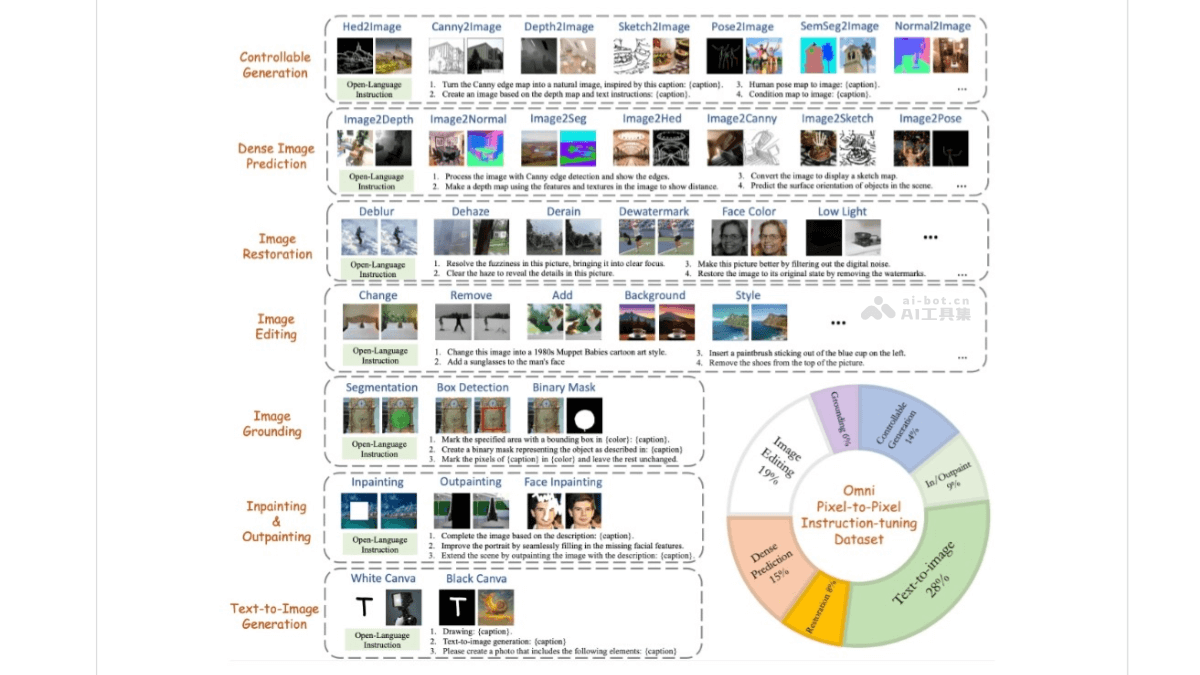
PixWizard's Main Features
- Image Generation: Generate new images based on text descriptions.
- Image Editing: Edit existing images based on natural language instructions, such as removing, replacing, or adding elements in the image.
- Image Translation: Convert one type of visual content to another, such as converting a sketch into a detailed image.
- Image Restoration: Repair damaged or degraded images, such as denoising, deraining, and deblurring.
- Image Localization: Locate objects in images based on text prompts.
- Dense Image Prediction: Perform tasks such as semantic segmentation and depth estimation.
PixWizard's Technical Principles
- Task Unification: Unify different visual tasks as image-to-image translation problems, which are converted to the required format after post-processing.
- Data Construction: Train on multi-task, multi-modal datasets containing 30 million data points, covering various tasks such as image generation, editing, and restoration.
- Architecture Design: Use a flow-based Diffusion Transformer (DiT) as the foundation model, offering flexibility and stability.
- Structure-aware and Semantic-aware Guidance: Obtain structural and semantic information from images through Variational Autoencoder (VAE) and CLIP models to guide the generation process.
- Arbitrary Resolution Processing: Process images of different resolutions through dynamic partitioning and padding schemes, preserving the original resolution.
- Two-stage Training and Data Balancing Strategy: The first stage focuses on tasks with smaller data volumes, and the second stage integrates data for training, improving the model's performance on small datasets.
- Flow-based Conditional Instruction Tuning: Initialize PixWizard's weights based on the pre-trained Lumina-Next-T2I model, predicting the velocity field for image generation.
PixWizard's Project Address
- GitHub Repository:https://github.com/AFeng-x/PixWizard
- arXiv Technical Paper:https://arxiv.org/pdf/2409.15278
PixWizard's Application Scenarios
- Content Creation: Artists and designers can use PixWizard to generate images based on text descriptions, or edit and style-transfer existing images to create new artworks.
- Media Editing: In news media or publishing, PixWizard quickly repairs or enhances images, such as removing noise or unwanted objects from photos.
- Advertising and Marketing: Marketers use PixWizard to generate attractive advertising images, or create customized visual effects based on product features.
- Social Media: Users use PixWizard to edit personal photos on social media, adding interesting effects or applying artistic processing.
- Education and Research: In the field of education, PixWizard serves as a teaching tool to help students understand image processing and visual concepts. In the field of scientific research, it helps researchers perform image analysis and data augmentation.
- E-commerce: Online retailers use PixWizard to enhance product images, making them more attractive, or to quickly adjust image content based on user feedback.