
What Is PixelUMM
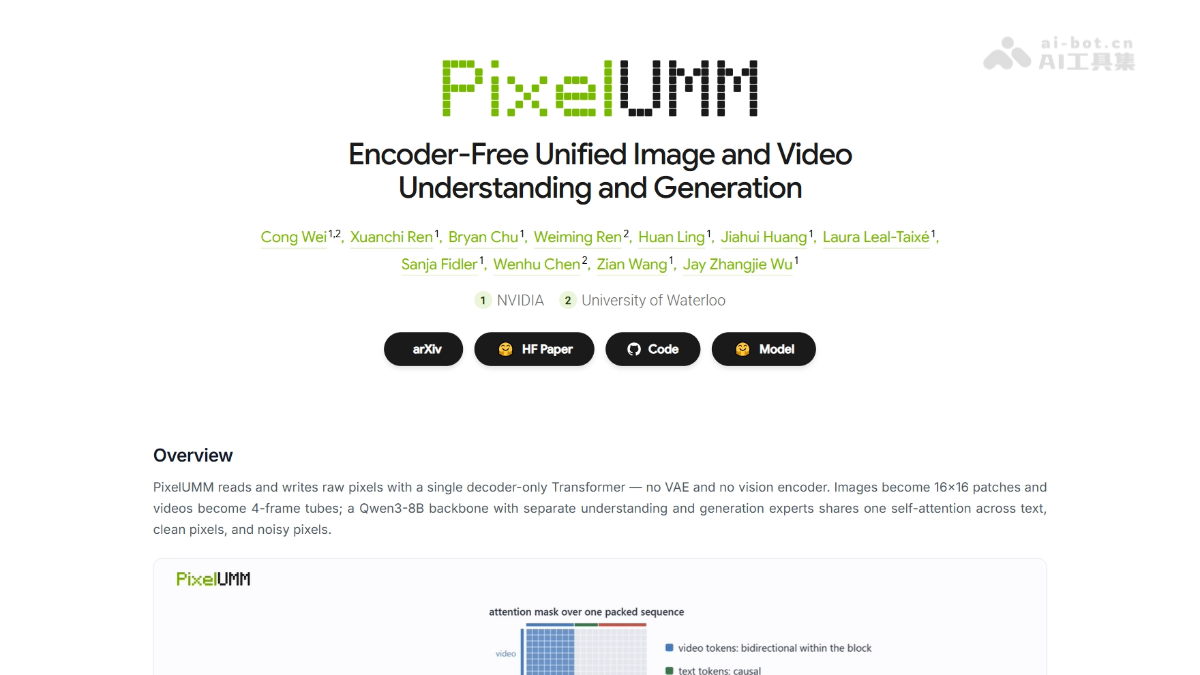
PixelUMM is an encoder-free unified multimodal model jointly launched by NVIDIA and the University of Waterloo. Its core breakthrough is the complete removal of the VAE and visual encoder, using a single Decoder-only Transformer to directly read and write images and videos in raw pixel space, with understanding and generation sharing the same decoder and self-attention. Images are split into 16×16 patches and videos into 4-frame tubelets, and the code has been open-sourced.
PixelUMM's Main Features
-
Text-to-Video (T2V): Supports generating videos up to 832×464, 96 frames, 24fps, 4 seconds long, with image quality comparable to mainstream video diffusion models.
-
Text-to-Image (T2I): Directly generates images within the same model, without the need for a separate image branch or decoder.
-
Image Understanding: Can complete 21 image understanding tasks including VQA, OCR, charts, and documents, reaching the average level of 8B-class VLMs.
-
Video Understanding: Supports video question-answering benchmarks such as MVBench and Video-MME, providing both dense and sparse input modes.
-
Image-to-Video (I2V): By injecting a clean first-frame image as a condition into the understanding expert, subsequent video can be generated, without the need for a VAE to encode the conditioning frame.
-
Video Editing: Uses the input video as a visual condition and implements editing-type tasks through a multimodal context conditioning mechanism.
PixelUMM's Technical Principles
- Encoder-Free Architecture: PixelUMM completely removes the VAE and visual encoder found in traditional unified models. Images are directly split into 16×16 patches and videos into 4-frame tubelets and input in raw RGB pixel form, while the output is likewise directly regressed to pixels by a linear head. The entire process has no latent-space encoding/decoding loss, achieving true end-to-end pixel reading and writing.
- MoT Shared Attention Structure: The model uses Qwen3-8B as its backbone to build a Mixture-of-Transformers: the understanding expert and the generation expert each have their own independent FFN and share the same set of self-attention, allowing text, clean pixels, and noisy pixels to interact within the same attention space, unifying understanding and generation within one model.
- Pixel-Space Diffusion Training: Generation tasks are trained directly in pixel space in a flow-matching style. Ablation experiments show that the gradient norms in pixel space and VAE space are almost identical, but training in pixel space is more stable, and compression-rate experiments confirm that 16×16 patches and 4-frame tubelets are the optimal balance between learning difficulty and efficiency.
- Multimodal Conditioning Injection Mechanism: "Clean conditions" such as reference text conditions, reference images, and input videos all uniformly go through the understanding expert, while the noisy tokens to be generated go through the generation expert. The two are fused in the shared attention, extending SenseNova-U1's encoder-free conditioning approach to image-to-video and video editing. Ablations show that the design does not harm understanding ability, with four video benchmarks improving by 0.89–3.49 points.
- Linear Output Head and Convolutional Head Ablation: By default, a lightweight linear output head is used, which introduces 16-pixel grid artifacts; experiments comparing a Wan-style upsampling convolutional head and a PixelShuffle head prove that the convolutional head can eliminate the artifacts, among which the time-first PixelShuffle is the best compromise between training loss and artifact suppression, and switching heads requires retraining.
How to Use PixelUMM
- Clone the repository:
git clone https://github.com/nv-tlabs/PixelUMM, followENVIRONMENT.mdto configure the CUDA environment. - Download the weights: from Hugging Face's
nvidia/PixelUMMdownload the default checkpointS8-F22-R05, and according toCHECKPOINT.mddownload Qwen3-8B's configuration and tokenizer files. - Set paths: configure
PIXELUMM_CKPT、PIXELUMM_QWEN_DIR、PIXELUMM_OUTPUTthree environment variables pointing to local absolute paths. - Validate checkpoint: first run
check_checkpoint.pyto check weight integrity and tensor compatibility. - Apply for safety review permission: go to Hugging Face to apply for access permission for
nvidia/Cosmos-1.0-Guardrailand log in. - Run inference: use
inference.pyto specify--task t2i / t2v / image-vlm / video-vlmrespectively, and with parameters such as prompt, resolution, and frame count, generate images, videos, or output understanding results. - Batch generation (optional): use
inference_batch.pytogether with a YAML prompt file to run tasks in batches. - Toy training (optional): according to
TRAIN.mddownload the toy dataset, and usetrain_toy.pyto run a four-task training example based on the F22 checkpoint.
PixelUMM's core advantages
-
Completely encoder-free architecture: removes the VAE and visual encoder, reading and writing directly in the raw pixel space, eliminating information loss and sources of artifacts caused by latent space encoding and decoding.
-
Unified understanding and generation: a single decoder-only Transformer simultaneously completes the four major tasks of text-to-image, text-to-video, image understanding, and video understanding, with the understanding expert and generation expert sharing the same self-attention.
-
Simple architecture, direct inference: the output is directly regressed to pixels by a lightweight linear head, without the need for an additional decoder, making the generation pipeline shorter.
-
Flexible and efficient condition injection: clean conditions such as reference images and input videos can be routed through the understanding expert to achieve image-to-video and video editing; ablations prove that this design does not impair understanding capability.
-
Clear training laws, scalable: the 8B model requires only about one third of the training steps of a 1.7B model to reach the same loss, showing clear scaling benefits.
PixelUMM's project addresses
- Project website:https://nv-tlabs.github.io/PixelUMM/
- GitHub repository:https://github.com/nv-tlabs/PixelUMM
- HuggingFace model library:https://huggingface.co/nvidia/PixelUMM
- arXiv technical paper:https://arxiv.org/pdf/2609.38597
PixelUMM's comparison with similar competing products
| Comparison dimension | PixelUMM(NVIDIA × University of Waterloo) | BAGEL(ByteDance) |
|---|---|---|
| Core architecture philosophy | Encoder-Free: completely removes the VAE and visual encoder, end-to-end reading and writing in pixel space | Encoder-Based: Wan-series VAE + SigLIP visual encoder, latent space diffusion generation |
| Backbone network | Qwen3-8B | Qwen2.5-7B-Instruct |
| Total parameter count | 15.2B (MoT, dense activation) | 14B MoE (about 7B activated per token) |
| Visual tokenization | 16×16 patches for images, 4-frame tubelets for videos (p16/t4), raw RGB input directly | After VAE compression to latent, project with patchify |
| Output method | Lightweight linear head directly regresses pixels (12.6M parameters) | VAE decoder restores pixels |
| Supported tasks | T2I, T2V, image understanding, video understanding, I2V, video editing | T2I, T2V, I2V, image understanding, image editing, video editing |
| Image understanding MMMU | 41.67 | 55.30(significantly ahead) |
| Image understanding AI2D | 80.12 | 89.20 |
| Image understanding ChartQA | 82.96 | 78.50 |
| Image understanding CountBench | 94.30 | 82.50 |
Application scenarios of PixelUMM
-
Short video content creation: input a line of copy to directly generate a 4-second 24fps video, suitable for quickly producing materials for social media.
-
Image-to-video and video editing: use the first frame or the original video as a condition to generate/modify content, usable for dynamic display of e-commerce products and film and television previews.
-
Long video understanding and question answering: perform description, summarization, and temporal reasoning on input videos, suitable for content moderation, material retrieval, and meeting minutes.
-
Document and chart parsing: the results of OCRBench 78.0 and DocVQA 90.4 can support enterprise document intelligence scenarios such as receipt recognition and report question answering.