
What is PixelHacker
PixelHacker is an image inpainting model jointly launched by Huazhong University of Science and Technology and VIVO AI Lab. Based on the introduction of the Latent Categories Guidance (LCG) paradigm, it separately encodes the foreground and background, and injects features into the denoising process based on linear attention, achieving structural and semantic consistency. The model is pretrained on a large-scale dataset (containing 14 million image-mask pairs) and fine-tuned on multiple open-source benchmark datasets (such as Places2, CelebA-HQ, and FFHQ), demonstrating excellent inpainting results.
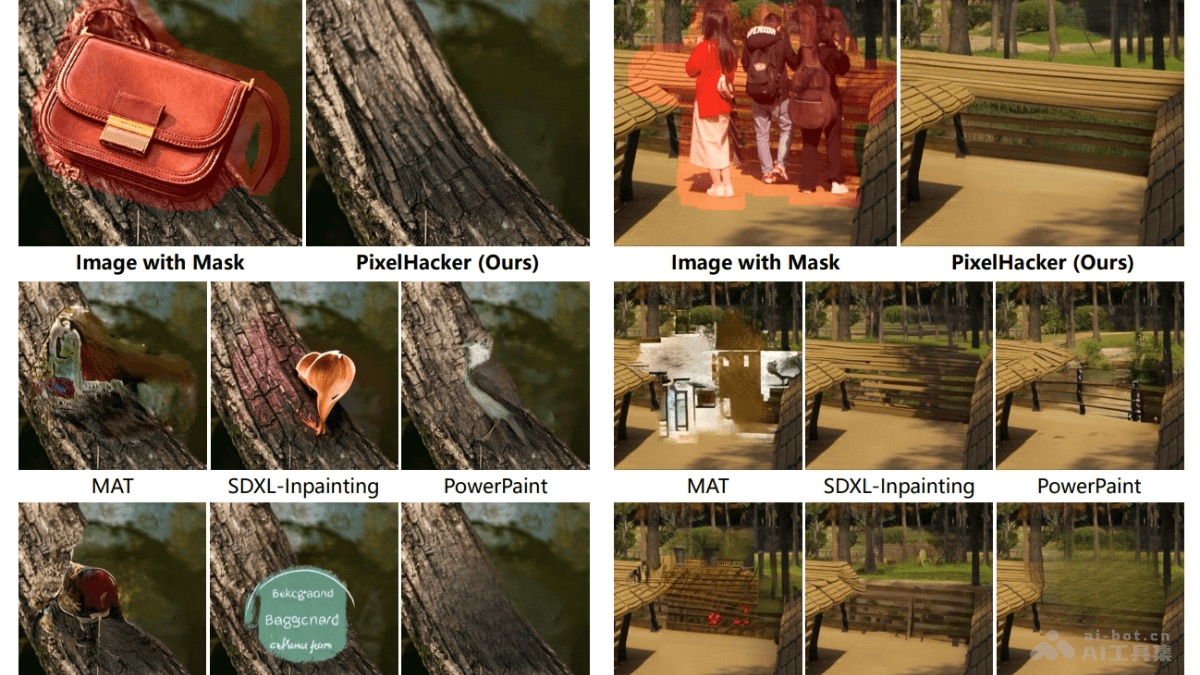
Main Features of PixelHacker
- High-Quality Image Inpainting: Performs excellently on various datasets such as natural scenes and face images, generating realistic inpainting content.
- Structural and Semantic Consistency: Ensures that the inpainted region transitions naturally with the surrounding environment in texture, shape, and color, and is logically consistent with the scene.
- Adaptability to Multiple Scenarios: Has good adaptability to different types of images (such as landscapes, faces, complex backgrounds), and supports multiple resolutions and mask types.
Technical Principles of PixelHacker
- Latent Categories Guidance (LCG): Divides the image into foreground and background parts, and encodes latent features using two fixed-size embeddings respectively. The method avoids dependence on specific category labels. During training, various masks (such as random brush masks, object semantic masks, scene semantic masks, etc.) are used to construct image-mask pairs, which are assigned to foreground or background embeddings.
- Diffusion Model Architecture: Uses a diffusion model as its generative framework. The diffusion model generates image content through a step-by-step denoising process, producing high-quality and diverse images. During the denoising process, the latent features of the foreground and background are injected into the model based on linear attention.
- Training and Fine-Tuning: Pretrained on a large-scale dataset containing 14 million image-mask pairs, learning rich image distributions and semantic information. On the basis of pretraining, PixelHacker is fine-tuned on multiple open-source benchmark datasets (such as Places2, CelebA-HQ, and FFHQ) to adapt to specific tasks and data distributions, further improving performance.
- Multi-Step Interaction: At each denoising step, the latent features of the foreground and background interact with the current image features based on linear attention, ensuring that the generated content remains structurally and semantically consistent with the surrounding environment.
- Classifier-Free Guidance (CFG): During inference, the Classifier-Free Guidance technique is used to adjust the guidance scale to balance the diversity and consistency of the generated content.
Project Address of PixelHacker
- Project Website:https://hustvl.github.io/PixelHacker/
- GitHub Repository:https://github.com/hustvl/PixelHacker
- arXiv Technical Paper:https://arxiv.org/pdf/2504.20438
Application Scenarios of PixelHacker
- Restoring Old Photos: Automatically fills in scratches, stains, or missing parts to restore the integrity of the photo.
- Removing Unrelated Objects: Removes unwanted elements (such as pedestrians, clutter) from images while keeping the background natural.
- Creative Content Generation: Assists artists and designers in quickly generating high-quality images for advertising, posters, or artistic creation.
- Medical Image Restoration: Filling in missing or damaged regions in medical images to improve diagnostic accuracy.
- Cultural Heritage Preservation: Restoring images of cultural relics and ancient books, filling in missing parts, and helping cultural transmission.