
What is Pixel Reasoner
Pixel Reasoner is a vision-language model (VLM) launched by the University of Waterloo, the Hong Kong University of Science and Technology, the University of Science and Technology of China, and other institutions. It enhances the model's understanding and reasoning capabilities for visual information based on pixel-space reasoning. The model can directly operate on visual inputs, such as zooming into image regions or selecting video frames, to capture visual details more finely. Pixel Reasoner uses a two-stage training method: instruction tuning to familiarize the model with visual operations, and curiosity-driven reinforcement learning to incentivize the model to explore pixel-space reasoning. Pixel Reasoner achieves excellent results on multiple visual reasoning benchmarks and significantly improves performance on vision-intensive tasks.
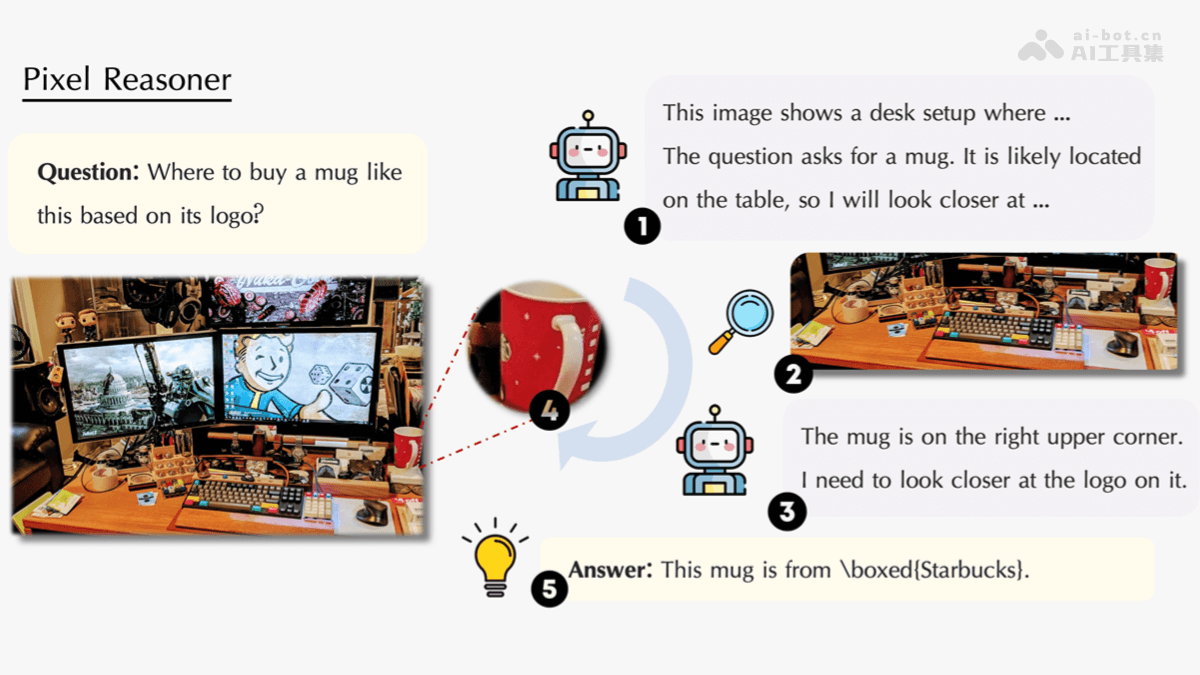
Pixel Reasoner's main features
- Direct visual operations: Directly operate on visual inputs (such as images and videos), for example zooming into image regions (zoom-in), selecting video frames (select-frame), etc., to capture visual details more finely.
- Enhanced visual understanding: Recognize and understand small objects in images, subtle spatial relationships, embedded small text, and subtle actions in videos.
- Multimodal reasoning: Handle complex vision-language tasks more comprehensively, such as visual question answering (VQA), video understanding, etc.
- Adaptive reasoning: Adaptively decide whether to use visual operations according to task requirements, achieving better reasoning results across different types of visual tasks.
Pixel Reasoner's technical principles
- Instruction Tuning:
- Collect seed data: Select image and video datasets with rich visual information, such as SA1B, FineWeb, and STARQA.
- Locate reference visual cues: Based on dataset annotations or annotations generated using GPT-4o, determine visual cues relevant to the question (such as bounding boxes or frame indices).
- Synthesize expert trajectories: Use templated methods to synthesize reasoning trajectories, ensuring that the model correctly uses visual operations during reasoning. For example, first analyze the entire visual input, then trigger specific visual operations to extract fine-grained visual details, and finally combine the details to arrive at the final answer.
- Training: Train the model with supervised learning (Supervised Fine-Tuning, SFT) to familiarize the model with visual operations. Based on inserting incorrect visual operations and synthesizing self-correction trajectories, enhance the model's ability to respond to unexpected visual results.
- Curiosity-driven reinforcement learning: Design a reward function that includes curiosity rewards and efficiency penalties to incentivize the model to explore pixel-space reasoning.
- Training process: Train the model with reinforcement learning (RL), using curiosity rewards to incentivize the model to explore pixel-space reasoning, and efficiency penalties to limit the number of visual operations. Based on a proximal policy RL method, update the behavior policy and improved policy every 512 queries. During training, the model gradually learns to use pixel-space reasoning in appropriate queries and to self-correct when visual operations fail.
Pixel Reasoner's project address
- Project official website:https://tiger-ai-lab.github.io/Pixel-Reasoner/
- GitHub repository:https://github.com/TIGER-AI-Lab/Pixel-Reasoner
- HuggingFace model library:https://huggingface.co/collections/TIGER-Lab/pixel-reasoner
- arXiv technical paper:https://arxiv.org/pdf/2505.15966
- Online experience Demo:https://huggingface.co/spaces/TIGER-Lab/Pixel-Reasoner
Pixel Reasoner's application scenarios
- Researchers and developersResearchers and developers conduct model training and optimization, especially in tasks such as visual question answering and video analysis, to improve model performance and accuracy.
- EducatorsThey are used by educators to assist teaching, using intuitive visual displays and explanations to help students better understand and master complex concepts.
- Industrial quality inspection personnelQuality inspection personnel perform automated visual inspection, quickly identify product appearance defects, and improve the efficiency and accuracy of quality control.
- Content creatorsCreators perform more precise visual content analysis and editing, improving the quality and appeal of content.