
What is PIKE-RAG
PIKE-RAG (sPecIalized KnowledgE and Rationale Augmented Generation) is a retrieval-augmented generation framework launched by Microsoft Research Asia, capable of addressing the limitations of traditional RAG systems in complex industrial applications. PIKE-RAG builds coherent reasoning logic based on extracting, understanding, and applying specialized knowledge, guiding large language models (LLMs) to generate accurate answers. PIKE-RAG introduces Knowledge Atomizing, which decomposes knowledge into fine-grained atomic units stored in the form of questions, facilitating efficient retrieval and organization. PIKE-RAG proposes a multi-agent planning module for handling creative problems, performing reasoning and planning from multiple perspectives.
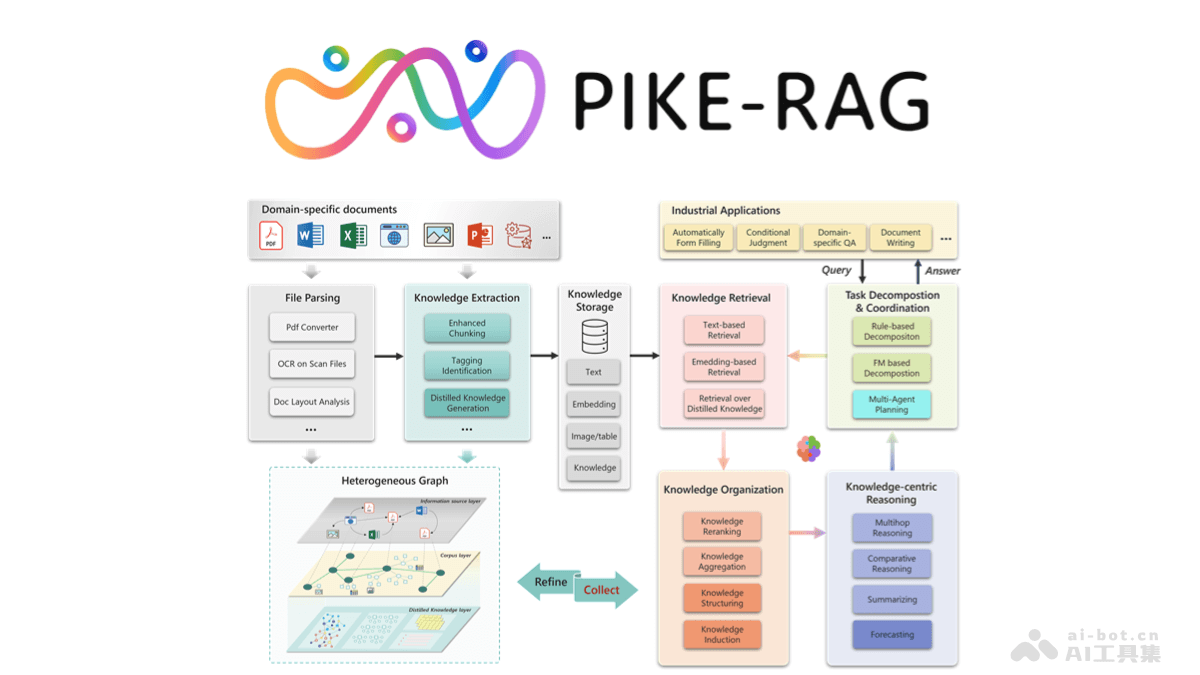
Main Features of PIKE-RAG
- Specialized Knowledge Extraction and Understanding: Extracts domain-specific knowledge from diverse data sources, transforming it into structured knowledge units to provide precise knowledge support for complex problems.
- Reasoning Logic Construction: Based on dynamic task decomposition and knowledge-aware reasoning path planning, it gradually builds coherent reasoning logic, guiding the language model to generate accurate answers.
- Multi-hop Problem Handling: Based on knowledge atomizing and task decomposition, it decomposes complex problems into multiple atomic problems, gradually solving multi-hop reasoning tasks.
- Creative Problem Solving: Introduces a multi-agent system to perform reasoning and planning from multiple perspectives, inspiring innovative solutions.
- Staged System Development: Based on task complexity, it supports staged development from basic factual problems to advanced creative problems, gradually enhancing system capabilities.
Technical Principles of PIKE-RAG
- Knowledge Atomizing: Decomposes knowledge in documents into fine-grained "atomic knowledge" stored in the form of questions. Atomic knowledge serves as retrieval indices, matching user questions more efficiently and improving the precision of knowledge retrieval.
- Knowledge-Aware Task Decomposition: Dynamically decomposes complex problems into multiple atomic problems, selecting the optimal reasoning path based on the content of the knowledge base. Based on iterative retrieval and selection, it gradually collects relevant information and builds complete reasoning logic.
- Multi-Agent Planning: When handling creative problems, it introduces multiple agents, each performing reasoning and planning from different perspectives. Based on the collaborative work of multiple agents, it generates more comprehensive and innovative solutions.
- Multi-Granularity Retrieval: Performs multi-granularity retrieval in a multi-layer heterogeneous knowledge graph, from whole documents to fine-grained knowledge units, gradually refining the retrieval scope. Combined with the structure of the multi-layer knowledge graph, it improves the efficiency and accuracy of knowledge retrieval.
- Staged System Development: Based on task complexity, it divides the RAG system into different levels (L1-L4), gradually enhancing system capabilities. Each level targets a specific type of problem, from simple factual problems to complex creative problems, gradually strengthening the system's reasoning and generation capabilities.
Project Address of PIKE-RAG
- GitHub Repository:https://github.com/microsoft/PIKE-RAG
- arXiv Technical Paper:https://arxiv.org/pdf/2501.11551
Application Scenarios of PIKE-RAG
- Legal Field: Assists legal professionals in interpreting regulations and analyzing cases, providing precise legal consultation and advice.
- Medical Field: Helps doctors with disease diagnosis and treatment plan planning, providing medical advice based on specialized knowledge.
- Semiconductor Design: Supports engineers in understanding complex physical principles, optimizing semiconductor design and R&D processes.
- Financial Sector: Used in risk assessment and market forecasting, providing data support and analytical reports for investment decisions.
- Industrial Manufacturing: Optimizes production processes and supply chain management, improving industrial efficiency and quality control.