
What is PhysGen3D
PhysGen3D is an innovative framework that can convert a single image into an interactive 3D scene and generate physically realistic videos. It combines image-based geometric and semantic understanding with physics-based simulation. By inferring the 3D shape, pose, physical, and lighting attributes of objects from a single image, it creates an image-centric digital twin. It then simulates the counterfactual physical behavior of objects based on the Material Point Method (MPM), and finally seamlessly integrates the dynamic effects into the original image to generate visually realistic results.
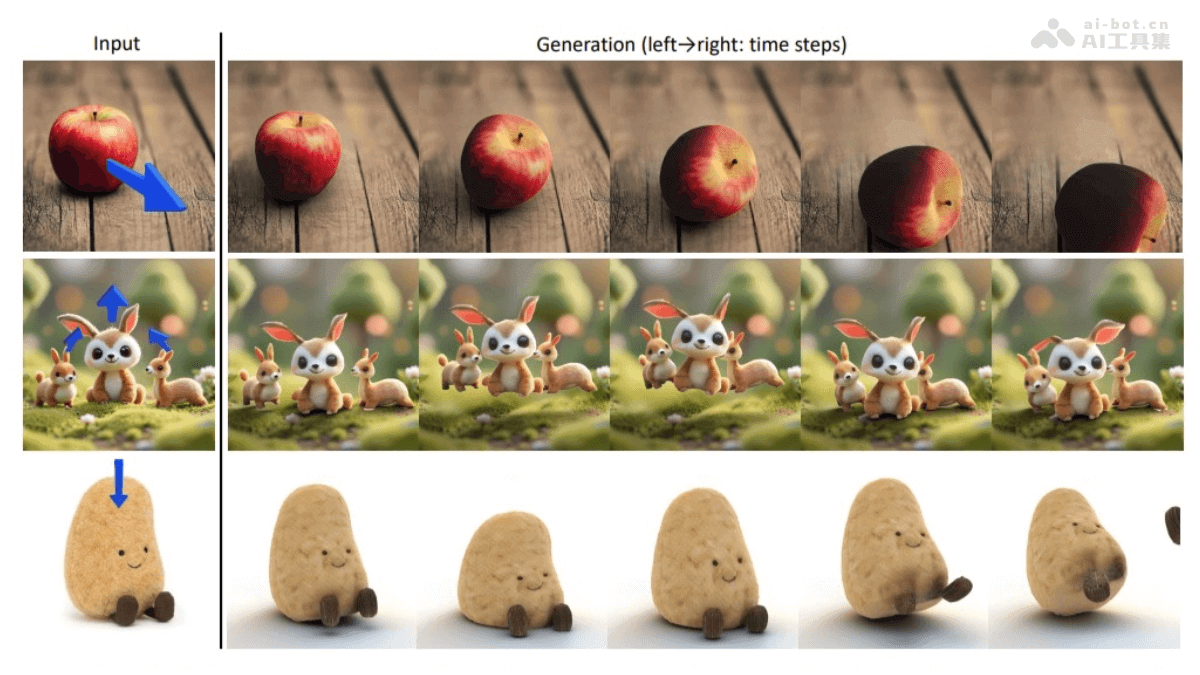
Main features of PhysGen3D
- Create interactive 3D scenes from a single image: PhysGen3D can convert a single image into an interactive 3D scene, in which users can simulate different physical behaviors.
- Precisely control the initial conditions of objects: Users can specify initial conditions such as object velocity and material properties, thereby finely controlling the results of the generated video.
- Generate videos with physical realism: By combining image-based geometric and semantic understanding with physics-based simulation, PhysGen3D can generate videos that are visually realistic and physically plausible in terms of dynamics and lighting.
- Dense 3D tracking: It can perform accurate 3D tracking of objects in the scene.
- Video editing: It can swap objects between different scenes, or remove certain objects while keeping the initial positions of objects unchanged.
- Camera control: It supports generating videos from different viewpoints.
- Generate videos from paintings: It can handle other types of input such as generated images and paintings, and generate videos.
Technical principles of PhysGen3D
- 3D scene reconstruction: Starting from a single image, PhysGen3D uses advanced image-based geometric and semantic understanding techniques to infer the 3D shape, pose, physical, and lighting attributes of objects, while reconstructing the geometry and appearance of the background. Based on multiple pretrained visual models, it integrates their outputs to create an image-centric digital twin.
- Physics simulation: In terms of physics simulation, PhysGen3D adopts the Material Point Method (MPM), a point-voxel-based framework used to simulate the counterfactual physical behavior of objects in the image. By accurately inferring the physical properties of objects, PhysGen3D can achieve a high degree of realism and stability in the simulation environment. Users can specify initial conditions such as object velocity and material properties to finely control the results of the generated video.
- Physics-based rendering: After completing the dynamic simulation, PhysGen3D computes vertex motion through motion interpolation, deforms the mesh, uses optimized physically based rendering (PBR) materials, and performs physics-based rendering with Mitsuba3 under environment lighting. To avoid converting the entire static background into the rendering pipeline, PhysGen3D constructs a 3D shadow-catching surface, uses a two-pass shadow mapping technique to extract shadows and global illumination effects, and finally composites the foreground objects and shadows onto the inpainted background to generate the final video.
Project address of PhysGen3D
- Project official website:https://by-luckk.github.io/PhysGen3D/
- Github repository:https://github.com/by-luckk/PhysGen3D
- arXiv technical paper:https://arxiv.org/pdf/2503.20746
Application scenarios of PhysGen3D
- Film and television production and special effects: PhysGen3D can be used for special effects generation in film and television production, helping creators quickly build dynamic scenes with physical realism.
- Virtual Reality and Augmented Reality: In virtual reality (VR) and augmented reality (AR) applications, PhysGen3D can generate interactive 3D scenes from a single image, providing users with an immersive experience.
- Education and Training: PhysGen3D can be used in the field of education to help students better understand physics concepts.
- Game Development: PhysGen3D provides new possibilities for game development. The ability of developers to generate dynamic scenes with physical realism from a single image allows them to quickly build levels and scenes in games.
- Advertising and Marketing: In the fields of advertising and marketing, PhysGen3D can be used to generate engaging dynamic advertising content. Generate dynamic videos from product photos, showcase product usage scenarios and physical characteristics, and attract consumers' attention.