
What is PhoneBuddy
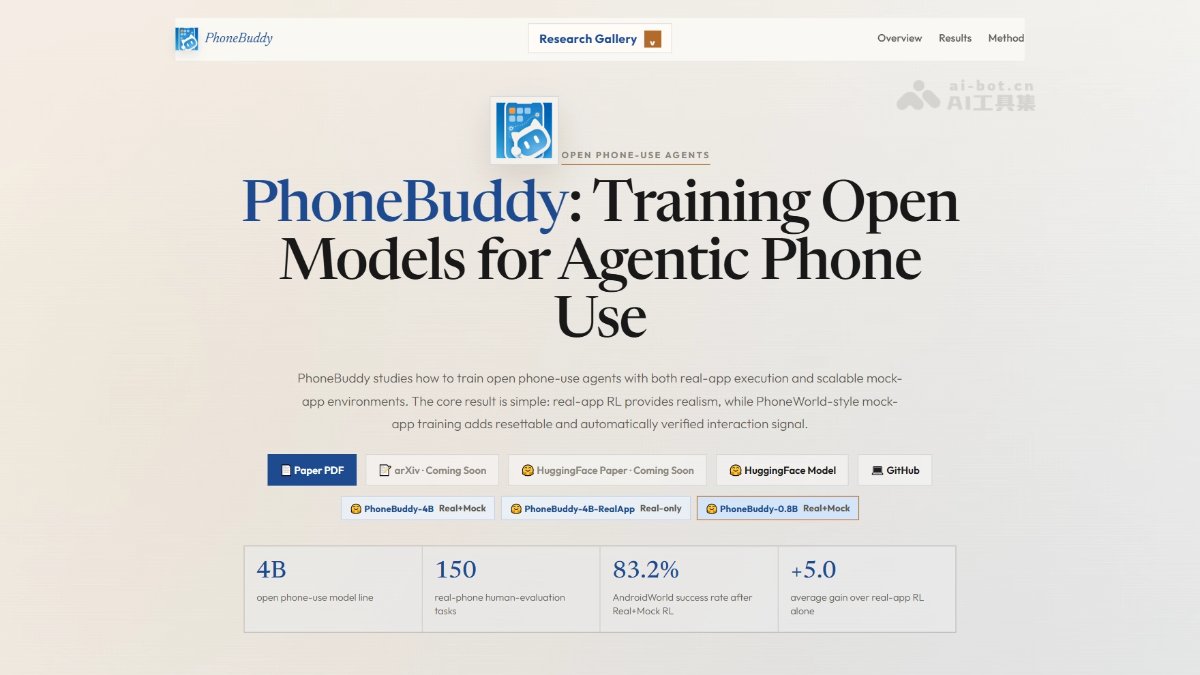
PhoneBuddy is a 4B parameter mobile Agent model open-sourced by the Tencent Hunyuan team, with its core research focused on how to train a usable AI Agent in real mobile phone scenarios. The model adopts a hybrid RL training scheme of real App + Mock App. In 150 real-device evaluation tasks, its success rates on single-App and WeChat Mini Program tasks both exceed GPT-5.4, and it reaches 83.2% on AndroidWorld, proving that small models can be highly competitive through environment design optimization.
PhoneBuddy's Main Features
-
Mobile GUI Understanding and Operation: Recognizes mobile phone screenshots and predicts the next action such as tapping, swiping, or typing.
-
Single App Task Execution: Completes operations such as searching, settings, and content creation within a single native application.
-
Cross-App Information Flow: Transfers information between multiple applications to complete complex tasks that require collaboration.
-
WeChat Mini Program Operation: Supports completing tasks such as searching, booking, and querying within the WeChat Mini Program ecosystem.
-
Real-Environment Task Verification: Verifies whether a task is truly completed, such as whether a message was sent or a document was saved.
PhoneBuddy's Technical Principles
- Two-Stage Training Architecture: Through Shared SFT, the model simultaneously learns operation trajectories from real Apps and Mock Apps, establishing a unified foundation for mobile operation capabilities; entering the RL stage, it separately compares the effects of training only in the real environment versus hybrid training with Real+Mock.
- Real+Mock Hybrid RL: Real Apps provide real business logic, account states, and side effects; PhoneWorld Mock Apps provide resetable, verifiable, and scalable training signals. The two complement each other to resolve the contradiction between being real but difficult to train and being controllable but not real.
- PhoneWorld Environment Construction: Reconstructs runnable Android Mock Apps from real GUI usage structures, preserving page structures, navigation relationships, interactive elements, and task verifiers, enabling RL to obtain stable reward signals.
- Task-Level Verification Mechanism: Directly checks the final state of the task, such as whether the hotel budget was filtered or whether the leave request content was correctly pasted, ensuring the Agent truly completes the user's goal.

Follow WeChat and reply “open source” to joinAI Open-Source Project Communication Group
How to Use PhoneBuddy
- Environment Preparation: Download and configure the PhoneBuddy-4B model weights and dependency environment, and prepare an Android real device or emulator as the execution environment.
- Data Collection: Collect real App operation trajectories for SFT-stage training, while constructing or integrating PhoneWorld Mock Apps to obtain verifiable interaction data.
- Model Training: First perform Shared SFT training so the model masters a unified operation format, then choose a Real-only or Real+Mock environment for RL fine-tuning.
- Task Deployment: Integrate the trained model into the mobile execution layer (such as PhoneHarness), and issue task instructions via GUI or CLI.
- Result Verification:Use task verifiers to check the final execution state and confirm whether the task is truly completed rather than just appearing correct on the page.
PhoneBuddy's Core Advantages
-
Real-Scenario Orientation: Training is directly oriented toward real phones and real apps, rather than only optimizing offline benchmark scores.
-
High performance with a small model: With only 4B parameters, it surpasses GPT-5.4 on single-app and WeChat Mini Program tasks, proving that environment design is more important than simply stacking parameters.
-
Verifiable RL training: The PhoneWorld Mock environment provides stable rewards, making RL training scalable.
-
Full technology stack open sourced: Everything from environment, training, and execution to security and privacy evaluation is publicly available.
-
Task completion assurance: Through constraint following and information transfer verification, it ensures that the Agent truly executes the user's intent.
PhoneBuddy's project address
- Project website:https://phonebuddyai.github.io/
- GitHub repository:https://github.com/PhoneBuddyAI/phonebuddy
- HuggingFace model library:https://huggingface.co/PhoneBuddyAI/PhoneBuddy-4B
- Technical paper:https://phonebuddyai.github.io/assets/paper.pdf
Comparison of PhoneBuddy with similar competing products
| Comparison dimension | PhoneBuddy-4B-Real+Mock | GPT-5.4 |
|---|---|---|
| Model scale | 4B (open source) | Closed-source large models (estimated at hundreds of B level) |
| Training method | Real+Mock hybrid RL | Specific phone Agent training scheme not disclosed |
| Single-app success rate | 62.0% | 50.0% |
| WeChat Mini Program success rate | 56.0% | 40.0% |
| AndroidWorld | 83.2% | 70.7% |
| Cross-app success rate | 18.0% | Not explicitly listed (not mentioned in the article) |
| Average success rate | 54.8% | 48.2% |
| Environment controllability | Supports Mock environment reset and verification | Depends on real APIs/environments |
PhoneBuddy's application scenarios
-
Smartphone assistant: Users use natural language instructions to have the Agent complete daily operations such as checking express delivery, booking hotels, and sending messages.
-
Automated testing: Automatically execute UI testing processes in real apps to verify functional completeness and business logic.
-
Accessibility assistance: Help visually impaired or users with inconvenient operation automatically complete complex multi-step phone operations.
-
Cross-application workflows: Automatically extract information from emails and fill it into forms, or transfer data among multiple office apps.
-
Mini Program service automation: Complete tasks such as queries, reservations, and orders within WeChat Mini Programs without installing native apps.