
What is Phidias
Phidias is an advanced 3D content generation model that introduces the concept of retrieval-augmented generation (RAG) into the field of 3D modeling. The model can assist in generating new 3D content based on 3D reference models provided by users or retrieved from large databases. Phidias improves the quality and controllability of 3D generation tasks through a complex system containing key components such as a meta-control network, dynamic reference routing, and self-reference enhancement. Phidias can generate 3D models from a single image or text prompt, and can accurately predict and fill in missing parts when given an incomplete 3D model while preserving the details and integrity of the original model. Phidias supports applications such as interactive 3D generation and high-fidelity 3D completion, greatly expanding the capabilities and flexibility of 3D modeling.
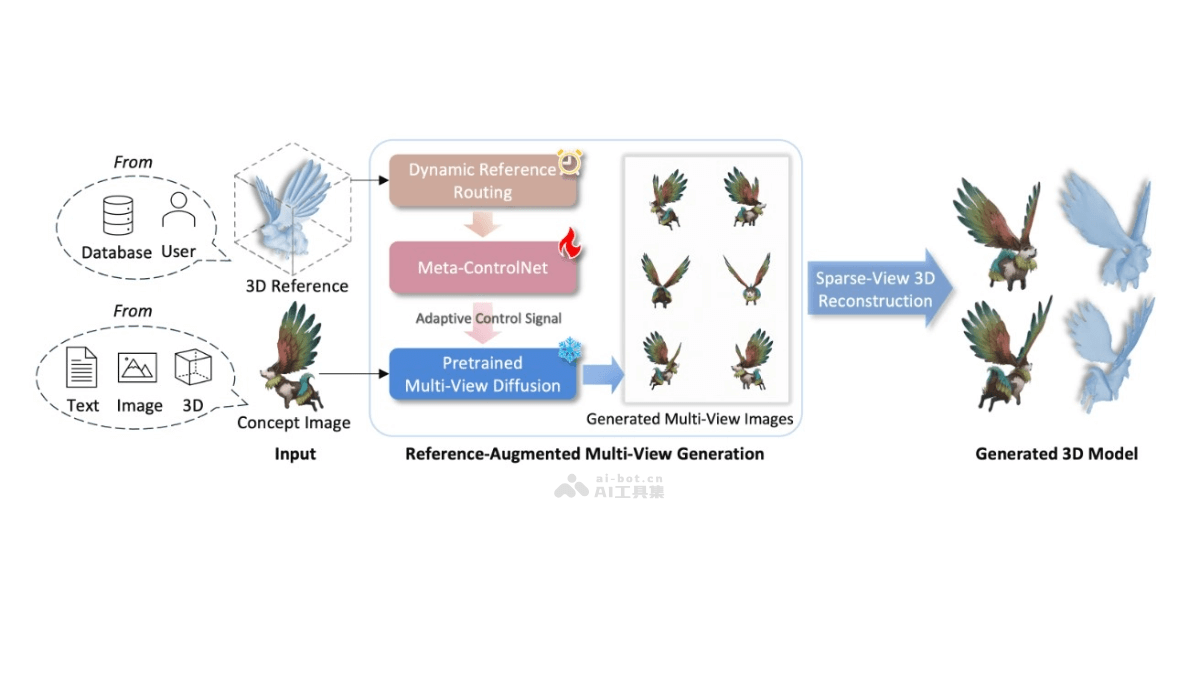
Phidias's Main Features
- Retrieval-Augmented 3D Generation: Assists in generating new 3D content based on retrieved or user-provided 3D reference models.
- Multimodal Input: Supports generating 3D content from text, images, and existing 3D models.
- High-Quality Generation: Improves the quality, detail, and realism of generated 3D models.
- Enhanced Generalization Ability: Uses 3D reference models as external memory to improve the model's ability to handle uncommon viewpoints or objects.
- Controllability: Allows users to adjust 3D reference models to control the generation process and achieve the desired 3D shape and style.
- Interactive Generation: Users interact with the generation model through rough 3D shape guidance to achieve the desired results.
- High-Fidelity Completion: Completes the missing parts of incomplete 3D models while preserving the original details.
Phidias's Technical Principles
- Meta-ControlNet: Dynamically adjusts the strength of conditional signals to address inconsistencies between reference models and target images.
- Dynamic Reference Routing: Adjusts the resolution of 3D reference models according to different stages of the denoising process, gradually introducing details from coarse to fine.
- Self-Reference Enhancement: Uses enhanced versions of the 3D model itself as references and performs self-supervised training by simulating various inconsistencies.
- Multi-View Diffusion Model: Converts 3D reference models into multi-view canonical coordinate maps (CCMs), providing consistent geometric information across different views.
- Sparse-View 3D Reconstruction: Obtains the final 3D model through 3D reconstruction techniques based on the generated multi-view images.
- Progressive Curriculum Learning: Gradually increases the training difficulty during the training process, thereby better utilizing reference models of different similarity levels.
Phidias's Project Address
- Project Website:rag-3d.github.io
- GitHub Repository:https://github.com/3DTopia/Phidias-Diffusion
- arXiv Technical Paper:https://arxiv.org/pdf/2409.11406
Phidias's Application Scenarios
- 3D Art and Design: Artists and designers use Phidias to generate 3D models from concept sketches or descriptions, accelerating the creative process.
- Game Development: Game developers use Phidias to quickly generate game assets such as characters, props, and environmental elements.
- Film and Animation Production: In the film and animation industry, Phidias is used to create high-detail 3D models, reducing the need for manual modeling.
- Virtual Reality (VR) and Augmented Reality (AR): Quickly generate realistic 3D objects and scenes for virtual environments, enhancing user immersion.
- Architecture and Urban Planning: Generate 3D architectural models based on design sketches or descriptions, assisting planning and visualization.
- Education and Training: In the field of education, Phidias is used to create teaching models and visualize complex concepts.