
What is PersonaTalk
PersonaTalk is a two-stage framework based on attention mechanisms launched by ByteDance, used to achieve high-fidelity and personalized visual dubbing. PersonaTalk can synthesize videos with precise lip sync to the target audio while preserving the speaker's unique speaking style and facial details. The first stage involves style-aware audio encoding and lip-sync geometry generation, and the second stage uses a dual-attention facial renderer to render the texture of the target geometry. PersonaTalk demonstrates superior performance over existing technologies (including Wav2Lip, VideoReTalking, DINet, and IP_LAP) in visual quality, lip-sync accuracy, and personality preservation, and as a general framework, it can achieve results comparable to person-specific methods.
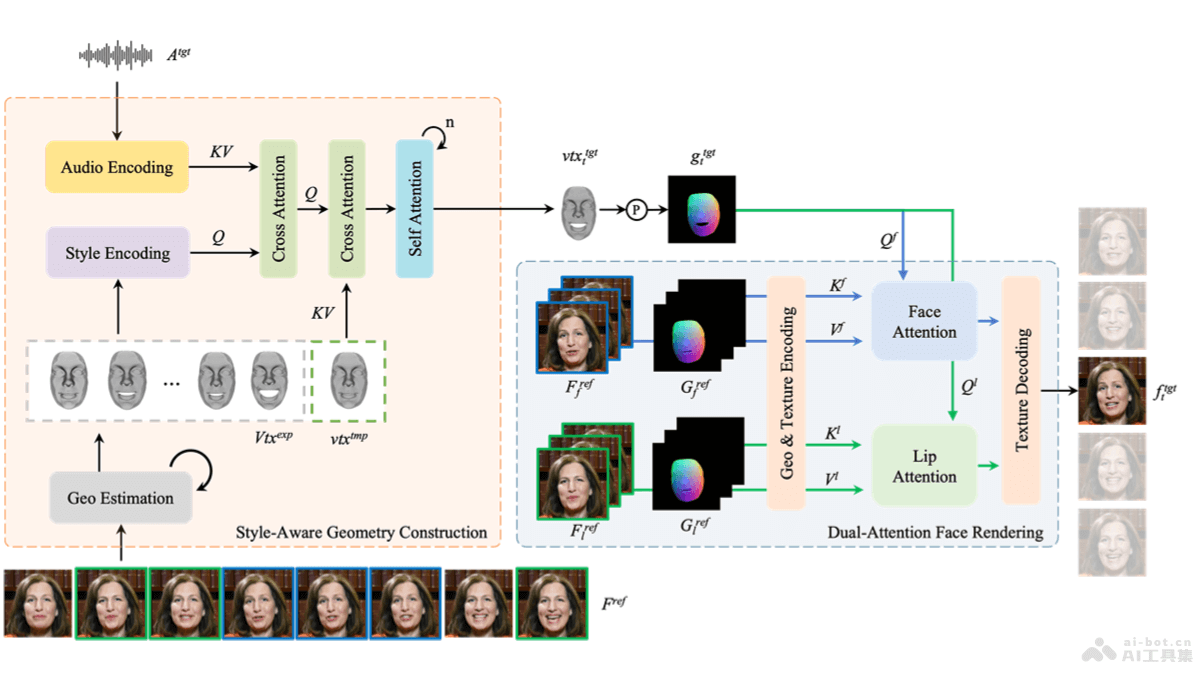
PersonaTalk's main features
- Lip sync: Ensures that the mouth movements of the person in the video match the input audio precisely.
- Personality preservation: Preserves the speaker's unique style and facial features during video synthesis.
- Style awareness: Learns the speaker's speaking style based on analyzing the speaker's 3D facial geometry information, and incorporates it into the audio features.
- Dual-attention facial rendering: Uses two parallel attention mechanisms, Lip-Attention and Face-Attention, to separately handle texture rendering for the lips and other facial regions, generating facial images with rich details.
PersonaTalk's technical principles
- Geometry construction:
- Style-aware audio encoding: Uses pretrained models such as HuBERT to convert audio signals into rich contextual speech representations, and injects speaking style into audio features based on cross-attention layers.
- Lip-sync geometry generation: Uses stylized audio features to drive the speaker's template geometry, and generates lip geometry synchronized with the audio based on multiple cross-attention and self-attention layers.
- Facial rendering:
- Geometry and texture encoding: Encodes the geometry and texture of the reference video into latent space to facilitate subsequent processing.
- Dual-attention texture sampling: Based on two parallel cross-attention layers (Lip-Attention and Face-Attention), samples the lip and facial textures from different reference frames respectively.
- Reference frame selection strategy: Selects different reference frames for lip and facial textures, enhancing the diversity and global consistency of texture sampling.
- Texture decoding: Decodes the sampled textures from latent space back to pixel space, preserves the facial geometric structure, and generates the final facial image.
PersonaTalk's project address
- Project official website:grisoon.github.io/PersonaTalk
- arXiv technical paper:https://arxiv.org/pdf/2409.05379
PersonaTalk's application scenarios
- Film and video production: In film post-production, PersonaTalk dubs characters, especially when the original recording is unsatisfactory or the language needs to be changed, generating dubbed videos synchronized with the character's mouth movements.
- Video games: In game development, it is used to generate realistic dialogue for non-player characters (NPCs), providing a more immersive gaming experience.
- Virtual assistants and digital humans: Provides more natural and realistic synchronization of speech and facial expressions for virtual assistants or digital humans, improving the user interaction experience.
- Language learning applications: In language learning software, P generates lip-synced videos of teachers or virtual characters, helping learners better learn and imitate pronunciation.
- News and media broadcasting: Used to translate news anchors' speech into different languages while maintaining the original facial expressions and mouth shapes, improving the naturalness and accuracy of multilingual broadcasting.