
What Is PersonaPlex
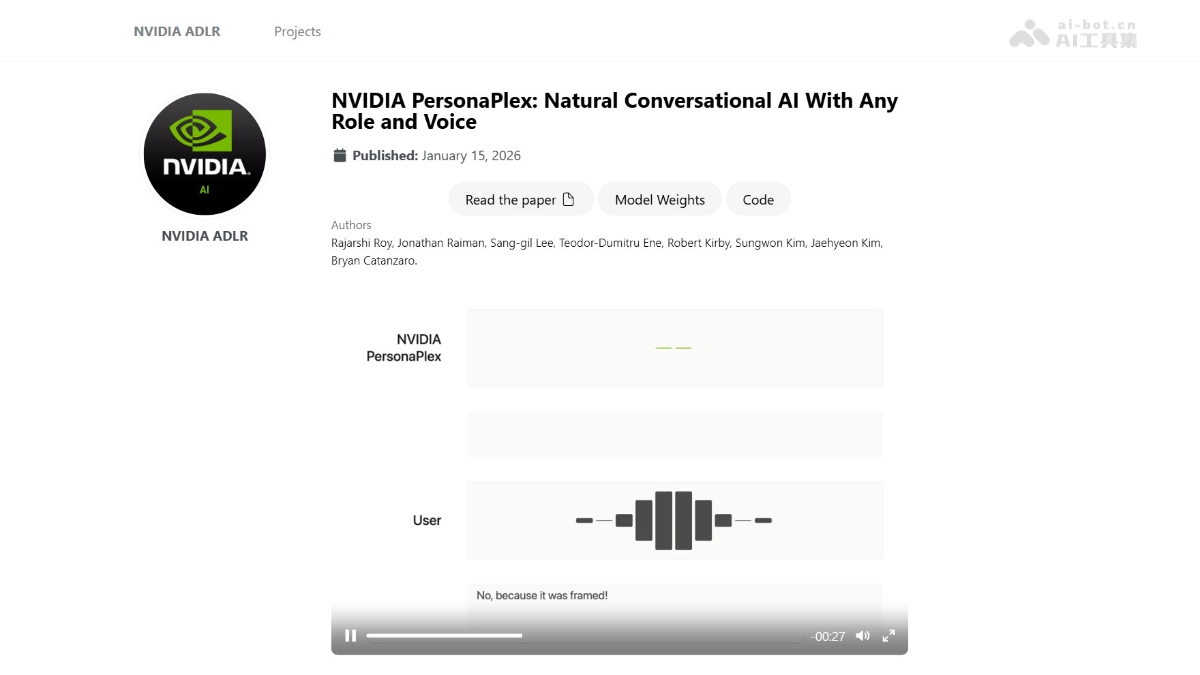
NVIDIA PersonaPlex is a full-duplex conversational AI model launched by NVIDIA. It has the ability to listen and speak simultaneously and can handle interruptions, pauses, and responses in natural conversation. Users can customize roles and voices through speech and text prompts, allowing the AI to play a variety of roles, from intelligent assistants to customer service agents. The model is trained on a combination of real conversation data and synthetic data, demonstrating excellent conversational naturalness and task-following capabilities. PersonaPlex performs well in a variety of scenarios, such as education, customer service, and emergency handling, providing users with a truly natural and human-like interaction experience. The PersonaPlex-7B-v1 model is now open source for developers to use.
PersonaPlex's Main Features
- Full-duplex conversation capability: PersonaPlex can listen and speak at the same time, supports real-time interaction, and naturally handles interruptions, pauses, and responses in conversation, making dialogue more fluent and natural.
- Role and voice customization: Users can define roles through text prompts (such as intelligent assistants, customer service agents, fictional characters, etc.) and select different voice styles and tones through speech prompts, enabling highly personalized interaction.
- Natural conversational behavior: Supports natural conversational rhythm, including interruptions, responses (such as "uh-huh," "okay," etc.), and appropriate pauses, making the conversation feel more like communication between humans.
- Task-following capability: Supports executing specific tasks based on text prompts, such as providing customer service, answering questions, or conducting technical discussions, while maintaining consistent role performance throughout the conversation.
PersonaPlex's Technical Principles
- Full-duplex architecture: PersonaPlex is based on a full-duplex model and can simultaneously process the user's speech input and generate speech output, avoiding the latency of traditional cascaded systems (ASR→LLM→TTS). The model updates its internal state while the user is speaking and can immediately stream responses, enabling low-latency interaction.
- Hybrid prompt architecture:
- Speech prompts: Use audio embeddings to capture voice characteristics, speaking style, and prosody.
- Text prompts: Describe roles, background information, and conversational context through natural language.
- Joint processing: Speech prompts and text prompts are processed jointly to generate coherent role performance.
- Transformer architecture: The Mimi speech encoder converts audio into text tokens. The Temporal and Depth Transformers can process conversation content and behavior, such as when to pause and when to interrupt. The Mimi speech decoder converts text tokens into output speech, supporting a 24 kHz sampling rate.
- Training data: The model uses 7,303 real conversations (1,217 hours) from the Fisher English corpus and generates role descriptions through GPT-OSS-120B. The model uses a language model to generate conversation scripts and synthesizes speech through Chatterbox TTS, covering a variety of scenarios and roles. By combining real conversations and synthetic conversations for training, the model can learn natural speech patterns and follow task requirements.
PersonaPlex's Project Address
- Project website:https://research.nvidia.com/labs/adlr/personaplex/
- GitHub repository:https://github.com/NVIDIA/personaplex
- HuggingFace model library:https://huggingface.co/nvidia/personaplex-7b-v1
PersonaPlex's Application Scenarios
-
Education: As an intelligent teacher, it provides clear and engaging answers and suggestions, helping students better understand knowledge.
-
Customer service: The model can play the role of bank customer service or medical front desk, handle customer issues based on text prompts, and provide professional and empathetic service.
-
Entertainment and Social Interaction: Simulate various fictional characters or engage in open-ended small talk to provide users with a fun and personalized social experience.
-
Emergency Response: In simulated emergency scenarios such as space missions, use professional roles to provide technical support and emergency response recommendations.
-
Medical Consultation: Assist in recording patient information in medical scenarios, provide professional advice, and support the daily work of medical staff.