
What is PersonaMagic
PersonaMagic is an innovative high-fidelity face customization technology that achieves personalized image generation through a stage-regulated text conditioning strategy. Based on a simple multilayer perceptron (MLP) network, it learns a series of dynamic embeddings to accurately capture facial concepts within specific time-step intervals. PersonaMagic introduces a Tandem Equilibrium mechanism that adjusts self-attention responses in the text encoder, effectively balancing the relationship between text description and identity preservation, and improving the accuracy and consistency of generated images. By dividing the reverse process of the diffusion model into dynamic and static stages, PersonaMagic can focus on facial regions during training, avoid overfitting, and maintain the integrity of identity information. Experiments verify that PersonaMagic outperforms existing technologies in both text similarity and identity preservation, and has strong potential and application value in the field of personalized image generation.
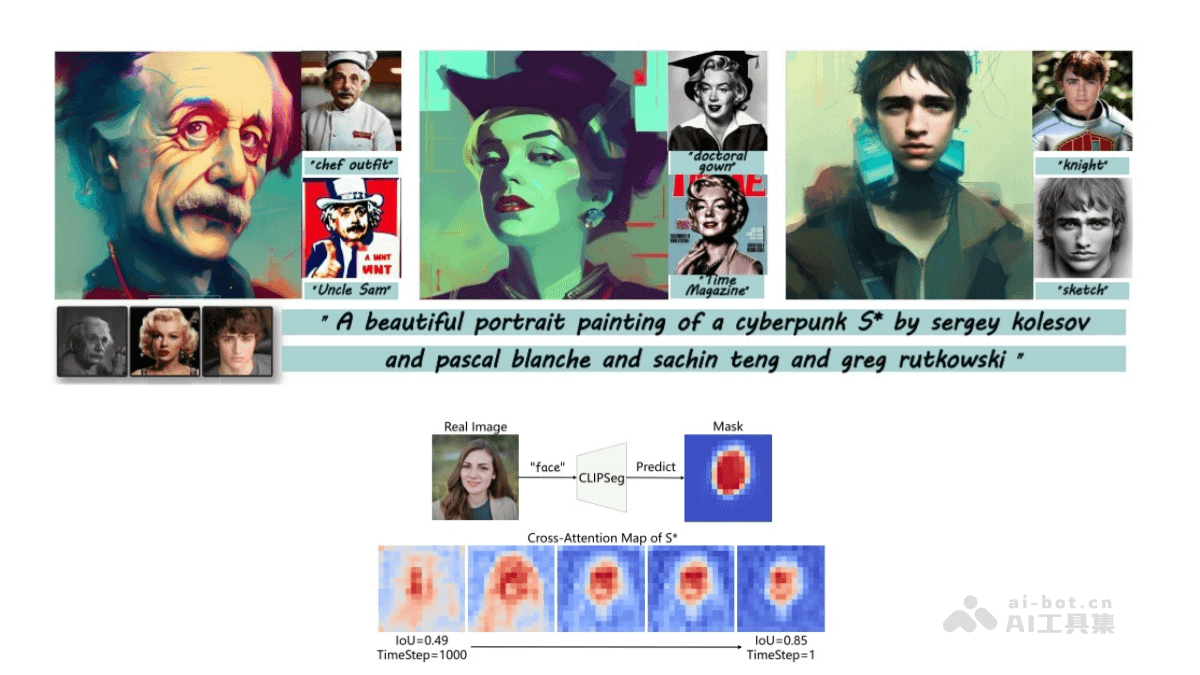
Main Features of PersonaMagic
- High-fidelity face customization: Through a stage-regulated text conditioning strategy and dynamic embedding learning, PersonaMagic can generate high-fidelity face images based on user text prompts. While preserving individual identity characteristics, it can adjust elements such as facial style, expression, and background according to the prompt, achieving personalized customization.
- Single-image training: Only a single image is needed for training and generation, without requiring multiple images for guidance. This reduces the user's data preparation cost and model training complexity, and improves the efficiency and operability of face customization.
- Balance between text description and identity preservation: Introduces the Tandem Equilibrium mechanism, which adjusts self-attention responses in the text encoder to effectively balance the accuracy of text descriptions and the preservation of identity characteristics.
- Flexible plug-in application: PersonaMagic can serve as a plug-in for pretrained personalized models to enhance their performance. It can be used in combination with other personalized generation models to improve their performance in text alignment and identity preservation, expanding their application scope and flexibility.
Technical Principles of PersonaMagic
- Stage-regulated text conditioning strategy: The strategy analyzes the temporal dynamics of the text-to-image conditioning process and divides the reverse process of the diffusion model into dynamic and static stages. In the dynamic stage, a lightweight network is introduced to obtain dynamic embeddings, focusing on capturing information from facial regions; in the static stage, fixed supercategory word embeddings are used to stabilize training. This stage division enables the model to leverage its respective advantages at different stages and effectively balance the relationship between text description and identity preservation.
- Dynamic embedding learning: Based on a simple multilayer perceptron (MLP) network, it learns a series of dynamic embeddings to accurately capture facial concepts within specific time-step intervals. Dynamic embeddings can flexibly adjust the focus on facial features according to temporal changes during training, better adapting to personalized needs under different text prompts.
- Tandem Equilibrium mechanism: Adjusts self-attention responses in the text encoder to balance text description and identity preservation. By randomly inputting text prompts, extracting self-attention maps, and calculating the Tandem Equilibrium loss, the model can focus on the learned embeddings (such as facial features) while not ignoring semantic information in other text prompts (such as background, style, etc.), achieving the dual goals of text alignment and identity preservation.
- Loss function design: Introduce mask M to calculate the mean squared error loss Lmse, forcing the diffusion model to focus on denoising the masked region and ensuring accurate generation of facial details; use Arcface to extract identity features, define identity loss Lid, maintain the identity information of the given image, and avoid identity distortion or loss. The combination of these loss functions optimizes the model's generation performance, enabling it to meet personalized needs while maintaining identity accuracy and consistency.
PersonaMagic's project address
- Github repository:https://github.com/xzhe-Vision/PersonaMagic
- arXiv technical paper:https://arxiv.org/pdf/2412.15674
Application scenarios of PersonaMagic
- Entertainment and social media: Users can generate personalized avatars or photos with different styles, expressions, or backgrounds according to their preferences and creativity, for use as profile pictures on social media platforms, meme creation, etc., increasing interactivity and fun.
- Games and virtual reality: In role-playing games or virtual reality applications, PersonaMagic can provide players with highly customized character creation functionality. Players can generate virtual characters with specific appearance features, styles, and identities based on their own ideas and the game background, enhancing the game's immersion and personalized experience.
- Film and television production and animation: Film and television production staff and animators can use PersonaMagic to quickly generate character images that match the script or animation settings, as references for character design or for direct use.
- Marketing and advertising: Enterprises can use PersonaMagic to create character images that match brand concepts, product features, or marketing campaign themes, for advertising, brand endorsements, or social media marketing, etc.