
What is PDF to Podcast
PDF to Podcast is an AI tool launched by NVIDIA for converting PDF to audio. It is based on the NVIDIA NIM microservices architecture and can convert PDF documents into vivid audio content, such as podcasts. Based on large language models (LLMs), text-to-speech (TTS) technology, and NVIDIA's microservices, it extracts and converts content from PDFs into Markdown format, then generates natural and fluent audio in the form of dialogue or monologue. The tool supports users in uploading target PDF files, optionally adding context PDFs as references, and focusing the generated content through guiding prompts (such as "focus on the key drivers of NVIDIA's third-quarter earnings report").
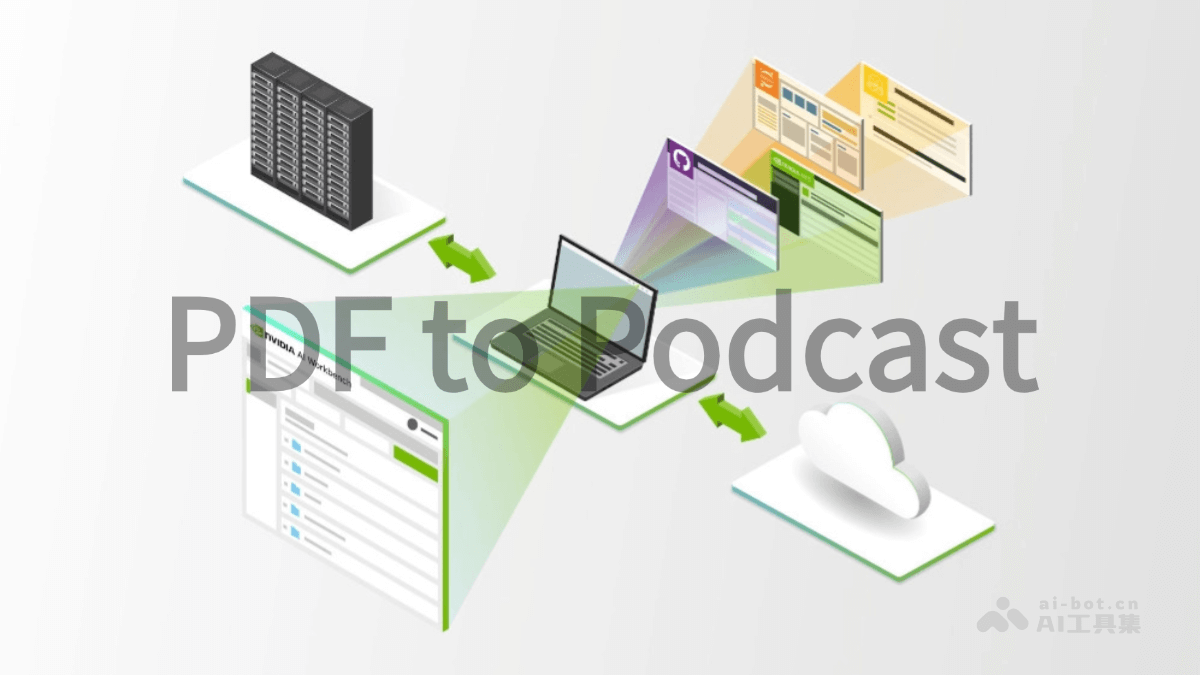
Main features of PDF to Podcast
- PDF to Markdown conversion: Extract content from PDFs and convert it to Markdown format for further processing.
- Generate dialogue or monologue: AI processes the Markdown content and generates a natural and fluent audio script.
- Text-to-speech (TTS): Convert the processed text content into high-quality speech.
Project address of PDF to Podcast
- Github repository:https://github.com/NVIDIA-AI-Blueprints/pdf-to-podcast
Software components of PDF to Podcast
- NVIDIA NIM microservices: Use the Llama 3.1 series models for inference.
- Document parsing: Use Docling for PDF to Markdown conversion.
- Speech synthesis: Use ElevenLabs for text-to-speech conversion.
- Storage and caching: Use MinIO and Redis.
Deployment methods of PDF to Podcast
- Use the NVIDIA API catalog: No local GPU hardware is required, and all model inference is completed on NVIDIA cloud infrastructure. The minimum requirements are an 8-core CPU, 64GB of memory, and 100GB of disk space.
- Deploy NVIDIA NIM locally: If higher performance and privacy protection are needed, you can choose to deploy NVIDIA NIM locally, but higher hardware requirements must be met.
How to use PDF to Podcast
- Install dependencies: Tools such as Docker and Docker Compose need to be installed.
- Obtain API keys: NVIDIA API catalog and ElevenLabs API keys are required.
- Clone the repository: Clone NVIDIA-AI-Blueprints/pdf-to-podcast from GitHub.
- Set environment variables: Configure environment variables such as API keys.
- Start the services: Use Docker Compose to start all microservices.
- Generate audio: Specify a PDF file through the command-line tool to generate audio content.
- Change models: You can switch to different LLM models as needed.
- Adjust GPU configuration: Optimize GPU usage, for example by using smaller models to reduce GPU memory requirements.
Application scenarios of PDF to Podcast
- Corporate training and policy interpretation: Convert lengthy PDF documents such as training manuals and policy documents into audio podcasts, so employees can listen during commutes or breaks and improve learning efficiency.
- Technical and R&D briefings: Convert technical research reports or R&D documents into audio content, making it convenient for researchers and engineers to access information in mobile scenarios. At the same time, combined with virtual role-playing, it can simulate technical reporting scenarios and improve communication skills.
- Customer Service and Hospitality Management: Convert customer service guides or hospitality management manuals into conversational podcasts, allowing employees to practice through interactions with virtual customer roles and improve service skills and conflict resolution abilities.
- Healthcare and Emergency Preparedness: Convert medical protocols or emergency response guidelines into easy-to-understand audio content, and simulate emergency situations through virtual role-playing, allowing medical staff to conduct practical drills in a safe environment.
- Education and Learning: Convert academic papers or teaching materials into audio content, so students can learn anytime and anywhere. Combined with virtual reality (VR) or augmented reality (AR) technology, the learning experience can be further enhanced.