
What Is PatentClaw
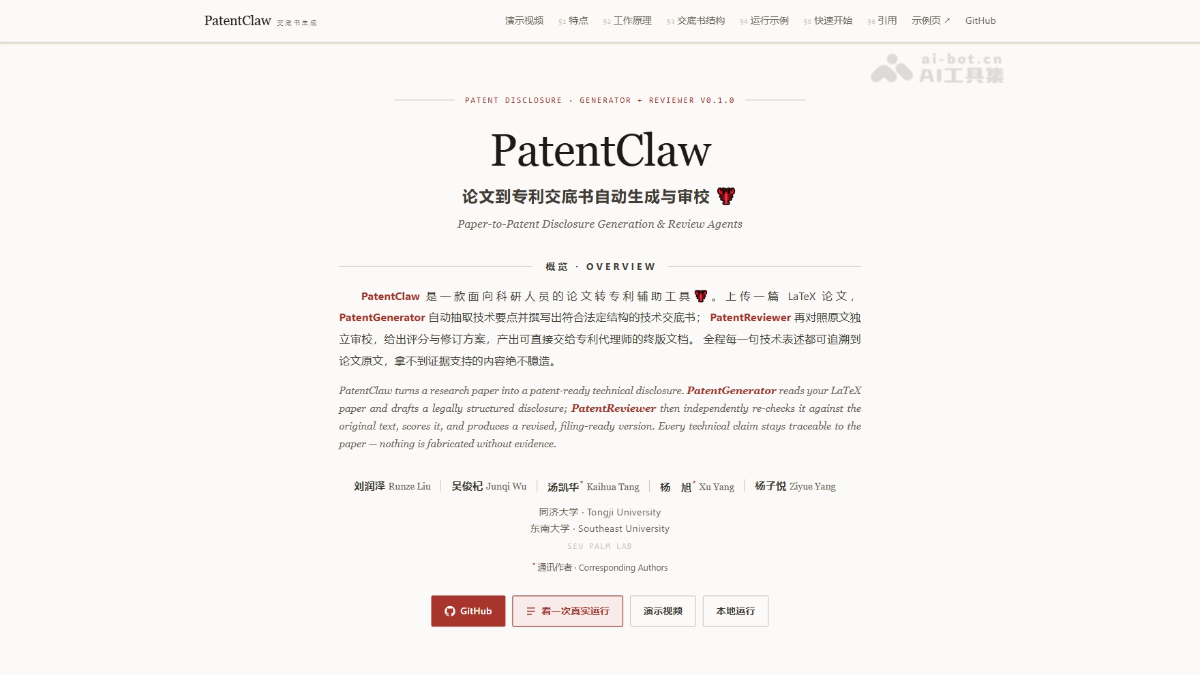
PatentClaw is an open-source assistant tool for researchers, inventors, and patent agents that automatically organizes LaTeX research papers into Chinese invention patent technical disclosure documents. The tool uses multi-agent collaboration to complete paper parsing, invention point mining, and first-draft writing, establishing traceable evidence mappings for formulas, tables, and algorithms to avoid fabricating experimental data. After PatentClaw generates the draft, PatentReviewer conducts multiple rounds of review and localized revisions according to a 30-item checklist, forming a closed loop.
Main Features of PatentClaw
-
Paper-to-Disclosure Conversion: Automatically organizes LaTeX research papers or engineering archives into technical disclosure documents that meet Chinese invention patent requirements.
-
Multi-Agent Collaboration: Multiple specialized agents divide the work to complete paper understanding, invention point mining, technical solution extraction, and first-draft writing.
-
Evidence Mapping: Parses sections, formulas, tables, algorithms, and figure captions in the paper to build traceable evidence chains and prevent unsupported expansion.
-
Rule-Based Review: PatentReviewer conducts rule-based and semantic review of the first draft according to a fixed 30-item checklist covering 13 dimensions.
-
Localized Revision Loop: Assigns an independent agent to implement localized revisions for each failed issue, forming a quality closed loop through multiple rounds of re-review.
-
Full Traceability: Retains initial review, final review, revision records, evidence sources, and before-and-after differences to ensure the process is auditable.
-
Multi-Format Export: Supports exporting disclosure documents in JSON, Markdown, and DOCX formats.
-
Dual-Mode Operation: Supports local offline verification and is also compatible with the OpenAI Responses API online generation mode.
-
Service-Oriented Deployment: Can run the generation and review modules as independent FastAPI services for easy integration.
-
Anti-Hallucination Mechanism: Strictly avoids fabricating parameters, steps, or experimental results not disclosed in the paper, and marks blockers and prompts for supplementation when materials are insufficient.
How to Use PatentClaw
-
Environment Preparation: Clone the repository and create a Python 3.10+ virtual environment, then install the PatentGenerator and PatentReviewer packages in development mode.
-
Configure API: Set environment variables such as the OpenAI-compatible API key, Base URL, and model name to enable online generation mode.
-
Upload Paper: Input the LaTeX paper (single file
.tex, project directory, or.zippackage) into PatentGenerator for parsing. -
Generate First Draft: Run the
latex2disclosurecommand, and five agents collaborate to convert the paper into a first draft of the technical disclosure document and export Markdown/DOCX. -
Review and Revise Draft: Pass the
job.jsonoutput by the Generator and the original paper into PatentReviewer to perform the fixed 30-item checklist review. -
Multi-round revision: Each failed check item is handled by an independent issue Agent, which submits a local patch, and the Reviewer automatically re-reviews until it passes or the round limit is reached.
-
Obtain final draft: Export a complete artifact package containing the initial review report, revision plan, change records, and final disclosure document.
-
Human review: The inventor verifies the technical facts and parameters, and the patent agent completes the legal review before formally filing the application.

Follow on WeChat and reply "open source" to join theAI open source project community group
PatentClaw's core advantages
-
Multi-Agent collaborative generation: Five specialized Agents handle paper understanding, invention mining, technical solutions, embodiments, and disclosure drafting, enabling pipeline-style automated output.
-
Traceable evidence: Parses LaTeX sections, formulas, tables, and figure captions and establishes evidence number mapping, ensuring every technical description is supported by the original paper text.
-
30-item fixed checklist: Versioned review standards covering 13 dimensions, including 18 deterministic rules and 12 online semantic checks, systematically identifying material risks.
-
Per-issue isolated revision: Each failed item is handled by an independent issue Agent, which submits only local patches for the corresponding fields, avoiding cascading changes during revision.
-
Multi-round review closed loop: After revision, the full checklist is automatically re-executed, continuously fixing until all pass or the round limit is reached, ensuring output quality convergence.
-
Structured multi-format artifacts: Simultaneously outputs JSON, Markdown, and DOCX, and retains the initial review, final review, item-by-item revision records, and before-and-after comparison.
PatentClaw's project address
- Project website:https://lzlfwow.github.io/PatentClaw/
- GitHub repository:https://github.com/lzlfwow/PatentClaw
PatentClaw's comparison with similar competitors
| Comparison dimension | PatentClaw | Idea2PatentAI |
|---|---|---|
| Product positioning | Open-source "paper → patent disclosure" automatic generation and review system | AI patent drafting platform for inventors and startups |
| Target users | Researchers, university faculty and students, patent agents | Inventors, entrepreneurs, non-lawyer users |
| Input method | LaTeX paper (.tex / .zip) |
About 500 words of invention text description |
| Output content | Chinese invention patent technical disclosure (with evidence tracing) | U.S. provisional patent application draft (35–55 pages) |
| Core process | Multi-Agent collaborative generation → 30-item checklist review → per-issue multi-round revision | Guided invention detail collection → AI analysis of missing information → one-click draft generation |
| Review mechanism | 18 deterministic rules + 12 online semantic checks, multi-round closed-loop review | Built-in patent drafting guidance, no fixed checklist |
| Traceable evidence | Establishes evidence number mapping for LaTeX sections/formulas/figures and tables | No explicit evidence tracing mechanism |
PatentClaw's application scenarios
-
Patentization of research achievements: University/institute researchers can quickly convert published LaTeX papers into technical disclosure documents that meet the requirements of Chinese patent law, shortening the cycle from paper to patent.
-
Thesis technology mining: Automatically identify patentable technical innovation points from doctoral/master's theses, extract technical problems, solutions, and embodiments, and avoid omissions of achievements.
-
Enterprise R&D document conversion: Organize technical reports and algorithm documents from technical departments into standardized patent disclosure materials, reducing communication costs between inventors and agents.
-
Patent agent-assisted review: Agents use a fixed 30-item checklist and a multi-round revision mechanism to quickly locate material risks, logical defects, and supplementation needs in the disclosure document.
-
Research team intellectual property management: Research groups systematically convert years of paper achievements into patent assets in batches, establish a traceable technical evidence chain, and support subsequent patent applications and achievement transformation.