
What Is PartEdit
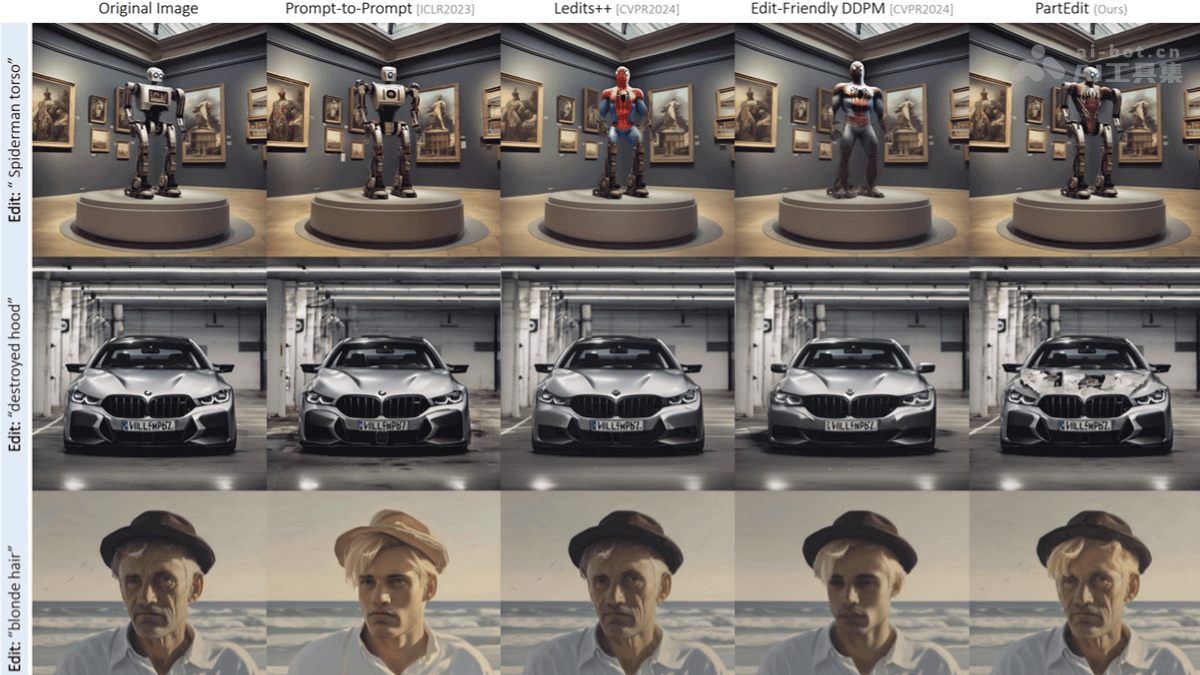
PartEdit is a fine-grained image editing method launched by KAUST based on pretrained diffusion models. PartEdit optimizes specific text tokens (called "part tokens"), enabling the diffusion model to precisely locate and edit individual parts of objects in an image. These part tokens learn non-binary masks corresponding to object parts, achieving localization of the edited region at each diffusion step, and combining feature blending with an adaptive thresholding strategy to seamlessly integrate the edited content while preserving unedited regions. PartEdit requires no model retraining and can achieve high-quality editing results. PartEdit supports real image editing and simultaneous multi-part editing, providing creators with a powerful tool for precise and creative image modifications.
PartEdit's Main Features
- Precise Localization and Editing of Object Parts: Precisely locates and edits individual parts of objects in an image (such as the head, body, hood, etc.), enabling user-specified fine-grained modifications.
- Seamless Integration of Edited Content: Based on optimized non-binary masks and an adaptive thresholding strategy, seamlessly blends the edited content with the original image, avoiding abrupt transitions in the edited regions.
- High-Quality Visual Results: The generated edited images have high visual quality, preserve the original details of unedited regions, and ensure that the edited parts are consistent with the overall image style.
- Support for Multiple Editing Types: Enables semantic editing (such as replacing object parts) and style adjustment (such as changing color, material, etc.), and can generate complex concepts that are difficult to achieve with traditional methods.
- Real Image Editing: Combines image inversion techniques to edit real photos, not limited to synthetic images.
- Simultaneous Multi-Part Editing: Supports editing multiple parts simultaneously during inference without retraining the model, improving editing efficiency.
PartEdit's Technical Principles
- Pretrained Diffusion Models: Based on the powerful generative capabilities of pretrained diffusion models (such as SDXL), generates images by reversing the diffusion process. Diffusion models generate images by gradually removing noise, using text prompts to guide the generation process.
- Part Tokens: Optimizes specific text tokens to extend the model's understanding of object parts. These tokens generate reliable non-binary masks at each step of the diffusion process, used to localize the edited regions.
- Optimization Process: Uses a binary cross-entropy (BCE) loss function, combined with a small amount of annotated data (such as PASCAL-Part or PartImageNet), to optimize part tokens, generating attention maps corresponding to object parts across different UNet blocks and time steps.
- Feature Blending and Adaptive Thresholding Strategy: At each time step and UNet layer of the diffusion process, blends the source image features with the edited image features based on non-binary masks. The adaptive thresholding strategy is used to smooth the transition between edited and unedited regions, ensuring the naturalness of the edits.
- Time Step Selection: Analyzes the image generation state at different time steps, selecting intermediate time steps to optimize the localization of large parts, and combining intermediate and later time steps for small parts to achieve the best localization results.
- Real Image Inversion: For real image editing, combines image inversion techniques (such as Ledits++ or EF-DDPM) to estimate the diffusion trajectory of real images, using it as the source path for editing.
PartEdit's Project Address
- Project Website:https://partedit.github.io/PartEdit/
- arXiv Technical Paper:https://arxiv.org/pdf/2502.04050
Application Scenarios of PartEdit
- Artistic Creation and Design: Help artists and designers quickly realize creative concepts.
- Film and Game Production: In the production of visual effects for film and games, quickly modify character appearances or scene elements.
- Advertising Design: Advertising designers quickly generate multiple visual effects for product advertisements.
- Virtual Reality (VR) and Augmented Reality (AR): In VR and AR applications, modify objects in the virtual environment in real time.
- Education Industry: In the education field, create teaching materials to help students better understand complex concepts.