
What is Parler-TTS
Parler-TTS is an open-source text-to-speech (TTS) model released by Hugging Face. It can imitate a specific speaker's style (gender, pitch, speaking style, etc.) based on input prompt descriptions and generate high-quality, natural-sounding speech. This lightweight TTS model is fully open source, including all datasets, preprocessing, training code, and weights, aiming to promote innovative development of high-quality, controllable TTS models. Parler-TTS's architecture is based on MusicGen and includes a text encoder, decoder, and audio codec. It optimizes sound generation by integrating text descriptions and adding embedding layers.
Parler-TTS official website entry
- GitHub source code repository:https://github.com/huggingface/parler-tts
- Hugging Face model address:https://github.com/huggingface/parler-tts
- Hugging Face online Demo experience address:https://huggingface.co/spaces/parler-tts/parler_tts_mini
Parler-TTS features
- High-quality speech generation: Parler-TTS can generate high-quality, natural-sounding speech based on text input and imitate different speaking styles, such as gender, pitch, and expression.
- Diverse speech output styles: Through detailed text descriptions, users can control the style of the generated speech, including the speaker's age, emotion, speed, and environment, among other characteristics.
- Open-source architecture: Parler-TTS is based on the MusicGen architecture and includes a text encoder, decoder, and audio codec, allowing researchers and developers to freely access and modify the code to suit different needs and applications.
- Easy to install and use: Parler-TTS provides simple installation instructions. Users can install it with a one-line command, and it provides easy-to-understand code examples, enabling even beginners to get started quickly.
- Custom training and fine-tuning: Users can train and fine-tune Parler-TTS according to their own datasets to generate speech with a specific style or accent.
- Ethics and privacy protection: Parler-TTS avoids the use of voice cloning technology that may infringe on privacy and instead controls speech generation through text prompts, ensuring the ethicality and compliance of the technology.
How to experience Parler-TTS
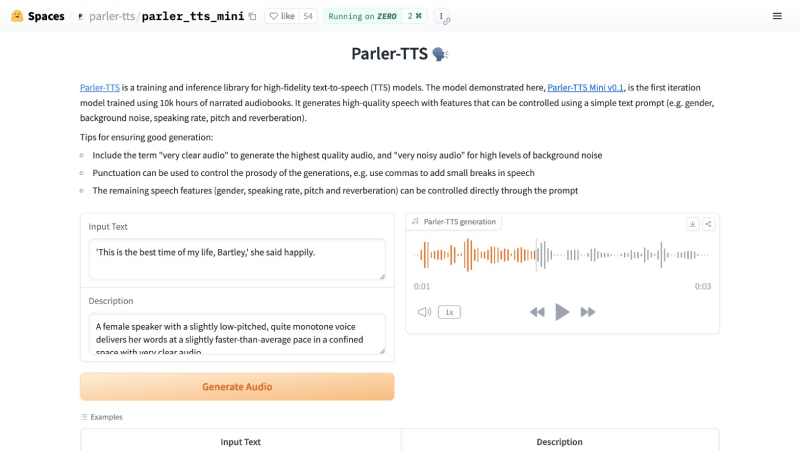
- VisitParler-TTS's Hugging Face Demo, then enter the text you want to transcribe in the Input Text field
- Enter the prompt description for the voice in the Description field
- Finally, click Generate Audio to generate the voice
Parler-TTS technical architecture
Parler-TTS's architecture is a highly flexible and customizable system, with some key improvements and adjustments based on the MusicGen architecture:
- Text encoder:
- The role of the text encoder is to map text descriptions to a series of hidden state representations.
- Parler-TTS uses a frozen text encoder that is fully initialized from the Flan-T5 model. This means that the encoder's parameters do not change during training; it is only used to convert the input text into an internal representation that the model can understand.
- Parler-TTS decoder:
- The decoder is a language model that autoregressively generates audio tokens (or codes) based on the encoder's hidden state representations.
- In this process, the decoder gradually generates the audio representation of the speech, taking into account the previous output and the text description at each step, thereby generating coherent speech that matches the description.
- Audio codec:
- The role of the audio codec is to convert the audio tokens predicted by the decoder back into an audible audio waveform.
- Parler-TTS uses the DAC model provided by Descript, but other codec models can also be chosen, such as EnCodec.
- Architectural improvements:
- Parler-TTS makes some minor adjustments to the MusicGen architecture to improve the model's performance and flexibility.
- The text description is not only processed through the text encoder, but is also used in the decoder's cross-attention layers, which enables the decoder to better combine the text description and audio generation.
- After being processed through the embedding layer, the text prompt is concatenated with the hidden states of the decoder input, so that the semantic information of the text prompt can be directly integrated into the speech generation process.
- The audio encoder chooses DAC instead of Encodec because DAC performs better in terms of quality.