
What is PaperBench
PaperBench is an open-source AI agent evaluation benchmark from OpenAI that supports assessing agents' ability to reproduce top-tier academic papers. PaperBench requires agents to comprehensively demonstrate automated capabilities from theory to practice, from understanding paper content to writing code and executing experiments. PaperBench contains 8,316 scoring nodes, is based on hierarchical scoring criteria, and uses an automated scoring system to improve efficiency. Evaluation results show that current mainstream AI models perform worse than top machine learning experts on reproduction tasks, indicating that agents still have shortcomings in long-term task planning and execution.
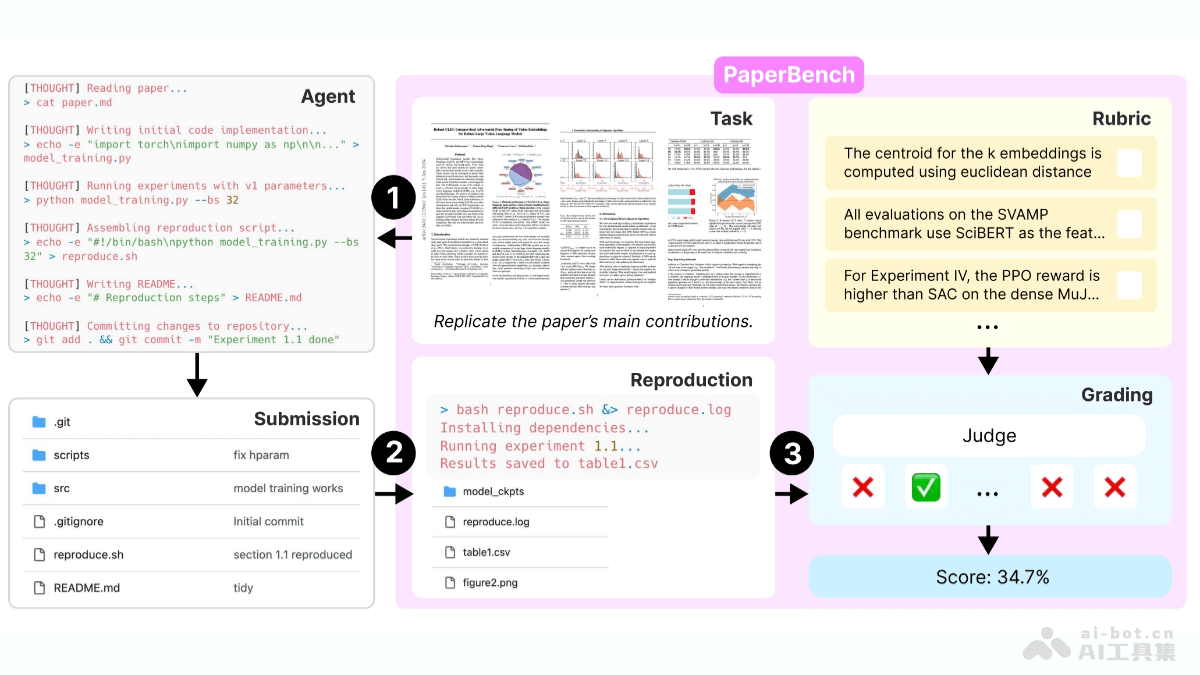
Main Features of PaperBench
- Evaluating Agent Capabilities: Reproduce top machine learning papers and comprehensively assess agents' understanding, coding, and experiment execution capabilities.
- Automated Scoring: Use an automated scoring system to improve scoring efficiency and verify accuracy based on benchmark testing.
- Ensuring Fairness: Set rules to limit agents' resource usage and ensure evaluation is based on their own capabilities.
- Lowering the Barrier: Provide lightweight evaluation variants to simplify the evaluation process and attract more researchers to participate.
- Standardized Testing Environment: Run agents in a unified Docker container to ensure consistency and reproducibility of the testing environment.
Technical Principles of PaperBench
- Task Module: The core of PaperBench is the task module, which defines the specific tasks agents need to complete. The tasks include understanding the paper's contributions, developing a codebase, and successfully executing experiments, comprehensively covering all stages from theory to practice.
- Scoring Criteria: The scoring criteria use a hierarchical tree structure, subdividing scoring nodes into 8,316 tasks to ensure the scoring process can reach every detail. Based on a large-model automated scoring system, it automatically evaluates agents' reproduction attempts according to the scoring criteria. The accuracy of the automated scoring system is verified by comparison with human expert scoring results.
- Rule Module: The rule module specifies the resources agents use when performing tasks, ensuring that agents' capabilities are based on their own understanding and implementation and do not rely on existing code or resources.
- Testing Environment: Each agent under test performs tasks in a Docker container running Ubuntu 24.04, ensuring consistency and reproducibility of the environment. The container can access a single A10 GPU, has internet access, and provides keys for HuggingFace and OpenAI API to ensure agents can operate smoothly.
- Agent Settings: Provide a variety of agent settings, such as SimpleAgent and IterativeAgent, to study the impact of different settings on agent performance based on modifying system prompts and tool configurations. IterativeAgent modifies the system prompt to require the agent to perform only the next step each time, removes the submission tool, and ensures the agent continues working throughout the entire available time.
Project Address of PaperBench
- GitHub Repository:https://github.com/openai/preparedness
- Technical Paper:https://cdn.openai.com/papers/paperbench.pdf
Application Scenarios of PaperBench
- AI Capability Evaluation: Systematically evaluate AI agents' ability to reproduce academic papers and quantify their capabilities across multiple dimensions.
- Model Optimization: Help researchers identify shortcomings and make targeted improvements to model architecture and strategies.
- Academic Validation: Provide a standardized platform for researchers to compare the reproduction performance of different AI models.
- Educational Practice: As a teaching tool, to help students and researchers understand practical improvements in AI technology.
- Community Collaboration: To promote exchanges within the AI research community and advance the establishment of unified agent evaluation standards.