
What is PaperBanana
PaperBanana is an academic illustration automation generation framework jointly launched by Peking University and Google Cloud AI Research, addressing the pain point of AI researchers spending time and effort drawing paper figures. The system adopts an innovative multi-agent collaboration architecture, including five specialized agents: Retriever, Planner, Stylist, Visualizer, and Critic. Through a two-stage process of linear planning and iterative optimization, it automatically generates publication-standard methodology diagrams and statistical charts.
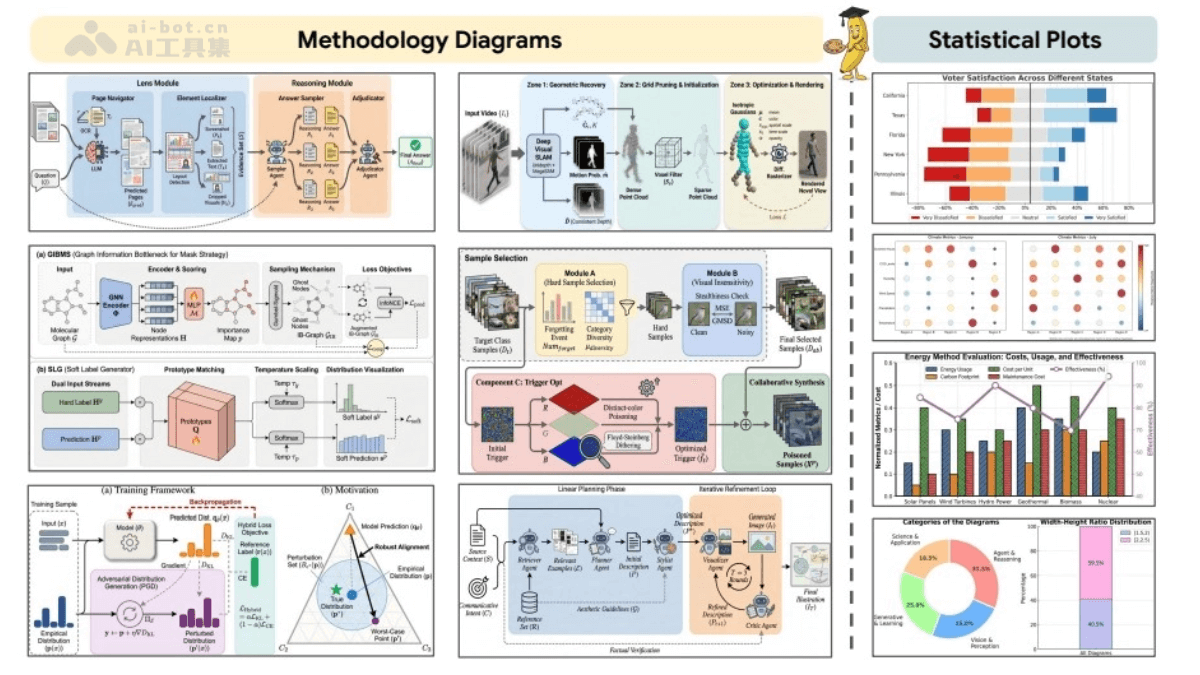
PaperBanana's main features
-
Methodology diagram generation: Input a paper description to automatically generate publication-level algorithm architecture diagrams and flowcharts.
-
Statistical chart generation: Supports two ways of making statistical charts: code generation for accuracy or image generation for aesthetics.
-
Aesthetic style optimization: Upgrades rough sketches into a modern academic visual style that meets top conference standards.
-
Multi-agent collaboration: Five specialized AI agents divide the work to complete the entire process of retrieval, planning, design, drawing, and optimization.
-
Automatic quality evaluation: A built-in AI reviewer automatically checks and iteratively optimizes the accuracy and aesthetics of charts.
-
Cross-domain generalization: An evaluation benchmark built based on NeurIPS papers supports chart generation in multiple AI subfields.
-
Flexible output formats: Can output PNG/SVG images or Python code for subsequent editing and modification.
PaperBanana's technical principles
-
Multi-agent architecture: A system of five specialized AI agents working collaboratively, simulating the workflow of human designers.
-
Two-stage process: First use linear planning to determine content and style, then iteratively optimize to generate the final chart.
-
Retrieval-augmented generation: Retrieves similar cases from high-quality paper libraries to provide reference guidance for generation.
-
Vision-language model: Uses the cross-modal capabilities of VLM to achieve accurate conversion from text to visual descriptions.
-
Hybrid generation strategy: Method diagrams are generated with AI drawing models, while statistical charts are generated with code to ensure data precision.
-
Self-critique mechanism: The AI reviewer checks and provides feedback over multiple rounds, gradually eliminating errors and improving chart quality.
-
Aesthetic specification learning: Automatically extracts the color schemes, fonts, and layouts of high-quality papers to form reusable style templates.
-
Structured information transfer: Uses standard data formats to precisely transfer visual element parameters between agents.
PaperBanana's project address
- GitHub repository:https://github.com/dwzhu-pku/PaperBanana
- arXiv technical paper:https://arxiv.org/pdf/2601.23265
PaperBanana's application scenarios
-
Academic paper illustrations: Automatically generates publication-level method flowcharts and model architecture diagrams, solving the problem of researchers spending time drawing figures with insufficient aesthetics.
-
Thesis writing: Helps graduate students quickly generate charts that conform to formatting standards, unifying the visual style and enhancing professionalism.
-
Conference poster production: Transforms research results into clear and intuitive poster content, optimizing color schemes and layouts to enhance information communication efficiency.
-
Research Grant Applications: Generate professional technical roadmaps for grant applications, improving the visual quality of application materials and enhancing reviewers' impressions.
-
Academic Presentations: Automatically generate key diagrams for slides, transforming complex algorithms into visuals that audiences can easily understand.
-
Chart Aesthetic Upgrades: Modernize the style of early papers or hand-drawn sketches, and unify multiple papers to form an academic brand.