
What is Paper2Code
Paper2Code is a multi-agent large language model (LLM) framework jointly launched by KAIST and DeepAuto.ai, supporting the automatic conversion of scientific papers in the machine learning field into runnable code repositories. Paper2Code achieves this goal based on three stages: planning (building the system architecture and generating configuration files), analysis (interpreting implementation details), and code generation (generating modular code). Paper2Code performs well in multiple benchmarks, and the generated code is of high quality and faithful to the original paper, significantly accelerating the reproduction and further development of scientific research.
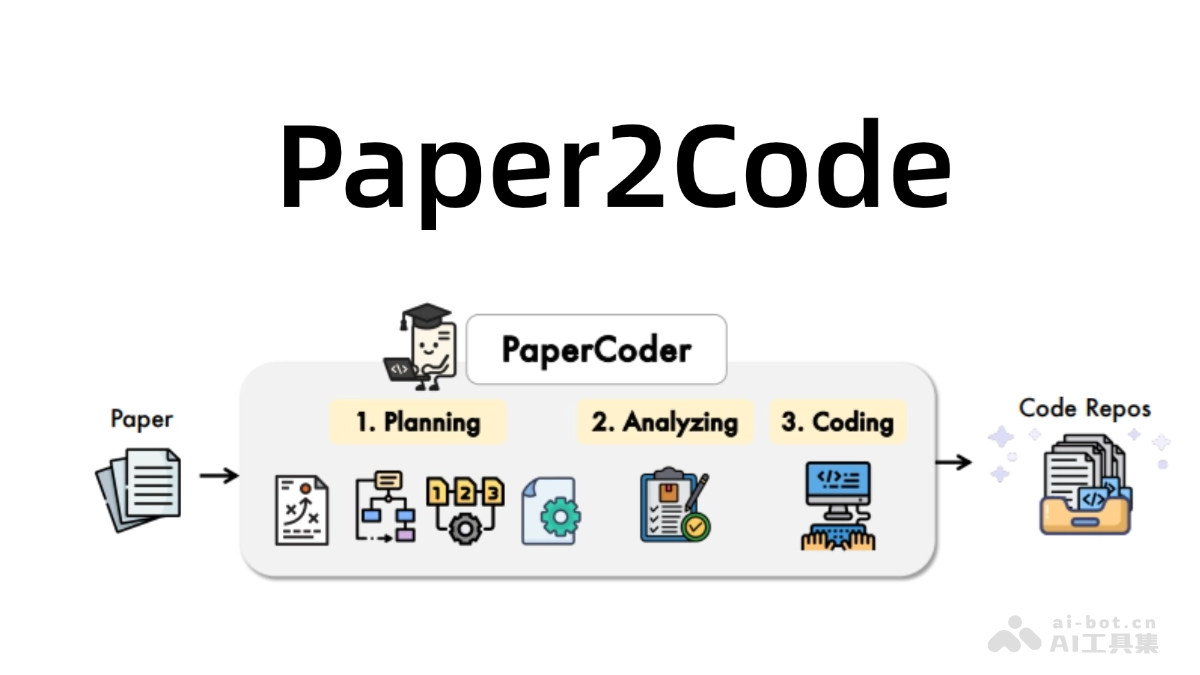
Main Features of Paper2Code
- Automated Code Generation: Automatically converts machine learning papers into functional code repositories.
- High-Quality Code Output: The generated code has a clear structure and is faithful to the original paper, supporting rapid reproduction and verification of research results.
- Efficiency Improvement: The automated process greatly reduces the time and effort required for manual code implementation, accelerating the iteration and innovation of scientific research.
Technical Principles of Paper2Code
- Multi-Agent Large Language Model (LLM):
- Planning Stage (Planning): Based on the understanding and generation capabilities of LLMs, the paper content is decomposed into a structured implementation plan. Natural language processing techniques are used to extract key information and generate system architecture diagrams and file dependency relationships.
- Analysis Stage (Analysis): Fine-grained analysis is performed on each file and function to ensure that the generated code accurately implements the methods and experiments in the paper. Based on the reasoning capabilities of LLMs, detailed implementation guidelines are generated.
- Code Generation Stage (Coding): Based on the outputs of the planning and analysis stages, modular code with clear dependency relationships is generated. During the code generation process, the design of the planning stage and the detailed requirements of the analysis stage are strictly followed to ensure the executability and logical consistency of the code.
- Evaluation and Feedback: A combination of model evaluation (reference-based and reference-free evaluation) and human evaluation is used to ensure the quality and practicality of the generated code repositories. Based on evaluation by human experts, it is verified whether the generated code can effectively support the reproduction and verification of research.
Project Address of Paper2Code
- GitHub Repository:https://github.com/going-doer/Paper2Code
- arXiv Technical Paper:https://arxiv.org/pdf/2504.17192
Application Scenarios of Paper2Code
- Research Reproduction: Helps researchers quickly reproduce the methods and experiments in papers, even if the original authors did not provide code.
- Code Generation: Automatically generates high-quality code, accelerating the implementation process of machine learning papers.
- Academic Communication: Assists researchers in better presenting and verifying research results during academic communication.
- Teaching and Learning: Generates code for teaching purposes, helping students understand the methods in machine learning papers.
- Industrial Applications: Rapidly generates code frameworks, helping enterprises apply research results to actual projects.