
What is PanoDreamer
PanoDreamer is a new method capable of generating coherent 360° 3D scenes from a single image. This method differs from existing technologies by formulating the problem as two optimization tasks: single-image panorama and depth estimation, and introducing an alternating minimization strategy to effectively solve the objectives. PanoDreamer can generate panoramic images and their corresponding depth information, ensuring consistency across the entire 360° scene, and solving the visible seam issues that existing state-of-the-art methods may have when looping back to the input image. By inpainting small occluded regions and projecting them into 3D space, the scene can be reconstructed. PanoDreamer outperforms existing technologies for single-image 360° scene reconstruction in terms of consistency and overall quality.
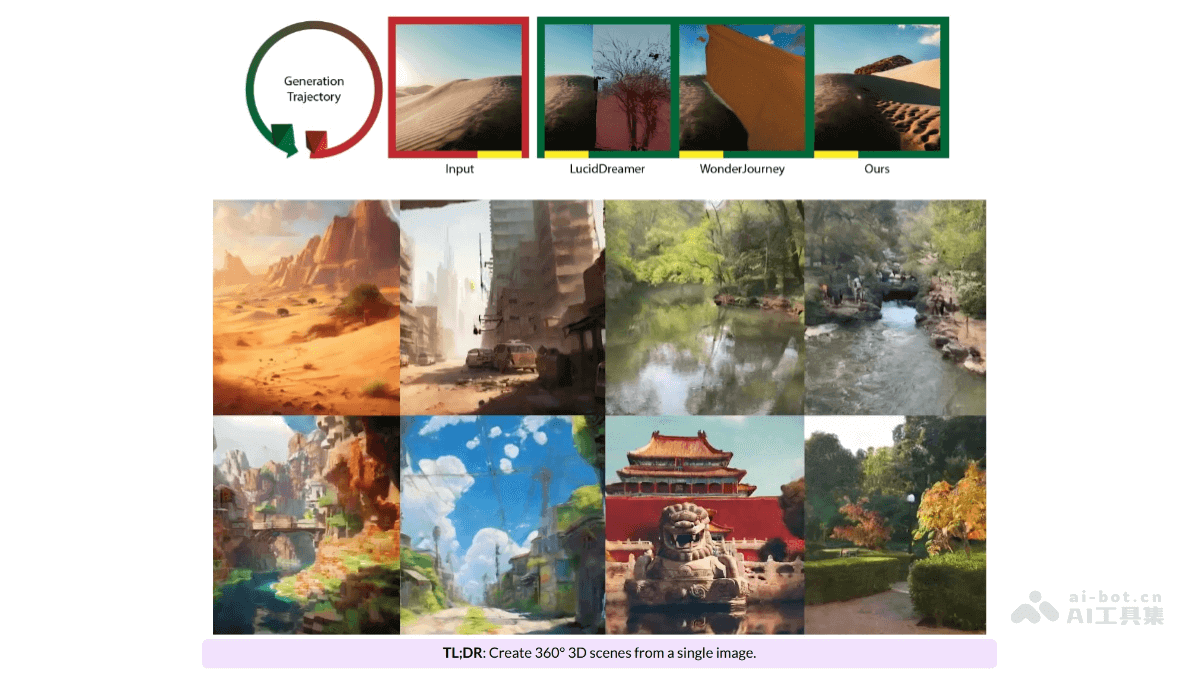
PanoDreamer's Main Features
- Panoramic Image Generation: PanoDreamer can create a complete 360-degree 3D scene from a single 2D image, meaning that with just one photo, it can present a realistic and coherent spatial view.
- Depth Information Generation: Alongside panoramic image generation is the generation of depth information, which is crucial for converting 2D images into 3D scenes.
- Consistency and Completeness: PanoDreamer adopts a one-shot generation approach, ensuring the consistency and completeness of the panorama, unlike traditional methods that stitch step by step.
- Natural Transitions: The generated 360-degree scene has smooth transitions with no obvious seams or abruptness, giving the viewer a sense of realism.
- Optimization Tasks: PanoDreamer formalizes single-image panorama and depth estimation as two optimization tasks and introduces an alternating minimization strategy to effectively solve their objectives.
- 3D Scene Reconstruction: Once a coherent panoramic image and its corresponding depth are obtained, the scene can be reconstructed by inpainting small occluded regions and projecting them into three-dimensional space.
- Superior Performance: PanoDreamer outperforms existing technologies in single-image 360-degree scene reconstruction in terms of consistency and overall quality.
PanoDreamer's Technical Principles
- Single-Image Panorama and Depth Estimation: PanoDreamer formulates the problem as two optimization tasks: single-image panorama and depth estimation. This approach differs from existing technologies, which typically generate scenes sequentially.
- Alternating Minimization Strategy: PanoDreamer introduces an alternating minimization strategy to effectively solve the objectives of panorama and depth estimation, and this approach helps generate coherent panoramic images and their corresponding depth.
- Layered Depth Image (LDI) and 3D Gaussian Splatting (3DGS): PanoDreamer uses the LDI method for depth-aware texture inpainting and initializes 3D Gaussians to construct the scene, then sharpens details by optimizing the 3DGS representation and obtains the final scene.
PanoDreamer's Project Addresses
- Project Official Website:https://people.engr.tamu.edu/nimak/Papers/PanoDreamer/index.html
- Github Repository:https://github.com/avinashpaliwal/PanoDreamer
- arXiv Technical Paper:https://arxiv.org/pdf/2412.04827v1
PanoDreamer's Application Scenarios
- Virtual Reality (VR) and Augmented Reality (AR): PanoDreamer can generate 360° 3D scenes from a single image, which for virtual reality and augmented reality applications can provide immersive environments and experiences.
- Game Development: In game design, PanoDreamer can be used to create coherent game environments and backgrounds, enhancing the game's immersion and realism.
- Panoramic Image Generation: PanoDreamer can be used to generate panoramic images and is very valuable in applications that require panoramic views, such as real estate displays, travel experiences, and more.
- Content Creation: Content creators can use PanoDreamer to create rich 3D content from a single image, for video production, advertising, or other visual art works.
- Education and Training: In the field of education, PanoDreamer can be used to create virtual learning environments, providing a more intuitive and interactive learning experience.