
What is PaliGemma 2 mix
PaliGemma 2 Mix is the latest multi-task vision-language model (VLM) released by Google DeepMind. It integrates multiple visual and language processing capabilities, supports tasks such as image captioning, object detection, image segmentation, OCR, and document understanding, and can flexibly switch between different functions within a single model. The model offers three different parameter scales (3B, 10B, 28B) to meet the needs of different scenarios, while also supporting two resolutions, 224px and 448px, balancing performance and resources. PaliGemma 2 Mix is developed based on open-source frameworks (such as Hugging Face Transformers, Keras, PyTorch, etc.), making it easy to use and extend. Developers can switch tasks through simple prompts without additionally loading models.
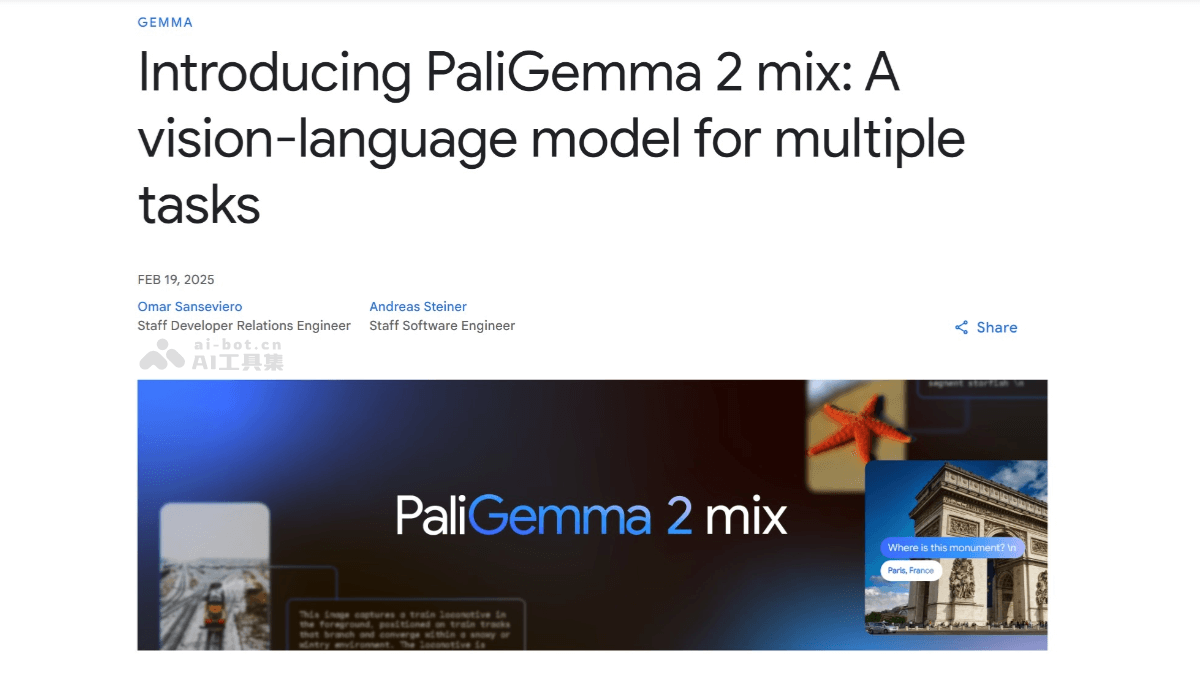
Main features of PaliGemma 2 mix
- Image captioning: Generate accurate and detailed image descriptions, supporting both short-text and long-text descriptions.
- Optical Character Recognition (OCR): Recognize text content in images, suitable for document digitization, historical document archiving, and automated data extraction.
- Object detection and image segmentation: Can detect and locate objects in images and perform precise semantic segmentation.
- Visual Question Answering (VQA): Users can upload images and ask questions, and the model will analyze the images and provide answers.
- Document understanding: Understand and analyze the content of document images, supporting chart and diagram analysis.
- Scientific question answering: Can understand and answer complex scientific questions.
- Text-related tasks: Including text detection, table structure recognition, molecular structure recognition, etc.
Technical principles of PaliGemma 2 mix
- Model architecture: PaliGemma 2 Mix consists of three core components:
- SigLIP image encoder: Uses SigLIP-So400m as the image encoder, converting images into a sequence of tokens through contrastive pretraining. The encoder supports multiple input resolutions (such as 224px², 448px², and 896px²), generating 256, 1024, and 4096 tokens respectively.
- Gemma-2B language model: As the decoder, it is responsible for processing text input and generating output. Text is converted into tokens through the SentencePiece tokenizer and combined with image tokens.
- Linear projection layer: Projects the image tokens output by SigLIP to the same dimension as the Gemma-2B vocabulary tokens, allowing the two to be effectively fused.
- Training strategy: The training of PaliGemma 2 Mix is divided into three stages:
- Stage 1: Basic multimodal task training: Combines pretrained SigLIP and Gemma-2B and jointly trains them on a multimodal task mixture dataset containing 1 billion samples. The goal is to improve the model's transferability across multiple tasks, with a training resolution of 224px².
- Stage 2: Training with gradually increasing resolution: Trains on 50 million and 10 million samples at resolutions of 448px² and 896px², respectively. The weight of high-resolution tasks is increased, and the output sequence length is extended to support complex tasks (such as long-text OCR).
- Stage 3: Fine-tuning to specific tasks: Fine-tunes the checkpoints from Stage 1 or Stage 2 to adapt to specific tasks, such as Visual Question Answering (VQA), document understanding, long-form caption generation, etc.
- Multimodal fusion: PaliGemma 2 Mix combines image tokens and text tokens as input to a language model for autoregressive generation. Image tokens can "look ahead" to the task prompt (prefix), update representations, and adapt to the current task.
PaliGemma 2 mix project address
- Project official website:https://developers.googleblog.com/en/introducing-paligemma-2-mix/
- Github repository:https://github.com/huggingface/blog/blob/main/paligemma2mix.md
- HuggingFace model repository:https://huggingface.co/collections/google/paligemma-2-mix
Application scenarios of PaliGemma 2 mix
- Document understanding: It can understand document content such as charts and diagrams, and supports complex document analysis tasks.
- Scientific question answering: PaliGemma 2 Mix can understand and answer complex scientific questions, making it suitable for education and scientific research.
- E-commerce and content generation: The model can automatically generate descriptions for product images, enhancing the appeal of product listings on e-commerce platforms.
- Text-related tasks: These include text detection, table structure recognition, molecular structure recognition, music score recognition, etc., and are widely used in document processing and scientific research.