
What is PaddleOCR-VL-1.6
PaddleOCR-VL-1.6 is a document parsing vision-language model (VLM) released by Baidu's PaddlePaddle team, and is the latest upgraded version of the PaddleOCR-VL series. The model has only 0.9B parameters and achieves a new SOTA score of 96.33% on the authoritative OmniDocBench v1.6 benchmark, while also setting records on OmniDocBench v1.5 and Real5-OmniDocBench, leading both open-source and closed-source solutions across text, formula, and table recognition. The model architecture is fully identical to version 1.5, supporting zero-cost plug-and-play migration.
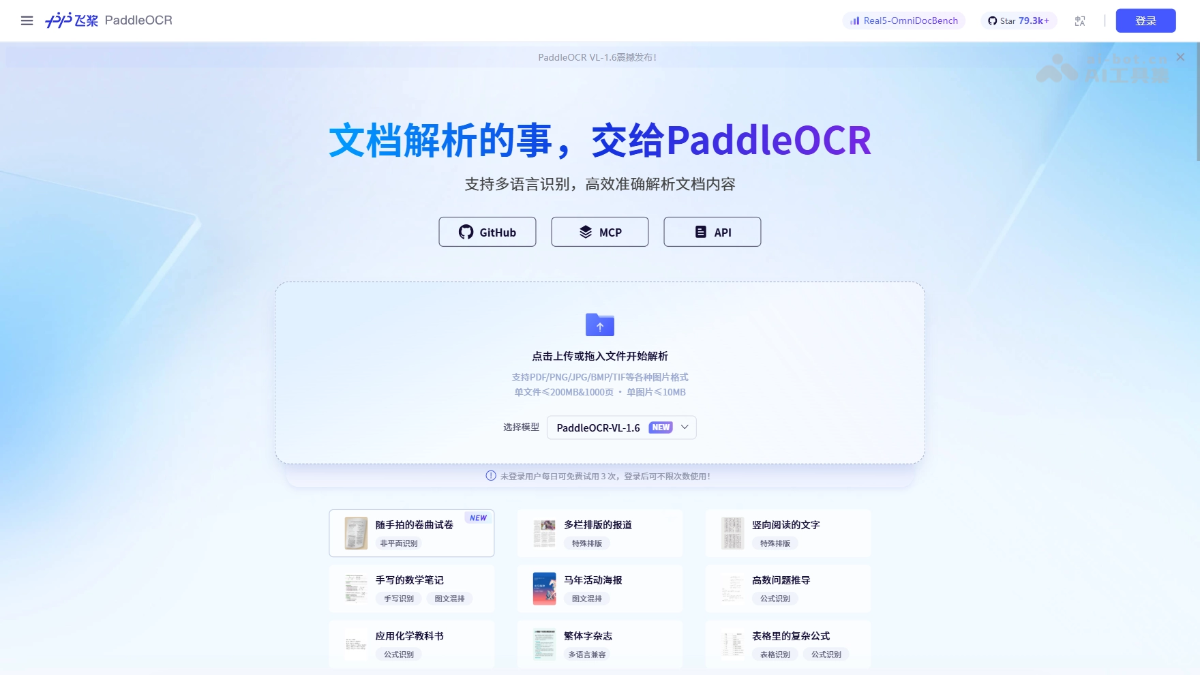
Main features of PaddleOCR-VL-1.6
-
Text recognition: General text recognition, supporting 109 languages, with a text score of 96.8 on OmniDocBench v1.6.
-
Formula recognition: LaTeX recognition of mathematical formulas, with a score of 97.5, surpassing GLM-OCR and MinerU.
-
Table recognition: Parsing of complex table structures (including merged cells and multi-level headers), with a TEDS score of 94.8.
-
Ancient book recognition: Greatly improved recognition of Chinese ancient books and vertical text.
-
Rare character recognition: Significantly enhanced recognition of rare Chinese characters.
-
Seal recognition: Extraction and localization of text from official seals/stamps.
-
Chart recognition: Parses 11 categories of charts, such as pie charts and line charts, into structured data.
-
Text detection (Spotting): Natural scene text detection.
-
Structured output: Supports export in Markdown, JSON, and DOCX formats.
-
Cross-page table merging: Automatically identifies and merges cross-page tables.
Technical principles of PaddleOCR-VL-1.6
- Two-stage decoupled architecture: The model adopts a two-stage design of "layout analysis + VLM recognition": in the first stage, PP-DocLayoutV3 detects 25 categories of document elements and outputs reading order and coordinates; in the second stage, a 0.9B-parameter VLM recognizes each element. Internally, the VLM uses a NaViT dynamic-resolution vision encoder to adaptively process images of different sizes, and works with the ERNIE-4.5-0.3B language model to generate structured output, avoiding the loss of small-text information caused by fixed resolution.
- Data-driven upgrade with zero architecture changes: Version 1.6 is fully identical in structure to the 1.5 model, and the performance leap comes entirely from data and training strategy optimization. The team analyzed the weak areas of 1.5 across OmniDocBench subitems and implemented targeted data augmentation for scenarios such as ancient books, rare characters, seals, and complex tables.
- Region-aware data augmentation: For weak regions, CV-based distortion simulation techniques were introduced to simulate real physical distortions such as scanning, skew, lighting, and screen photography in training data for formulas and text; at the same time, the maximum resolution of the text spotting task was expanded to 2048×28×28 pixels, and large-scale seal and ancient book specialized data was injected, significantly improving robustness in real scenarios.
- Progressive three-stage training: A progressive scheme of "pretraining → SFT → reinforcement learning" is adopted: pretraining data was expanded from 29 million to 46 million image-text pairs; in the SFT stage, seal recognition and text spotting tasks were added on top of the original OCR, table, and formula tasks; finally, GRPO reinforcement learning further aligned output quality, achieving multi-task unification.
How to use PaddleOCR-VL-1.6
- Local installation (Python): Install
paddlepaddle-gpu==3.2.1(CUDA 12.6), and runpip install -U "paddleocr[doc-parser]", available after completing environment configuration. - Command-line usage: after installation, run
paddleocr doc_parser -i your_document.pngorpaddleocr doc_parser -i document.pdf, directly output the parsing results, supporting single-image and PDF batch processing. - Python API: import the
PaddleOCRVLclass to initialize the pipeline, callpredict()to pass in the image path, and view the results viaprint(), or usesave_to_json()、save_to_markdown()to save as a structured file. - Docker deployment (production environment): pull the official image
ccr-2vdh3abv-pub.cnc.bj.baidubce.com/paddlepaddle/paddleocr-vl:latest-nvidia-gpu, start the container, and then run directly inside the container, suitable for server deployment. - Inference service deployment: execute
paddleocr genai_serverto start the HTTP service with one click, supporting multiple backends such as vLLM, SGLang, FastDeploy, Transformers, llama.cpp, etc., suitable for high-concurrency API call scenarios.
Core advantages of PaddleOCR-VL-1.6
-
SOTA accuracy: reaches 96.33% on OmniDocBench v1.6, ranking first across all dimensions for text, formulas, and tables
-
Extremely lightweight: 0.9B parameters, far smaller than general-purpose large models such as Qwen3-VL-235B and GPT-5.2
-
Zero-cost migration: the architecture is completely identical to 1.5, so the weights can be replaced directly
-
Robust in real-world scenarios: sets a new SOTA in all 5 major scenarios: scanning, distortion, screen capture, lighting changes, and skew
-
Multi-hardware support: NVIDIA GPU (including Blackwell), Apple Silicon, Kunlunxin, Ascend, AMD, Intel
Project address of PaddleOCR-VL-1.6
- GitHub repository:https://github.com/PaddlePaddle/PaddleOCR
- HuggingFace model library:https://huggingface.co/PaddlePaddle/PaddleOCR-VL-1.6
Comparison of PaddleOCR-VL-1.6 with similar competitors
| Comparison dimension | PaddleOCR-VL-1.6 | GLM-OCR | MinerU 2.5 |
|---|---|---|---|
| Developer | Baidu PaddlePaddle | Zhipu AI | Shanghai AI Lab / Tsinghua |
| Parameter scale | 0.9B | 0.9B | 1.2B |
| OmniDocBench v1.6 | 96.33% | 95.22% | 95.75% |
| Text recognition | 96.8 | 94.0 | – |
| Formula recognition | 97.5 | 96.5 | – |
| Table recognition (TEDS) | 94.8 | 85.2 | 88.4 |
| Real-world scenario robustness | ✅ SOTA | ⚠️ Basic | ⚠️ Basic |
| Ancient books/rare characters | ✅ Significantly enhanced | ✅ Supported | ⚠️ Average |
| Seal recognition | ✅ Enhanced | ✅ Supported | ❌ Not mentioned |
| Deployment cost | Extremely low | Extremely low | Medium |
| Open-source license | Open source and free | Open source and free | Open source and free |
Application scenarios of PaddleOCR-VL-1.6
- Document digitization: convert scanned copies of paper archives, books, and papers into Markdown or JSON structured electronic documents, supporting batch processing.
Enterprise office: automatically extract key information from contracts, invoices, reports, and approval forms, and integrate with ERP or OA systems to achieve process automation.
Education and research: recognize complex formulas (LaTeX output) and table data in academic papers, assisting with literature organization and knowledge extraction.
Financial services: Parse bank notes, financial statements, and account statements to achieve automatic data entry and compliance auditing.
Healthcare: Structured entry of medical records, examination reports, and prescriptions, with support for integration with hospital information systems.