
What is OxyGent
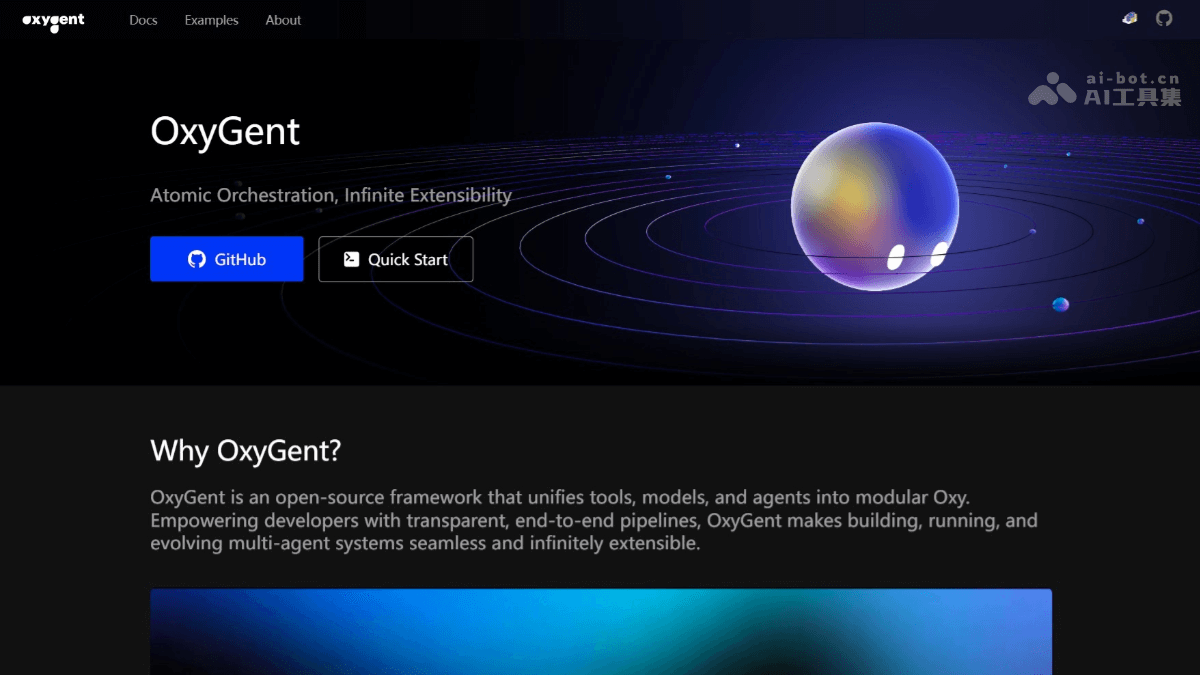
OxyGent is an open-source multi-agent collaboration framework from JD Retail's Oxygen team, designed to help developers efficiently assemble multi-agent systems. OxyGent abstracts tools, models, and agents into pluggable modules (Oxy), supporting flexible combination like building blocks, with extreme scalability and full-chain decision traceability. Based on a team collaboration-style interface, developers can assign tasks as if communicating with real teammates, and agents automatically respond and feed back results. OxyGent supports agent cognition visualization, performance profiling, and continuous evolution, helping developers quickly build, deploy, and optimize multi-agent systems.
OxyGent's Main Features
- Team Collaboration-Style Interface: Based on a team chat-like interface, developers can assign tasks as if communicating with teammates, and agents automatically respond and feed back results, enabling efficient collaboration.
- Agent Cognition Visualization: From high-level strategies to atomic operations, it fully visualizes the agent's reasoning path, supports auditing and traceability, and ensures transparent decision-making.
- Multi-Agent System Performance Profiling: Built-in production-grade time tracking visually shows the agent's time consumption in real time, helping developers quickly locate performance bottlenecks.
- Explore Multiple Possibilities for Agents: Supports replaying decision branches, resampling alternative reasoning paths, and large-scale stress testing to explore multiple possibilities for agents.
- Continuous Evolution and Self-Optimization: Built-in evaluation engine supports agents in achieving continuous self-evolution through a knowledge feedback mechanism, optimizing the decision-making process.
OxyGent's Technical Principles
- Modular Architecture: OxyGent abstracts tools, models, and agents into pluggable modules (Oxy), supporting flexible combination like building blocks. Each module can be independently developed and tested, supporting hot-swapping and cross-scenario reuse.
- Dynamic Planning Paradigm: Agents can intelligently decompose tasks, negotiate solutions, and adapt to changes in real time. Based on the dynamic planning paradigm, agents automatically adjust behavior according to task requirements, enabling efficient collaboration.
- Full-Chain Decision Traceability: Each decision step automatically generates a traceable decision graph, similar to Git version control. Supports auditing and backtracking, ensuring transparent agent behavior.
- Distributed Architecture: The underlying layer uses an elastic architecture, supporting arbitrary agent topologies. Based on automatic dependency mapping and visual debugging, it optimizes the performance of distributed systems.
OxyGent's Project Address
- Project Website:https://oxygent.jd.com/
- GitHub Repository:https://github.com/jd-opensource/OxyGent
OxyGent's Application Scenarios
- Automated Office Work: Based on agents assigning and managing tasks, it realizes automated office processes such as document processing, email classification, and schedule arrangement, improving work efficiency.
- Document Processing: Agents can automatically generate document content, assist with editing, or perform document review and proofreading, ensuring document quality.
- Code Generation and Optimization: Agents generate code snippets or complete programs based on requirements, or analyze code performance and provide optimization suggestions, improving development efficiency.
- Intelligent Customer Service: Agents automatically answer customer questions and provide instant support, or multiple agents collaborate to handle complex issues, improving customer satisfaction.
- Data Analysis and Decision Support: Agents automatically collect and analyze data, provide decision support, or perform prediction and modeling based on historical data.