
What is Oryx
Oryx is a multimodal large language model (MLLM) jointly launched by Tsinghua University, Tencent, and Nanyang Technological University. It is based on two core innovations for processing visual data: the pretrained OryxViT model and a dynamic compression module. OryxViT encodes images of arbitrary resolution into visual representations suitable for LLMs, and the dynamic compression module compresses visual tokens by 1 to 16 times as needed. This enables Oryx to flexibly handle visual inputs of different resolutions and durations, whether high-definition images or ultra-long videos. Oryx demonstrates excellent performance on multiple vision-language benchmarks, especially in spatial and temporal understanding.
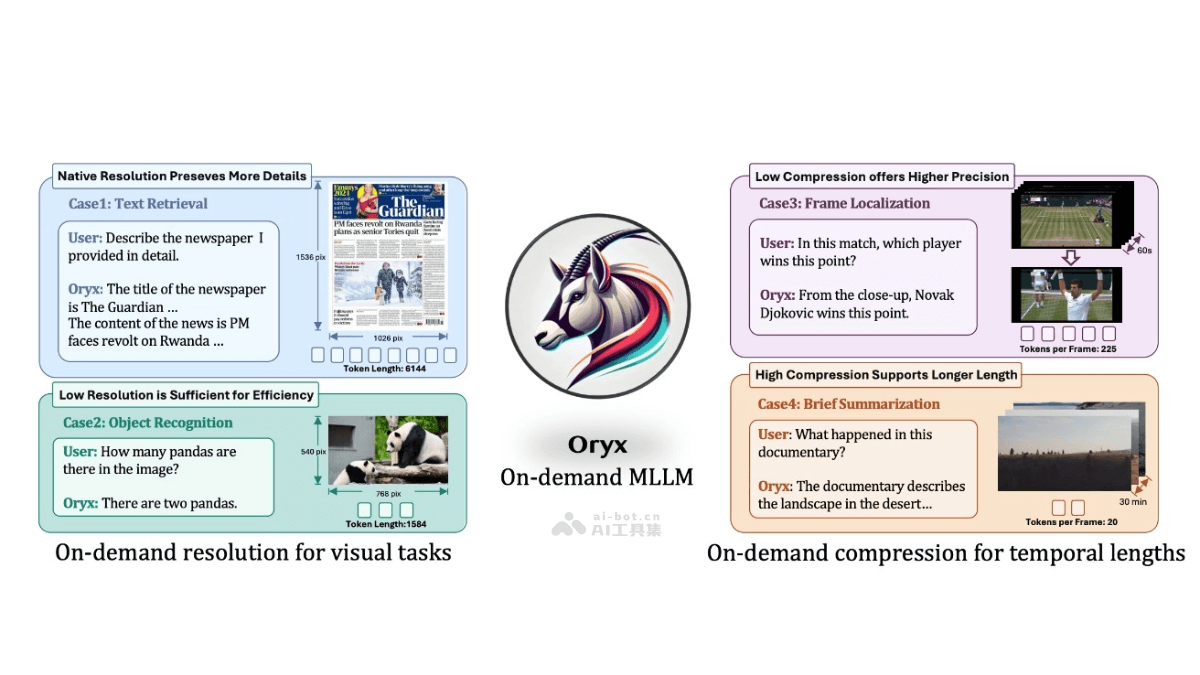
Oryx's main features
- Native resolution processing: Oryx can process visual inputs of arbitrary resolution, preserving all image details, making it suitable for tasks requiring high-precision visual information.
- Dynamic compression: Based on task requirements, Oryx can dynamically compress visual data by 1 to 16 times, handling large-scale data such as long videos and improving computational efficiency.
- Multimodal understanding: Understands and analyzes images, videos, and 3D data, providing rich spatial and temporal understanding capabilities, suitable for a variety of vision-language tasks.
- Context retrieval: Strengthens contextual understanding of video content, retrieving specific information from broad contexts.
- Spatial awareness: Oryx can accurately grasp the positions and relationships of objects in 3D space, enhancing understanding of three-dimensional space.
Oryx's technical principles
- OryxViT model: A pretrained visual encoder that converts images of different resolutions into visual representations suitable for processing by large language models.
- Adaptive position embedding: OryxViT uses an adaptive position embedding layer, allowing the model to process images of different sizes without needing to adjust to a fixed resolution.
- Variable-length self-attention mechanism: Allows the model to process visual data of different sizes in parallel, improving processing efficiency and flexibility.
- Regional attention operation: In the dynamic compression module, regional attention operations are used to interact high-resolution and low-resolution feature maps, mitigating the impact of downsampling.
- Mixed data training: Trained on a mixed dataset including images, videos, and 3D data, improving the model's performance on multimodal tasks.
Oryx's project addresses
- Project official website:oryx-mllm.github.io
- GitHub repository:https://github.com/Oryx-mllm/Oryx
- HuggingFace model library:https://huggingface.co/spaces/THUdyh/Oryx
- arXiv technical paper:https://arxiv.org/pdf/2409.12961
Oryx's application scenarios
- Intelligent surveillance: Based on Oryx's video understanding capabilities, it monitors and analyzes events and activities in surveillance videos in real time.
- Autonomous driving: In autonomous driving systems, Oryx helps parse and understand the environment around the vehicle, providing more precise visual recognition.
- Human-computer interaction: Oryx can understand image and video content, making human-computer interaction more natural and efficient.
- Content moderation: On social media and online platforms, Oryx helps automatically identify and filter inappropriate content.
- Video editing and enhancement: Oryx can automatically edit videos, such as video summarization and highlight clip generation.
- Education and training: In the field of education, Oryx provides intelligent analysis of image and video content, assisting teaching and learning.