
What is Orchard
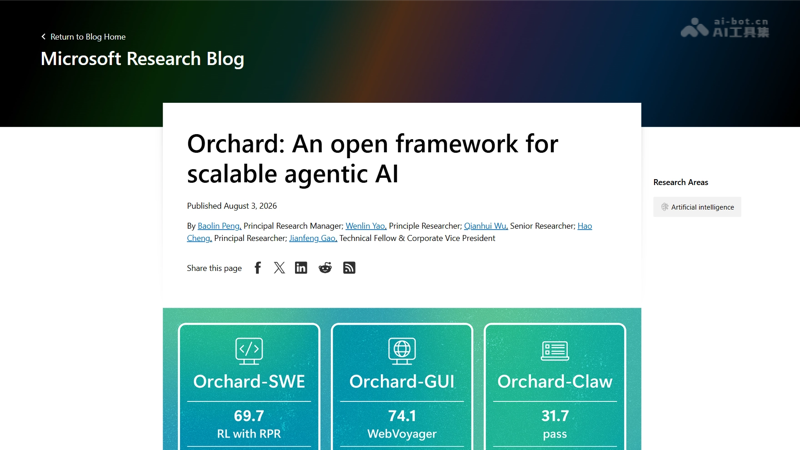
Orchard is an open-source Agentic AI modeling framework introduced by Microsoft Research. At its core is the Kubernetes-based Orchard Env environment service, which supports cross-domain reuse of sandboxes for data distillation, reinforcement learning rollout, and evaluation. The framework already covers three major scenarios—software engineering, browser navigation, and personal assistants—and has open-sourced training data and evaluation methods.
Orchard's main features
- Cross-domain unified environment service: Orchard Env provides sandbox lifecycle management, command execution, file I/O, network policies, and REST APIs. One set of infrastructure can support code, web, desktop, mobile, and productivity workflows.
- Training recipes for three major domains: Orchard-SWE specializes in code repair, Orchard-GUI handles visual web navigation, and Orchard-Claw targets daily productivity tasks such as email and calendars. All provide complete SFT + RL training pipelines.
- Training within real harnesses: Supports end-to-end training and evaluation directly in real deployment harnesses such as Codex, OpenClaw, and ZeroClaw, eliminating the mismatch between training environments and deployment environments.
- Open-source datasets and evaluation protocols: Releases 107K SWE trajectories and 3,070 GUI multimodal rollout data, along with corresponding evaluation benchmarks and reproducible recipes.
Orchard's technical principles
- Kubernetes-native environment layer: Orchard Env runs as an independent service, using container orchestration to enable parallel creation and destruction of thousands of isolated sandboxes. Average command execution latency is only 0.28 seconds, and it supports automatic scaling and Redis distributed locks.
- Credit-Assignment SFT: In the software engineering domain, the system does not discard partially failed trajectories; instead, it extracts supervision signals from valid segments, maximizing the amount of usable training data.
- Balanced Adaptive Rollout + dense rewards: To address the sparse feedback problem in RL, it uses balanced adaptive rollout to capture rare success signals, and introduces on-policy distillation and a rule-based process reward model to provide dense guidance for intermediate steps.
- Value Model reranking: Uses rollout trajectories from 20 historical experiments to train a 4B-parameter value model, scores multiple candidate solutions during inference, and selects the best one, improving Orchard-SWE from 69.7% to 73.0%.
- Harness-Agnostic agent logging: A lightweight agent logs the harness's own model calls and reconstructs them into training samples, enabling any RL codebase to connect to any harness without modifying environment images.

Follow WeChat and reply "open source" to join theAI open-source project community group
How to use Orchard
- Install the SDK: Run
pip install -e "orchard_env[dev]"to install the Python SDK, and configure theSANDBOX_BASE_URLandSANDBOX_API_KEYenvironment variables. - Quickly invoke a sandbox: Use the
SandboxClientcontext manager to create a sandbox and execute commands, supporting synchronous and asynchronous modes, file read/write, git patch application, and PTY sessions. - Deploy the orchestrator: Through the four scripts provided by Azure AKS (provision, build, deploy, smoke-test), multi-replica orchestrator deployment can be completed in about 20 minutes, and non-Azure clusters are also supported.
- Run training recipes: Refer to the GitHub repository's
trainer/slime/Directory, execute the complete SFT + RL training pipeline for Orchard-SWE, Orchard-GUI, or Orchard-Claw on Orchard Env.
Orchard's Core Advantages
- Small models approach large model performance: Orchard-SWE achieves 73.0% on SWE-bench Verified with approximately 3B active parameters, approaching frontier systems with more than 10 times the parameter count; Orchard-GUI achieves an average of 68.4% across three major web benchmarks with 4B parameters, rivaling OpenAI CUA and Gemini CUA.
- Significantly lower cost: Compared with managed sandbox services such as E2B and Daytona, Orchard Env's on-demand cost is approximately 0.47 times, and the Spot instance cost is only 0.10 times, about a 10x price difference.
- Strong cross-Harness generalization ability: The same environment layer supports multiple harnesses such as ReACT, ZeroClaw, OpenClaw, and Codex. Orchard-Claw improves pass@3 from 59.6% to 73.9% under ZeroClaw.
- Efficient training data: Orchard-GUI reaches the level of the strongest open-source web Agent using only 400 distilled demonstrations and 2,200 open tasks, proving that a small amount of data combined with the right environment can train a highly capable model.
Orchard's Project Address
- Project Website:https://www.microsoft.com/en-us/research/blog/orchard-an-open-framework-for-scalable-agentic-ai/
- GitHub Repository:https://github.com/microsoft/Orchard
- HuggingFace Model Library:https://huggingface.co/datasets/microsoft/Orchard
- arXiv Technical Paper:https://arxiv.org/pdf/2605.15040
Comparison of Orchard with Similar Competitors
| Dimension | Orchard | OpenHands |
|---|---|---|
| Positioning | Microsoft's open-source cross-domain Agentic modeling framework, covering the three major scenarios of code, web, and productivity | An open-source community-led software engineering Agent, focused on codebase repair and development tasks |
| Environment Layer | Self-developed Kubernetes-native general-purpose environment service (Orchard Env), with one set of infrastructure reused across domains | Relies on Docker containerized environments, customized for code tasks, and difficult to migrate directly to web or desktop scenarios |
| Training Capability | Built-in complete SFT + RL training pipeline, supporting direct training within real harnesses such as Codex and OpenClaw | Mainly provides inference and execution frameworks; the training pipeline must be built separately and is usually conducted in simplified environments |
| Open-Source Data | Open-sources 107K SWE trajectories, 3,070 GUI multimodal rollouts, and a complete evaluation protocol | Open-sources code and some evaluation results, but large-scale training trajectory datasets are not fully public |
| Model Efficiency | 3B–35B active parameters are enough to reach 73.0% on SWE-bench, approaching frontier models with 10 times the parameter count | Usually relies on 70B-level models or commercial APIs such as GPT-4 to achieve similar SWE-bench results |
| Cost Structure | Self-hosted sandbox cost is approximately 10%–50% of commercial services, and Spot instances are supported to greatly reduce training overhead | Mainly relies on cloud servers or commercial APIs, with costs growing linearly with model scale and call volume |
| Harness Support | Natively supports seamless switching among multiple harnesses such as ReACT, ZeroClaw, OpenClaw, and Codex | Mainly designed around its own harness; switching to external harnesses requires additional adaptation |
Orchard's Application Scenarios
- Automated software engineering: Autonomously diagnoses bugs, writes tests, generates patches, and passes verification in real codebases, suitable for open-source project maintenance and enterprise internal code review.
- Intelligent web navigation: Automatically operate the browser based on visual understanding to complete open-domain tasks such as ticket booking, shopping, and information retrieval, and can serve as an RPA alternative.
- Personal Productivity Assistant: Execute complex workflows across tools such as email, calendars, and documents, such as automatically scheduling meetings, organizing inboxes, and generating reports.
- Agent Research Infrastructure: Provide academic and industrial research teams with a reproducible, low-cost platform for Agent training and evaluation, accelerating the development of the open-source Agentic AI ecosystem.
- Cross-Domain Agent Capability Transfer: Use a unified environment layer to explore skill transfer and cumulative learning across code, web, and desktop operations.