
What is Orbis
Orbis is the first Live Model (real-time world model) from Visko, making AI videorun continuously like a livestream. Users can enter new instructions at any time to change the direction of the visuals in real time, without waiting for a finished clip. The model supports 4K@24FPS real-time streaming generation, maintains hour-level long-term consistency through a multi-scale memory mechanism, and ensures realistic and natural motion based on causal temporal decomposition and physics-aware rewards, suitable for scenarios such as virtual livestreaming, interactive stories, and robot simulation.
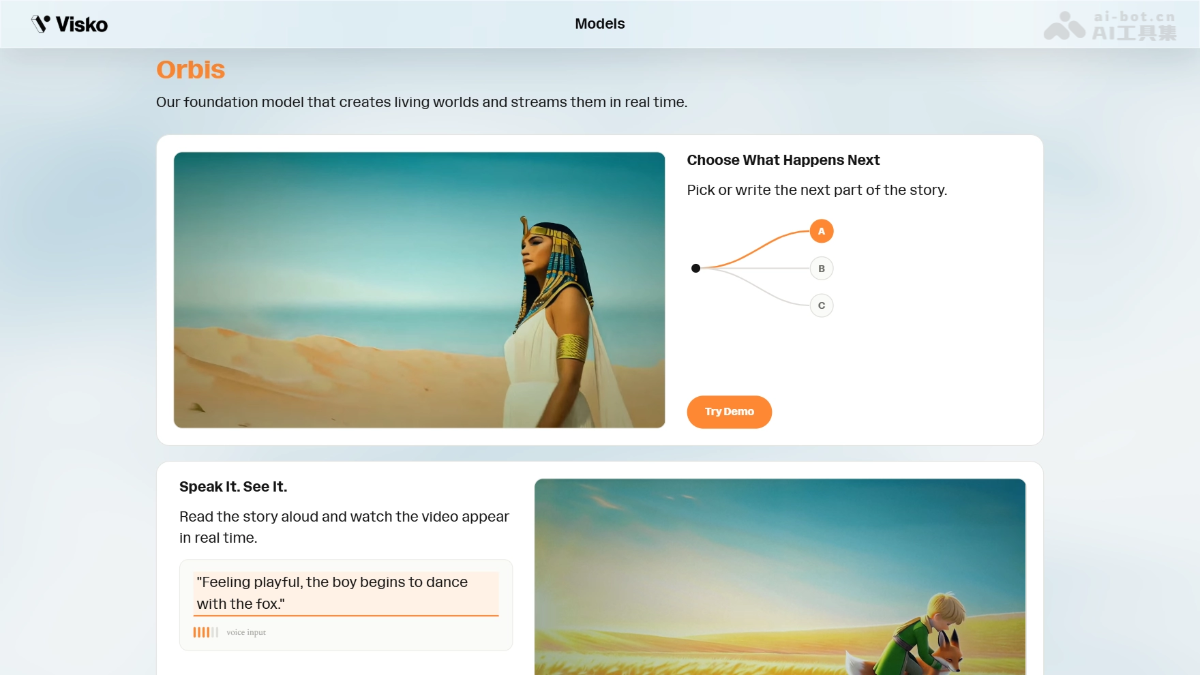
Orbis's main features
-
Real-time streaming generation: The visuals are output continuously without interruption like a livestream, supporting 4K@24FPS real-time delivery.
-
Interaction during generation: Users can add or modify prompts at any time, and new instructions take effect on subsequent visuals within an average of 1 second.
-
Multimodal input: Supports three ways to start the world: text-to-video, image-to-video, and video continuation.
-
Long-term consistency: Through the multi-scale memory mechanism, it can maintain hour-level continuous generation without obvious quality degradation.
-
Physical realism: Based on causal decomposition and world model rewards, it ensures object motion and interactions conform to the laws of physics.
Orbis's technical principles
-
Causal temporal decomposition: Generation is treated as an initial value problem; each chunk predicts the next time period only from committed history, naturally matching the Markov structure of physical evolution and avoiding the problem in bidirectional denoising where "future noise contaminates current decisions".
-
Bounded multi-scale memory: Recent history retains native latent resolution, distant history is progressively compressed, and information beyond the window is consolidated into a fixed-capacity learned state, decoupling memory and computational cost from rollout length.
-
Progressive training pipeline: Use a bidirectional model to learn short-range visual priors, then distill it into a streaming generator, train it on event-aligned long videos, fine-tune it with manually curated data, and finally align it with visual and physical rewards through self-forced distribution matching and GRPO reinforcement learning.
-
Physics-aware reward alignment: Introduces a frozen V-JEPA 2 latent world model to evaluate the predictive consistency between candidate frames and historical states, guiding generation to conform to real dynamics, and jointly optimizing with visual quality rewards.
-
Streaming inference engineering: State reuse, compiled Transformer execution, multi-GPU sequence parallelism, and a progressive decoding-super-resolution-transmission pipeline work together to achieve 4K real-time delivery.
How to use Orbis
- Start a session: Visit the Visko official website Playground or call the API, enter text, upload an image, or paste a video prefix to start a real-time session.
- Start real-time generation: Click the Live button to start streaming generation, and the visuals will continuously and automatically evolve like a livestream.
- Intervene in the visuals in real time: Enter new prompts or voice instructions at any time during generation, and the direction of subsequent visuals can be changed in real time within an average of 1 second.
- Switch scenes seamlessly: Use "Morph the scene" to describe scene changes, and new instructions will be seamlessly incorporated at the next chunk boundary.
- Choose output quality: Select 1080p, 2K, or 4K output resolution as needed, and the system delivers high-quality visuals in real time through streaming super-resolution.
- Capture and Save Clips: Click the Clip button to capture and save the currently generated video clip at any time for later editing or sharing.
- Integrate into Your Own Application: By obtaining an API Key, Orbis's real-time generation capabilities can be integrated into your own applications, live streams, or robot simulation workflows.
Orbis's Core Advantages
- Real-Time Streaming Interaction: The visuals are generated continuously like a live stream, and users can input new instructions at any time to change the direction in real time, without waiting for a finished video.
- Ultra-Long Temporal Consistency: Through a bounded multi-scale memory mechanism, it can maintain hour-level continuous generation without noticeable quality degradation or color drift.
- Strong Physical Realism: Based on causal temporal decomposition and latent world model rewards, it ensures that object motion and interaction conform to real physical laws.
- High-Quality Real-Time Delivery: Native generation combined with streaming super-resolution can output 4K@24FPS video in real time.
- Unified Generation Interface: The same causal continuation framework supports three startup modes: text-to-video, image-to-video, and video continuation.
Orbis's project address,
- Project Website:https://www.visko.ai/models
- Technical Paper:https://www.visko.ai/blog/papers/files/Visko_Orbis_1_0__A_Live_Model_for_Real_TimeInteractive_Long_Video_Generation.pdf
Comparison of Orbis with Similar Competing Products
| Comparison Dimension | Visko Orbis 1.0 | Kunlun Wanwei Matrix Game 3.0 |
|---|---|---|
| Core Positioning | General-purpose real-time streaming video world | Keyboard/mouse-driven real-time interactive world |
| Interaction Method | Real-time intervention via text/voice/image prompts | Real-time image control via WASD/mouse actions |
| Resolution/Frame Rate | 4K @ 24 FPS | 720P @ up to 40 FPS |
| Long-Term Consistency | Bounded multi-scale memory, hour-level stability | Long-term memory, maintaining spatial scene consistency |
| Generation Paradigm | Causal chunk streaming generation | Action-conditioned streaming generation |
| Physical Plausibility | Physics-aware rewards + world model | Focuses on interactive response and scene persistence |
| Main Scenarios | Live streaming, film and television, virtual companions | AI games, interactive world exploration |
Orbis's Application Scenarios
-
Interactive Entertainment and Story Creation: Users can choose plot branches in real time or narrate stories by voice, and the visuals are instantly advanced according to instructions, creating a "playable movie" experience.
-
AI Live Streaming and Virtual Anchors: As a real-time visual engine for virtual anchors, it continuously generates live stream visuals and responds to bullet comments or voice instructions, without the need for pre-recorded materials.
-
Robotics Simulation Training: Train and test robot behavior in generated high-fidelity virtual worlds, reducing the cost of trial and error before deployment in real environments.
-
Immersive Education and Training: Visualize abstract knowledge or historical scenes in real time; students can ask questions by voice to instantly change the demonstration content.
-
E-commerce Virtual Display: Virtual influencers dynamically display products in real-time generated scenes, and users can instantly request changes in style, angle, or usage context.