
What Is Oracle
Oracle is an AI Agent launched by the Flowith team, capable of achieving general artificial intelligence (pre-AGI). Oracle is designed specifically for handling complex, multi-step tasks, with autonomous planning, task decomposition, unlimited tool invocation, and self-optimization capabilities. Oracle breaks down tasks into subtasks based on the Recipe workflow and uses a task allocator to invoke tools for execution. Oracle emphasizes human-AI collaboration; users can modify, delete, or add task steps, while the AI is responsible for executing tasks and providing real-time feedback on results. Oracle supports a variety of external tools and can efficiently complete tasks within 10 minutes, making it suitable for scenarios such as in-depth research, content creation, and knowledge management.
Oracle's Main Features
- Autonomous Task Planning and Decomposition: Breaks down complex user requirements or instructions into a series of ordered subtasks (Recipe), designing a systematic workflow.
- Unlimited Tool Invocation: Invokes a rich library of tools to complete subtasks. Tools include but are not limited to search engines, data query tools, content generation tools, and more.
- Memory and Context Management: Intelligently manages memory and contextual information when handling complex tasks.
- Self-Optimization and Iteration: Dynamically adjusts the workflow (Recipe) based on the results of each step during task execution.
- User Interaction and Feedback: Confirms with the user after generating the workflow (Recipe); users can modify, adjust, or supplement specific steps. If the user is dissatisfied with the execution results, Oracle generates more steps based on the feedback and attempts to provide better results.
-
Sharing Feature Innovation: After task completion, Oracle's sharing feature supports process replay, providing a more immersive viewing experience.
- Oracle ULTRA Mode: Introduces ULTRA mode, supporting complex task workflows requiring 10-20 steps and easily handling more complex challenges.
- Presentation Generation: Supports generating slides, with download and subsequent editing, meeting presentation needs.
How to Use Oracle
- Visit the Flowith Platform: Open a browser and visit the official website of Flowith .
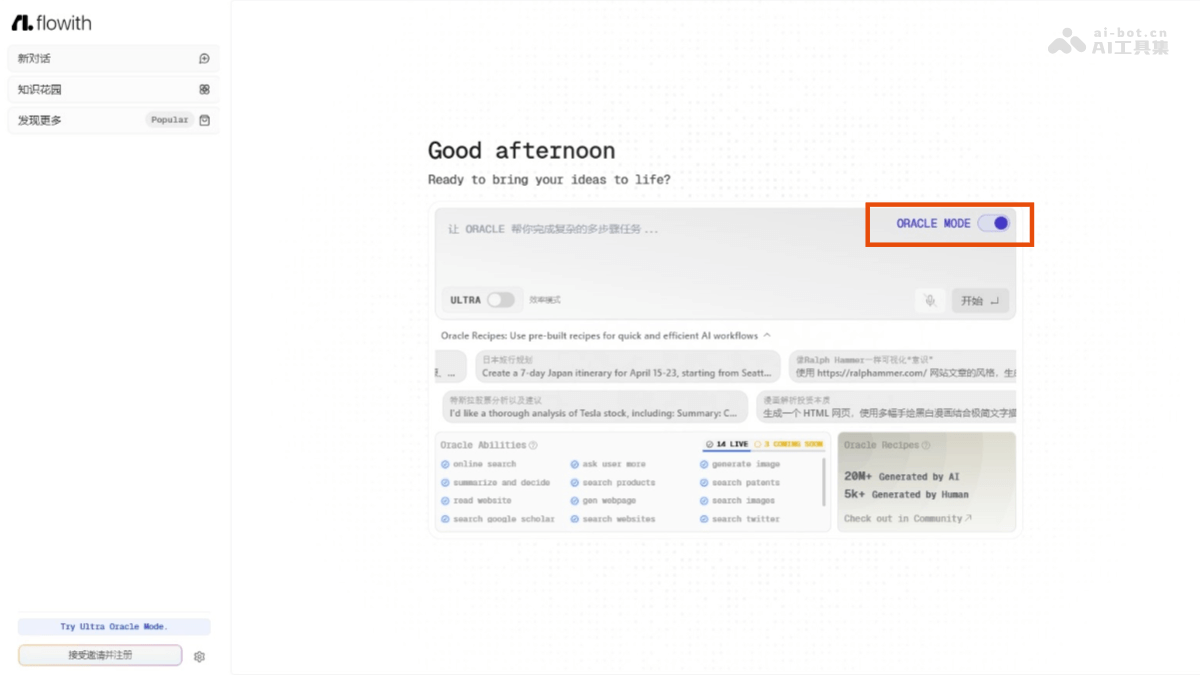
- Launch Oracle Mode: Turn on Oracle Mode (ensure Oracle Mode remains on). Review the generated Planner, and after confirming it is correct, click Confirm & Run to execute.
- View the Execution Progress of the Recipe: Select a node. Move the cursor to the input box at the bottom of the page. View the execution progress of the Recipe. The circle before each step shows the status of that step.
- Re-execute the Previous Recipe: Click any node of the Recipe you want to view. Move the cursor over the dialog box, and the Recipe will automatically pop up. Click Re-run, and a confirmation page will pop up. Click Confirm & Run to re-execute.
- Start a New Branch on the Same Canvas: Click New Branch. Enter a new question in the dialog box at the bottom of the page to start a new branch. Multiple branches can be started on one canvas, making it convenient to handle multiple tasks simultaneously.
- Use Recipe Templates: Search for the desired template keywords on the discovery page. Click Use this recipe to view details. Click Confirm & Run to use the template.
Oracle's Application Scenarios
- Complex Task Planning: Help users break down multi-step tasks, such as project planning, novel writing, etc., and display and adjust task flows based on a canvas format.
- Content Creation: Supports copywriting, idea generation, scriptwriting, etc., providing generation and optimization from outlines to specific content.
- In-depth Research: Assists users with market analysis, academic research, industry reports, etc., integrating information to generate visual results.
- Educational Assistance: Used in curriculum design, learning material organization, project-based learning, etc., helping students and teachers complete tasks efficiently.
- Knowledge Management: Combines with knowledge bases to generate personalized content, optimize creation workflows, and improve the efficiency of knowledge organization and output.