
Introduction
Since ChatGPT and similar large language models became popular, the convenience and practicality of AI have been greatly amplified. More and more people are beginning to use AI to assist with writing, searching, office work, answering questions, and creating new content. Many people encountering AI for the first time find that AI's degree of "cleverness" strongly depends on how questions are asked. With the same AI, some people can complete high-quality reports, code, or creative work, while others get nothing but confusion and irrelevant answers. The essential reason is: "What you ask is what you get." — The AI's prompt determines the quality of the response. The so-called "Prompt" is the language and instructions through which users communicate with AI. When the prompt is written well, AI is as if divinely assisted; when the prompt is vague or ambiguous, the replies obtained will also be greatly reduced in quality. For beginners, mastering "how to optimize prompts" directly affects the information users obtain and work efficiency, and is even a key part of improving personal digital competitiveness.

What is a Prompt?
The concept of Prompt
In the field of AI dialogue or information retrieval, a Prompt is "the sentence or passage of text used to ask AI a question." Similar to human conversation, AI needs to receive a series of input messages to determine the user's needs and what kind of answer is wanted. For example:
- Conversation between people:
- Xiao Wang: "I have a headache, what should I do?"
- Doctor: "How old are you? Do you have a fever? How long have you had the headache?"
- Xiao Wang: "30 years old, occasional fever, no fever."
- Doctor: "I suggest you change your pillow and stay up less late..."
- Conversation between people and AI:
- User Prompt: "What should I do about a headache?"
The AI algorithm is directly affected by the Prompt. The clearer and more complete the Prompt, the more likely the AI's "understanding of you" will be accurate.
A brief introduction to Prompts and the mechanism of AI
Taking large language models such as ChatGPT as an example, the essence of AI is actually outputting replies through "language prediction." To give a vivid example — AI is like a "super fill-in-the-blank champion," able to "guess" the most appropriate next word or sentence based on history and context. The Prompt provided by the user is the starting point for AI's "deduction," similar to an "exam essay topic." If the topic is clear and specific, the essay can stand firm; if the topic is vague or ambiguous, it is easy to go off-topic. Prompts are different from input in traditional software. Traditional software has strict menus and buttons, while AI can use almost any expression close to natural language. This degree of freedom is precisely the root of AI's coexistence of "cleverness" and "easy misunderstanding." The Prompt is the "key bridge" between users and AI.
Basic ways to write Prompts and common structures
Expression methods of Prompts
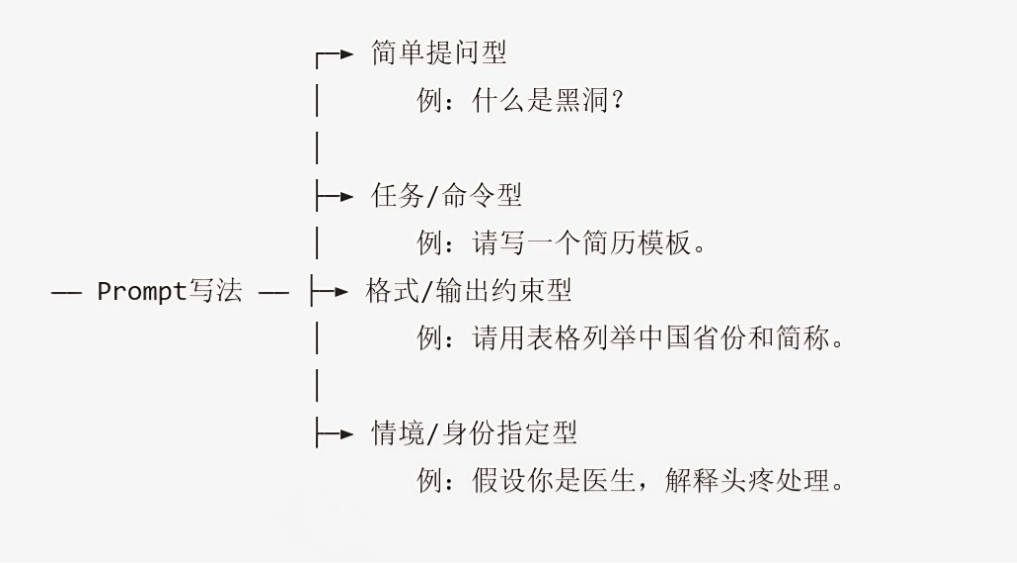
Prompts are very flexible to write and can be simple questions or detailed, step-by-step "instruction manuals." Common ways to write Prompts include:
- Simple question type:
- "What is a black hole?"
- Task/command type:
- "Please generate a three-day Shanghai travel guide."
- Completion type: "The largest mammal in the world is..."
- Format-constrained type: "Please use a table to list five Chinese historical dynasties and their representative figures."
- Context-specified type: "Assume you are a professional lawyer, please analyze my labor contract from a legal perspective."
Basic components of a Prompt
A clear and excellent Prompt includes the following elements:
- A clear goal or task: "Help me write an apology letter" is better than "apology letter."
- Information or background explanation needed: "I'm sending an email to apologize because I was late for two days" is more specific than "help me write an email."
- Expected output format: such as "list three points," "in about 800 words," "with code comments."
- Specify role or tone: such as "please write in the tone of a company general manager."
Before optimization: "Help me write an apology letter."
After optimization: "I am a company employee. Because I was sick and was late for two days, I now need to send an apology email to my department manager. Please help me write a concise apology letter in a formal tone, with no more than 200 words."
Common pitfalls in prompt writing
- Vagueness: "Help me write an essay"—about what? How long?
- Lack of scenario explanation: "Write a reply email"—to whom? About what?
- No role/tone specified: "Write blessings for a client"—formal or casual?
- Multiple requirements mixed together: "Write a letter, explain the reasoning, and add a joke"—you can give the list step by step.
The underlying principles of prompt optimization
How does a prompt affect the quality of AI responses?
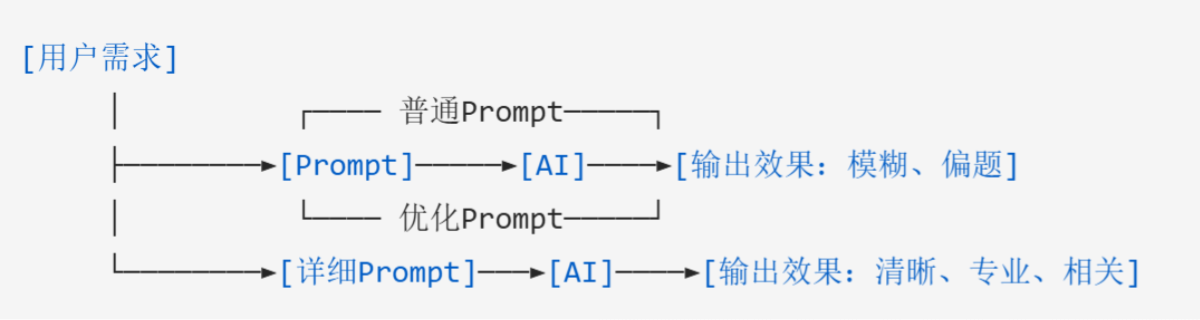
AI models do not "understand" human language; they only "learn" statistical patterns from massive amounts of text. Each time a prompt is input, the model automatically tries to use the knowledge and experience already in its "brain" to infer an appropriate response. A prompt is a clue for the model's cognition. The more specific and clear it is, the stronger the constraints on the model's "association" space, and the better it can align with the user's intent.
Tokens, context, and information completeness
In technical implementation, AI models do not process Chinese characters and words, but the smallest units into which they are divided (tokens). "Artificial intelligence" will be split into "artificial" and "intelligence," and the English "artificial intelligence" is split even more finely. Prompt length is limited, and each additional sentence takes up space in the "conversation context." A concise and effective information organization structure makes it easier for AI to "remember the key points."
The importance of "guidance" and "scenario-based framing"
Specifying an identity, scenario, and goal for AI can reduce going off topic and improve accuracy. For example: "Please take on the role of an elementary school science teacher, explain the principle of 'the three states of water,' and say it in words that elementary school students can understand." The prompt specifies the identity, knowledge object, difficulty level, and example (elementary school students' speech), so AI can align better.
Commonly used prompt optimization methods
Clarify the goal and output requirements
The mistake most AI beginners make is being "vague and unclear." AI does not proactively ask follow-up questions about details like a human interviewer, so:
- The purpose must be clear: What do you want? An article, code, a summary, a list...
- The format must be detailed: Output a table, list in bullet points, within 200 words...
- The scenario must be explained: Written to whom? What profession?
Example: "Suppose you are a secretary. Please organize the following meeting content into 3 important discussion items, each no more than 30 words, and present them in a checklist format."
Step-by-step questioning / progressive refinement method
For complex tasks, AI finds it hard to grasp the key points all at once, and it is easy to miss things or give a messy answer. You can adopt "step-by-step Q&A" or "task decomposition":
- Step one: "Please help me create a preliminary plan for learning AI"
- Step 2: "Based on the above plan, list the key tasks to complete each week"
- Step 3: "For each task, suggest a learning resource suitable for a complete beginner"
Demonstration method / example supplementation method
Write one or more desired output examples in the Prompt, and the AI will imitate the structure and "align" the output style.
Example: Prompt: "Please write three life tips in the following format. For example:
- Soften the toothbrush with hot water to make it easier to clean between teeth.
- Wipe glass with old newspaper to leave no streaks.
- Cover food with a paper towel when heating it in the microwave to prevent splattering."
Role-setting method
Having the AI take on a certain identity or perspective helps obtain professional, authoritative, and stylized answers.
Example:
- "As a psychologist, please use gentle language to offer three comforting suggestions to someone who is heartbroken."
- "Suppose you are a well-known child education expert. Use a story to tell children not to casually take things from strangers."
Output restriction and multiple-output method
To keep the AI from being "wordy" or "overdoing it," directly limit the word count and format in the Prompt, and encourage structured output.
Example:
- "Please write a love poem for me in no more than 200 words"
- "Please use a table format to list the three biggest differences between the Chinese and American college entrance examinations"
Add background and details
The closer the AI is to the specific scenario, the more practical the answer. The more detailed the explanation you provide, the more the response you get will "suit your taste."
Example: "I am going to attend an elementary school class meeting with the theme of environmental protection, and I need a speech of about 300 words advocating the protection of water resources."
Multi-angle and multi-round revision
Do not expect to get a perfect answer with one Prompt. After the AI responds, continue to add information or strengthen the instructions.
Example:
- "Your answer is very good, but I want a more humorous style. Can you rewrite it?"
- "Please add two more usage scenarios."
Practical application scenarios of Prompt optimization
- Daily life: writing apology letters, greeting card wishes, homework prompts, "Help me write a four-line birthday blessing poem," "How to politely refuse a friend's request to borrow money."
- Office and workplace: contract drafting, meeting minutes, market analysis, "As a legal professional, write an employee onboarding notice," "Send a leave request email to a leader, concise and to the point."
- Education and learning: course summaries, knowledge point organization, mock exam questions, "Please help me use a mind map to organize important events in modern Chinese history," "A list of commonly tested phrases for the CET-4 and CET-6 exams."
- Programming and technology: code generation, bug fixing, API usage, "Use Python to write a bubble sort and add comments," "Help me rewrite an SQL statement into MongoDB query language."
- Content creation and translation: new media copy, jokes, poetry, translation polishing, "Translate the following text into a creative English short poem," "Write a skincare product recommendation copy in Xiaohongshu style."
A Self-Study Guide to Prompt Optimization for AI Beginners
Conventional learning path
- Try more and practice more: Repeatedly interact with AI using different expressions to accumulate intuitive "experience".
- Study templates: Collect excellent industry Prompt templates and gradually learn the logic behind them.
- Focus on "feedback": Continuously observe the new answers given by AI and constantly adjust the Prompt.
- Join communities: Participate in AI-related communities such as Zhihu, Bilibili, and Xiaohongshu to share and absorb Prompt techniques.
- Tool utilization: Explore various AI prompt engineering tools, such as promptist.github.io, etc.
Common Prompt optimization "universal sentence patterns"
- "Please summarize concisely in ... characters or fewer/no fewer than ... characters..."
- "If you are ... (identity), please..."
- "Please highlight ... and give at least ... examples"
- "Please express it in Chinese/English/colloquial/humorous style"
- "Please output the results in a list/table/code format"
- "Please analyze the following scenario and provide three solutions"
With the rapid development of artificial intelligence technology, Prompt optimization is increasingly becoming one of the "soft skills" of the digital age. Mastering Prompt optimization techniques enables everyone to collaborate with AI more smoothly, obtain higher-quality and more personalized services, and inspires users to express their needs and creativity in a more open, systematic, and structured way, turning vague ideas into concrete and feasible results. Through effective Prompt optimization, everyone can greatly shorten the information gap and improve their own problem-solving and innovation capabilities.
With the continuous iteration of AI models and the ongoing enrichment of Prompt engineering tools, AI will become an indispensable "digital intelligence partner" for humanity. Prompt optimization will play an increasingly important role in education, work, life, and all aspects of life. Help every reader take the first step in dialogue with the intelligent era, and use efficient and accurate Prompts to make AI truly serve personal growth and social development. In the era of human-machine collaborative co-creation, use wiser questions to lead to more valuable answers!