
What is OpenStory
OpenStory is an open-source AI video production platformfocused on transforming scripts into short drama videos with a consistent style in one click. The platform can automatically split scenes, design shots, analyze emotions, and invoke Fal.ai and other mature models to generate images, videos, and audio, while ensuring that character appearance, scene layout, and visual style remain consistent across shots. OpenStory supports team collaboration and asset sharing, and is fully open source under the MIT license.
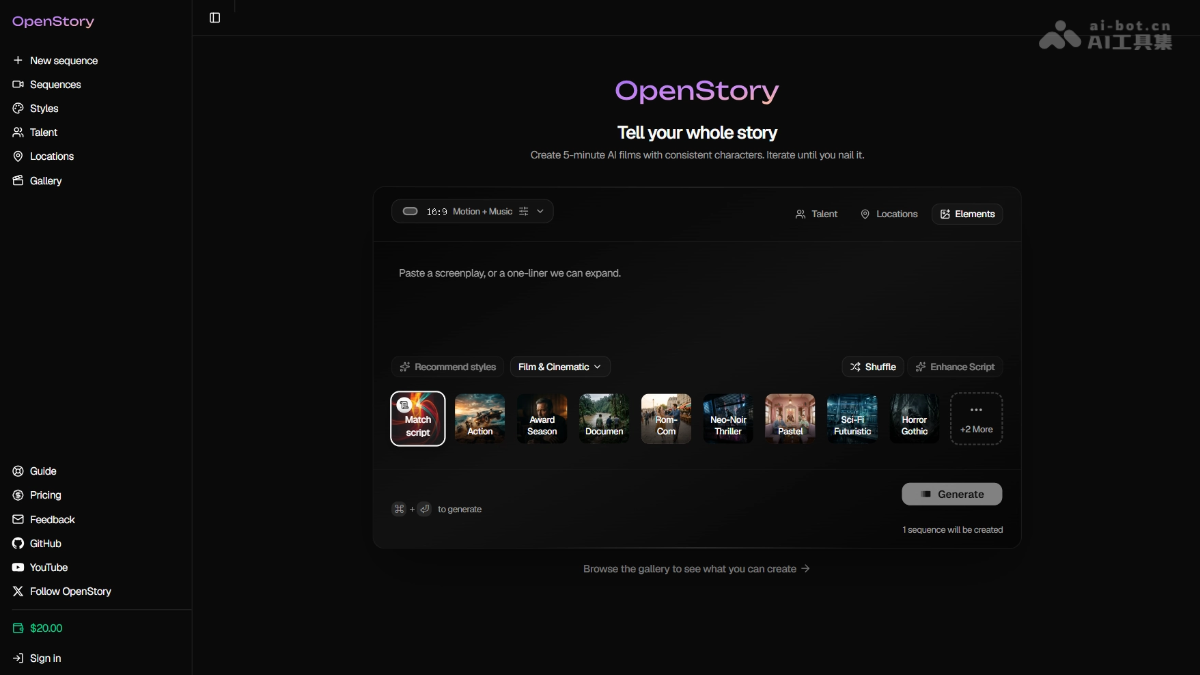
Main Features of OpenStory
-
Intelligent Script Parsing: Paste a script to automatically split scenes, recommend camera angles, and track narrative coherence.
-
Style Consistency: Automatically maintains consistency of character appearance, scene layout, color and lighting, and visual style throughout the entire film.
-
AI Image Generation: Invokes multiple models through Fal.ai to generate high-quality still images for each scene.
-
Image-to-Video: Automatically converts generated still frames into video clips with dynamic effects.
-
Multi-Shot Rendering: Supports models such as Seedance 2.0 and Kling 3.0 to generate multiple shots for an entire scene at once.
-
Video Composition and Export: The server automatically composes all clips and exports them as directly playable MP4 files.
-
Team Collaboration Space: Supports multiple people sharing character libraries, scene libraries, and visual style libraries, with unified collaborative management of material assets.
-
Prompt Engineering Automation: The platform automatically handles complex AI prompt writing, lowering the barrier to user operation.

Follow WeChat and reply "open source" to join theAI Open-Source Project Exchange Group
How to Use OpenStory
-
Clone the project: Execute
git clone https://github.com/openstory-so/openstory.gitand enter the directory. -
Install dependencies: Run
bun installto install all dependency packages required by the project. -
Start the service: Execute
bun devto automatically initialize the environment, migrate the database, and start the local development server. -
Configure keys: Run
bun setupto interactively enter theFAL_KEYandOPENROUTER_KEYtwo API keys. -
Paste the script: Paste your script or one-sentence synopsis in the interface, and the platform will automatically parse and split scenes.
-
Choose a style: Choose from preset cinematic styles (such as sci-fi, thriller, romantic comedy, etc.) or customize the visual style.
-
Generate content: Click the generate button, and the platform automatically completes prompt engineering, AI image generation, and dynamic video rendering.
-
Export the final film: The server automatically composes all clips and directly exports them as MP4 video files with audio and subtitles.
Core Advantages of OpenStory
-
Industrialized Pipeline: Upgrades AI short drama production from a "small workshop" to a replicable, scalable, standardized production process.
-
Ultimate Style Consistency: Automatically maintains a high degree of consistency in character appearance, scene layout, color lighting, and visual style throughout the entire film.
-
One-click script parsing: Simply paste the script to automatically split scenes, recommend camera angles, and analyze the emotional atmosphere, with no manual storyboarding required.
-
Fully automated workflow: From script parsing and AI generation to video composition and MP4 export, everything is completed in one stop, with no manual editing required.
-
Open source and free: Fully open source under the MIT license, with extremely high code quality, ready for direct use or as a learning reference.
-
Team collaboration support: Supports multiple people sharing character libraries, scene libraries, and visual style libraries, enabling unified management of asset materials.
OpenStory's project address
- Project official website:https://openstory.so/
- GitHub repository:https://github.com/openstory-so/openstory
Comparison of OpenStory with similar competing products
| Comparison dimension | OpenStory | LTX Studio |
|---|---|---|
| Product positioning | Open-source AI video production pipeline, focused on the industrialized process from script to finished film | Lightricks' AI video pre-production suite, focusing on storyboarding and concept visualization |
| Open-source license | Fully open source under MIT, free to deploy and develop further | Closed-source commercial product, offering only SaaS services |
| Usage cost | Free (only requires your own Fal.ai / OpenRouter API Key) | Free version: 800 one-time credits; paid version: $15–$125/month |
| Core capabilities | Script parsing, automatic storyboarding, style consistency, image-to-video, server-side MP4 composition | Storyboard generation, shot control, character consistency, timeline editing, audio synchronization |
| Deployment method | Local or Cloudflare Workers edge deployment, with data autonomy and control | Pure cloud SaaS, cannot be deployed privately |
| Model support | Integrates multiple models such as Seedance, Kling, and FLUX through Fal.ai | Built-in LTX-2.3, while also supporting partner models such as Veo, Kling, and Seedance |
| Collaboration features | Team workspace, shared asset library (in Roadmap) | Standard/Professional versions support real-time multi-person collaboration and approval |
OpenStory's application scenarios
-
AI short drama/micro-film production: Independent creators can input a script to automatically generate stylistically consistent storyboards and finished films, greatly lowering the threshold for short drama production.
-
Advertising creative preview: Advertising teams quickly transform creative scripts into visualized storyboards, showcasing shot design and visual direction to clients at low cost.
-
Education and training videos: Educational institutions turn course content into scripts and then generate in batches teaching animations or scenario demonstration videos with consistent characters and scenes.
-
Mass production of social media content: MCN agencies use a standardized pipeline to mass-produce series of short videos with a consistent style, ensuring brand visual consistency.
-
Game/animation concept validation: Independent developers quickly generate concept videos for characters and scenes, validate the worldview setting and narrative rhythm, and then invest in formal production.