
What is OpenScholar
OpenScholar is a retrieval-augmented language model (LM) jointly launched by the University of Washington and the Allen Institute for AI, designed to help scientists answer questions by retrieving and synthesizing relevant papers from the scientific literature. The system uses a large-scale database of scientific papers, a customized retriever and reranker, and an optimized 8B-parameter language model to generate accurate answers grounded in actual literature. OpenScholar surpasses existing proprietary and open-source models in providing factual answers and accurate citations. On ScholarQABench, OpenScholar-8B outperforms GPT-4o by 5% in correctness and PaperQA2 by 7%, and all related code and data have been open-sourced to support and accelerate scientific research.
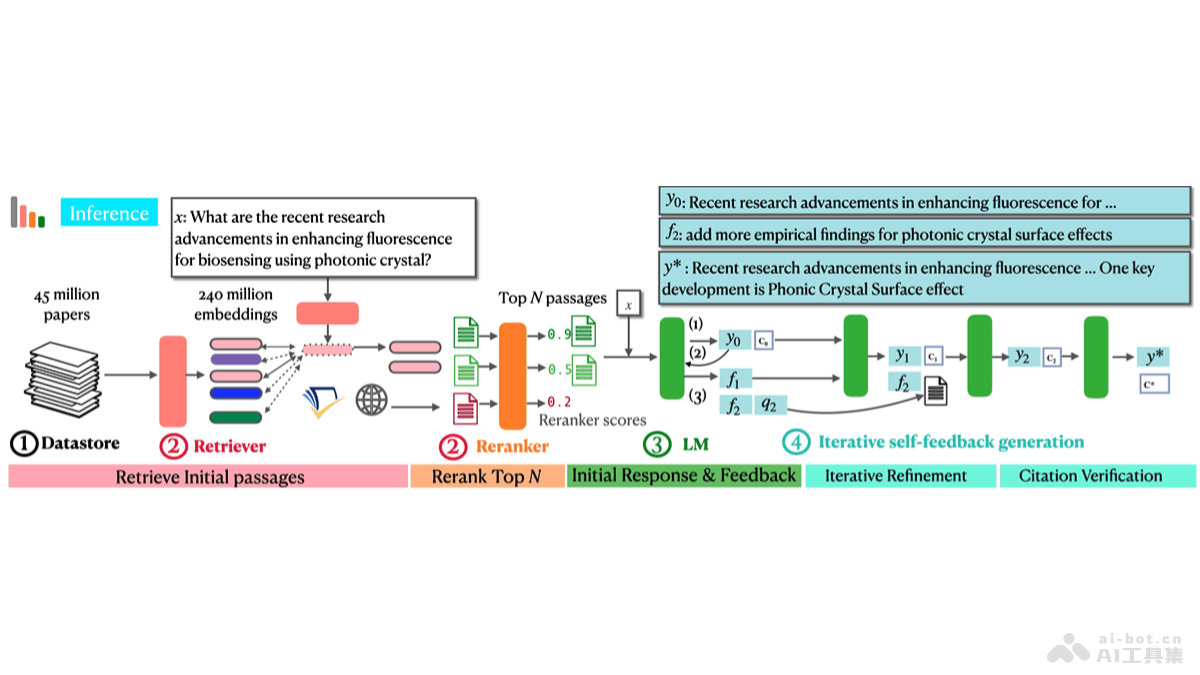
Main Features of OpenScholar
- Literature Retrieval and Synthesis: Retrieves a large amount of scientific literature and synthesizes relevant information to answer user queries.
- Citation-Based Answer Generation: Generated answers include accurate citations, improving the reliability and transparency of the answers.
- Cross-Disciplinary Application: Applicable to multiple scientific fields, including computer science, biomedicine, physics, and neuroscience, etc.
- Improved Retrieval Efficiency: Based on specialized retrievers and rerankers, it improves the efficiency and accuracy of retrieving relevant scientific literature.
- Self-Feedback Iteration: Uses a self-feedback mechanism to iteratively improve answers, enhancing answer quality and citation completeness.
Technical Principles of OpenScholar
- Data Storage (OpenScholar Datastore): Contains over 45 million scientific papers and their corresponding 237 million passage embeddings, providing the foundational data for retrieval.
- Specialized Retriever and Reranker: Retrievers and rerankers trained on the scientific literature datastore, used to identify and rank relevant literature passages.
- 8B-Parameter Language Model: An 8B-parameter large language model optimized for scientific literature synthesis tasks, balancing performance and computational efficiency.
- Self-Feedback Generation: At inference time, iteratively refines model outputs based on natural language feedback; each iteration may involve additional literature retrieval, improving answer quality and filling citation gaps.
- Iterative Retrieval Augmentation: After generating an initial answer, the model generates feedback that guides further retrieval, iteratively improving the answer until all feedback has been addressed.
Project Links for OpenScholar
- Project Website:allenai.org/blog/openscholar
- GitHub Repository:https://github.com/AkariAsai/OpenScholar
- HuggingFace Model Hub:https://huggingface.co/collections/OpenScholar/openscholar-v1-67376a89f6a80f448da411a6
- arXiv Technical Paper:https://arxiv.org/pdf/2411.14199
Application Scenarios of OpenScholar
- Research Assistance: Researchers can quickly obtain the latest research findings, helping them stay up to date within their own research fields.
- Literature Review: When writing academic papers or reports, authors can integrate and summarize a large amount of literature, improving writing efficiency.
- Cross-Disciplinary Research: Since OpenScholar covers multiple scientific fields, it helps researchers explore connections and intersections between different disciplines.
- Education and Learning: Students and teachers can use it to assist learning and teaching, obtaining in-depth literature analysis and summaries.
- Technology Monitoring: The enterprise R&D department monitors technology development trends, especially in rapidly changing technical fields.