
What is Fusion
Fusion is OpenRouterpenRouter's multi-model intelligent fusion service. It distributes the same prompt in parallel to multiple models for independent responses, then a judge model analyzes the consensus, contradictions, and blind spots across the answers, ultimately fusing them into the optimal answer. On the DRACO benchmark, the budget combination of Gemini 3 Flash + Kimi K2.6 + DeepSeek V4 Pro achieved a score of 64.7% at half the price, approaching Claude Fable 5 65.3%. This mechanism can enhance intelligence through model complementarity, offers robustness with automatic substitution when a single model fails, and opens a new path for cost-effective open-source models to compete with closed-source frontier models.
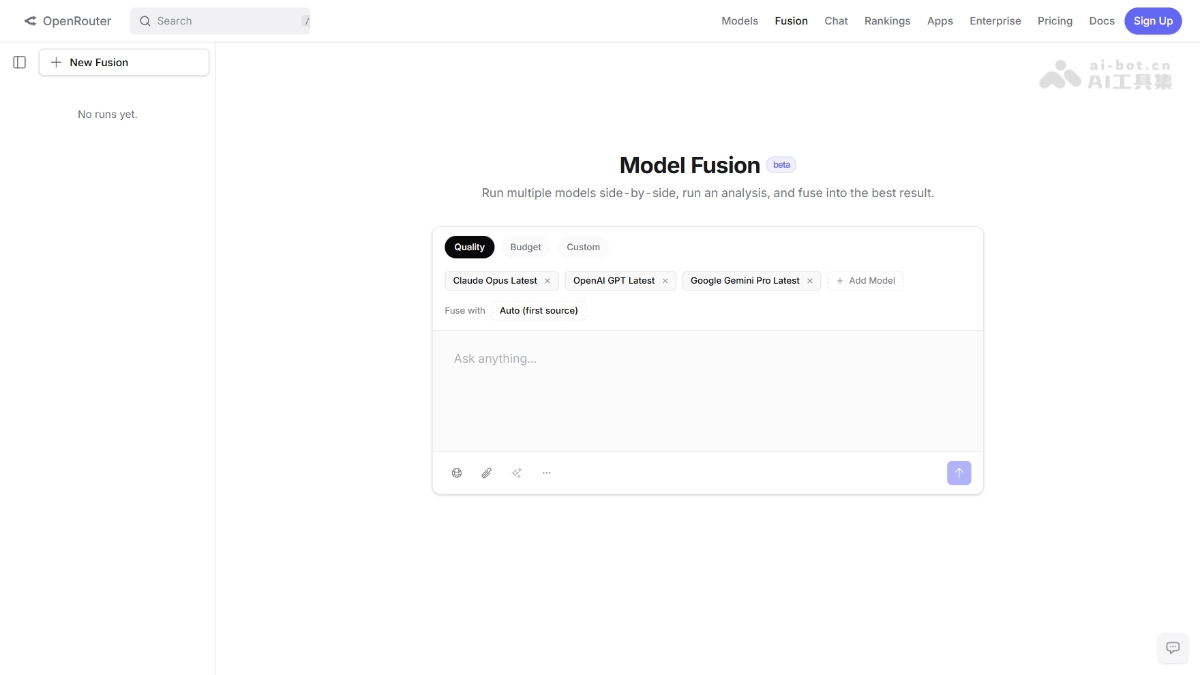
Fusion's Main Features
-
Multi-Model Parallel Response: The same prompt is simultaneously distributed to multiple models for independent responses, fully leveraging the differences in reasoning paths across models.
-
Judge Model Fusion: A judge model reads through all responses and produces a structured analysis, rather than simply voting for the best.
-
Answer Drafting by Response Model: Based on the judge's analysis, a designated response model re-outputs the final answer, ensuring consistent style and complete logic.
-
Flexible Invocation Methods: Supports direct API calls, tool mounting, custom model combinations, and web-based visual configuration.
-
Preset Package Selection: Provides three preset panels: Quality, Budget, and Custom.
How to Use Fusion
- Visit the Official Website: VisitOpenRouterthe official website and select Fusion.
-
Direct API Call: Set the model name in the request to
openrouter/fusion, and the server automatically completes parallel distribution and judge fusion, returning the result in a single call. -
Tool Mounting: Add Fusion as a tool to the
toolslist, and the main model autonomously determines when to trigger multi-model collaboration. -
Custom Combination: Specify the list of participating models and the judge model in the call parameters, for example, having domestic models participate and a stronger model serve as judge.
Fusion's Core Advantages
-
Cost-Effectiveness Breakthrough: The budget combination of Gemini 3 Flash + Kimi K2.6 + DeepSeek V4 Pro scored 64.7% on the DRACO benchmark, approaching Claude Fable 5's 65.3%, at only half the price.
-
Enhanced Robustness: When a single model refuses to answer due to content filters or blind spots, other models in the combination can automatically step in, avoiding task interruption.
-
Self-Fusion Gain: Running the same model twice and then fusing (Opus 4.8) can improve by 6.7 percentage points, proving that the fusion mechanism itself has independent value.
-
New Track for Open-Source Models: Cost-effective domestic models no longer need to compete head-on with closed-source giants in single-model leaderboard rankings; through combined collaboration, they can deliver results close to the frontier.
Fusion's Comparison with Similar Competitors
| Dimension | Fusion | Unify (Multi-Model Intelligent Routing) |
|---|---|---|
| Core Mechanism | Multiple models answer in parallel, and a judge model analyzes consensus, contradictions, and blind spots before fusing into a draft. | Trains a neural network router to match each request with the optimal single model based on benchmark data. |
| Quality Improvement | Multi-perspective complementarity covers blind spots; even running the same model twice and fusing can improve by 6.7 percentage points. | Jointly optimize the three dimensions of quality, cost, and speed to precisely match the single model with the strongest capability for the task. |
| Cost Structure | Multiple models are called simultaneously, and the total cost is the sum of the token consumption of each model. | Single-model invocation, achieving overall cost optimization by routing to a low-cost model. |
| Robustness | When a model is rejected by a filter or gets stuck, other models in the combination automatically take over, so the task is not interrupted. | When the primary model fails, it switches to a backup model, but the content filter blind spots inherent to a single model still affect the output. |
| Output Characteristics | Regenerates a unified answer based on structured analysis, eliminating the style bias and blind spots of a single model. | Directly returns the raw output of the selected model, preserving that model's inherent reasoning style and limitations. |
| Latency Performance | Calling multiple models in parallel and adding judge analysis makes latency higher than a single model, making it suitable for non-real-time tasks. | Single-model invocation, with lower latency, suitable for real-time conversation scenarios that are sensitive to response speed. |
| Applicable Scenarios | Tasks with high error tolerance costs and requiring multi-perspective verification, such as in-depth research, high-risk decision-making, and complex reasoning. | General conversation, high-frequency requests, and cost-sensitive applications, pursuing a balance between cost-effectiveness and speed. |
Application Scenarios of Fusion
- In-Depth Professional Research: Suitable for highly complex analysis tasks in fields such as academia, finance, law, and healthcare, eliminating the reasoning blind spots of a single model through parallel verification by multiple models to ensure rigorous and reliable conclusions.
- High-Robustness Production Environments: Geared toward business scenarios with extremely high requirements for service continuity. When a model refuses to respond due to content filters or security policies, other models in the combination automatically take over, avoiding task interruption.
- Budget-Sensitive High-Quality Requirements: Helps small and medium-sized enterprises and developers obtain output quality close to closed-source frontier models such as Claude Fable 5 at the cost of an open-source model combination, significantly lowering the barrier to large model applications.
- Complex Reasoning and Decision Verification: In tasks that require multi-path exploration and comparison of different tool-calling strategies before making a comprehensive decision, use the reasoning differences among models to generate more comprehensive structured analysis.