
What Is OpenPaper
Open Paper is an AI-driven academic research assistance platform designed specifically to improve academic research efficiency. The platform integrates a variety of intelligent tools, such as an AI academic reading and writing assistant, to improve the efficiency of literature processing and research work. The platform supports in-depth interactive reading of paper content and full-process writing support from topic selection to literature citation. OpenPaper provides features such as bilingual comparison, traceable source location, and collaborative annotation to promote deeper understanding of knowledge and team collaboration. OpenPaper helps researchers stay ahead in the era of information explosion and accelerates academic discovery and innovation.
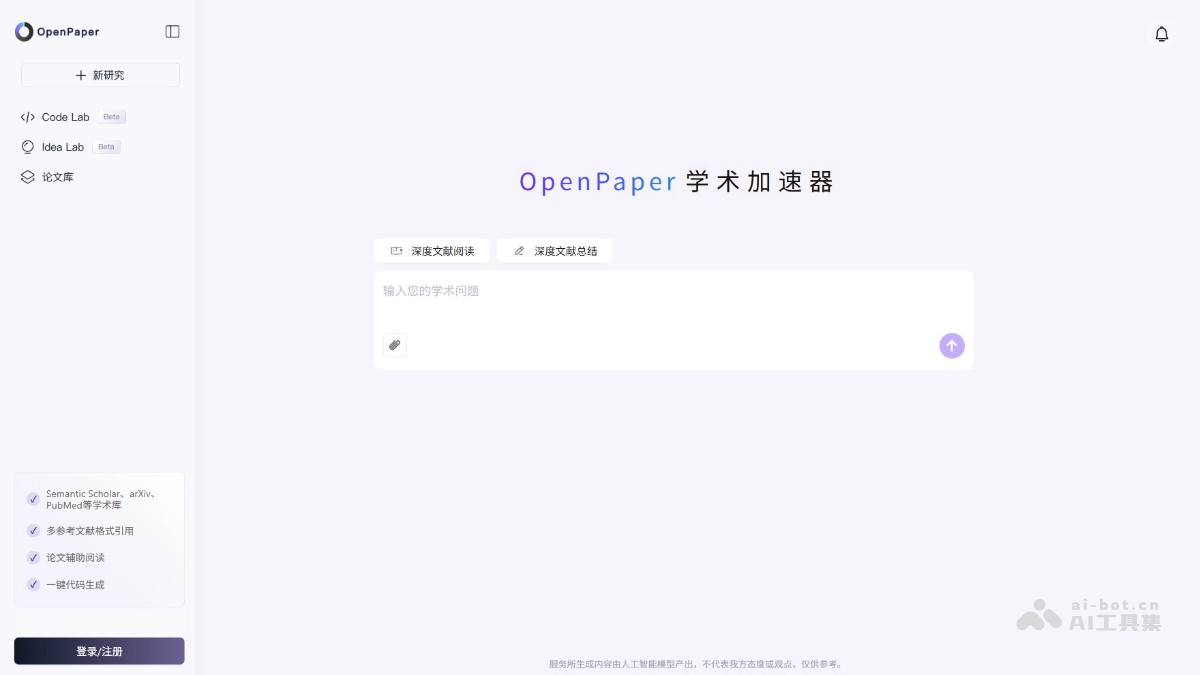
Main Features of OpenPaper
- Email Subscription Feature: Receive personalized academic information briefings by email to stay sensitive to research trends.
- Intelligent Paper Guided Reading: Quickly extract and summarize the core content of papers based on AI technology to improve users' efficiency in reading and understanding academic papers.
- Bilingual Comparison and Traceable Source Location: Provide bilingual translation of paper paragraphs and precise citation location to help users understand professional terminology more deeply and verify information sources.
- Featured Five-Question Method for Papers: Based on the preset five-question framework for papers, help users systematically analyze and understand the core content and research value of academic papers.
- Comparative Reading Feature: Support users in conducting side-by-side analysis of multiple papers, easily identifying similarities and differences between studies, deepening understanding, and promoting new insights.
- AI Academic Writing: An engine trained on large-scale academic data provides users with one-stop service from topic selection to literature citation, automatically creates citation networks, supports citation conversion in multiple formats, and performs AI-assisted polishing.
- Code Lab: Provide AI paper code reproduction functionality to help users efficiently and accurately reproduce the code in papers.
- Idea Lab: An AI innovation point mining tool that can automatically generate structured research ideas from research topic descriptions, including cross-disciplinary brainstorming, academic novelty verification, and experiment design structuring.
How to Use OpenPaper
- Visit the Official Website: Visit OpenPaper's official website:https://www.openpaper.com.cn/。
- Register an Account: Register a new account on the official website or log in with an existing account.
- Upload Literature: Use the platform's upload feature to upload the academic papers you want to analyze or read to OpenPaper.
- AI Academic Reading: Based on the AI multidimensional interactive reading feature, quickly grasp the core value of papers based on the preset five-question framework for papers, and use bilingual comparison and traceable source location features to improve reading efficiency.
- AI Academic Writing: During the writing process, use the AI academic writing feature to go from topic conception to literature citation, automatically build citation networks, and perform AI polishing and optimization.
Application Scenarios of OpenPaper
- Literature Review: Researchers can quickly conduct literature reviews, automatically generate association networks containing a large number of citations, and perform format conversion and AI polishing.
- Interdisciplinary Research: Researchers subscribe to interdisciplinary research topics, obtain the latest research trends in different fields, and promote interdisciplinary collaboration.
- Academic Writing: Students and researchers can receive assistance in writing papers, from topic conception to literature citation, improving writing efficiency and quality.
- Research Hypothesis Generation: Researchers automatically generate innovative research hypotheses based on the provided research topic.
- Experimental design: Help researchers transform research ideas into verifiable experimental plans, accompanied by analysis of related work.