
What Is OpenLens AI
OpenLens AI is a fully autonomous AI research assistant designed specifically for medical research, launched by the Department of Automation at Tsinghua University. Through multi-agent collaboration, it automates the entire process from literature review and experimental design to data analysis and paper generation, greatly improving medical research efficiency and shortening the research cycle from "month-level" to "hour-level." The tool integrates multiple quality control mechanisms to ensure the reliability and reproducibility of research results. The emergence of OpenLens AI marks the entry of medical research into the "zero manual" era and brings major changes to the research paradigm.
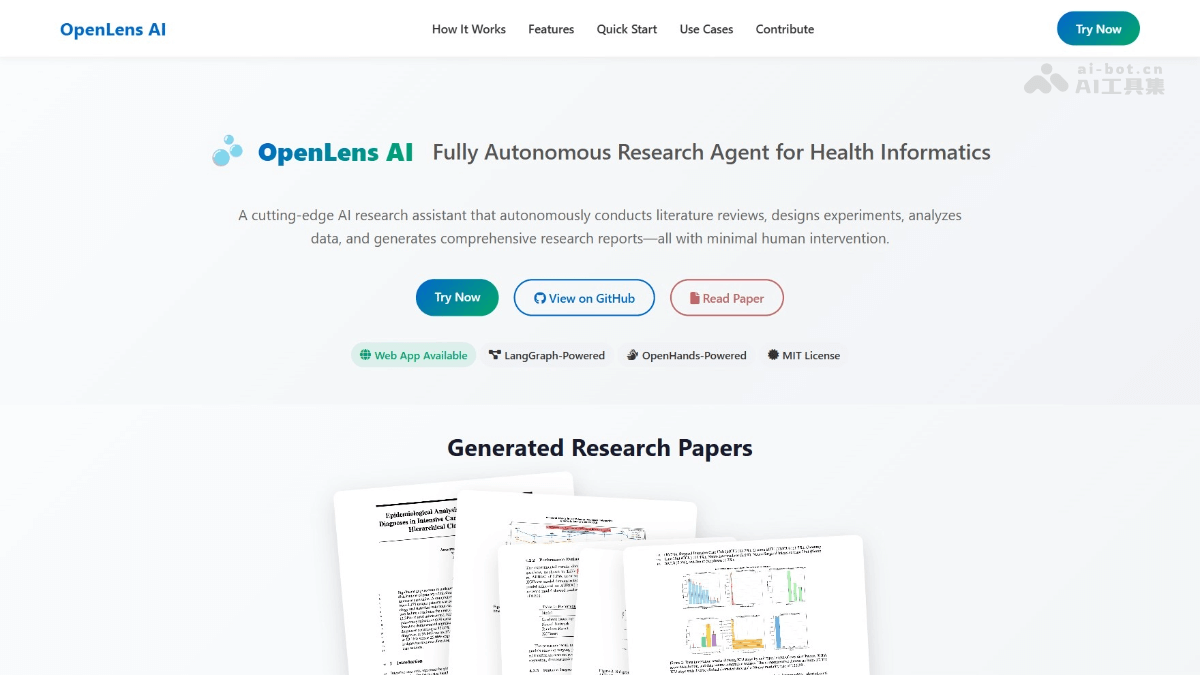
Main Features of OpenLens AI
-
Literature Review: Automatically retrieves and synthesizes relevant literature, using a ReAct-based reasoning framework to provide a comprehensive and accurate theoretical foundation for research.
-
Experimental Design: Generates detailed experimental plans based on the user's research question, converts them into executable code, and supports a variety of experimental design needs.
-
Data Analysis: OpenLens AI processes various types of medical data (such as time series, genomic information, etc.), generates structured and interpretable insights, and provides visualizations, statistical summaries, and natural language explanations.
-
Paper Writing: Integrates the outputs of all modules to generate high-quality scientific research papers, supports LaTeX format, and ensures figure quality and formatting consistency.
-
Quality Control: Integrates mechanisms such as academic rigor checks, evidence traceability checks, literature checks, and visual language feedback to ensure the reliability and reproducibility of research results.
Technical Principles of OpenLens AI
-
Multi-Agent Collaboration:
-
Supervisor Module: As the global coordinator, it decomposes user queries into structured subtasks, ensuring transparency and interpretability throughout the research process.
-
Literature Reviewer: Builds an autonomous knowledge exploration pipeline and uses a ReAct-based reasoning framework to retrieve and synthesize relevant literature.
-
Data Analyst: Coordinates multi-stage data processing workflows and transforms raw medical data into structured, interpretable insights.
-
Coder: Converts high-level experimental plans into executable code and evaluates output quality through a visual language model.
-
LaTeX Writer: Integrates the outputs of all preceding modules to generate publication-grade scientific papers.
-
-
Modular Architecture:Each agent focuses on a specific task, improving the system's flexibility and scalability through modular design.Agents work together through standardized interfaces, ensuring the continuity and efficiency of the research process.
-
Quality Control Mechanisms: Automatically verifies the rationality of experimental methods, detects common pitfalls such as data leakage and inappropriate performance metrics, and ensures the scientific validity of research results. The system links each research claim to underlying evidence and generates structured traceability reports to ensure research transparency. The system verifies all cited references, confirms the accuracy of metadata, removes unverifiable entries, and guarantees the reliability of the academic background. At key stages, the system evaluates figure quality and provides perceptual feedback to enhance the readability and scientific validity of the results.
OpenLens AI Project Address
- Project Website:https://openlens.icu/
- GitHub Repository:https://github.com/jarrycyx/openlens-ai
- arXiv technical papers:https://arxiv.org/pdf/2509.14778
Application scenarios of OpenLens AI
-
Disease prediction modeling: Develop disease prediction models based on historical patient data, such as the precision of predicting acute kidney injury (AKI).
-
Drug interaction research: Analyze the latest drug interaction research findings to help improve medication safety and efficacy.
-
Causal relationship analysis: Use structural causal models to explore the potential causal drivers of complex medical issues, such as the reasons for prolonged ICU length of stay.
-
Medical data analysis: Process and analyze medical datasets (such as the MIMIC-IV and eICU datasets), and generate statistical reports and visualization results.
-
Scientific research paper generation: Automate the entire process from research questions to paper writing, generate high-quality scientific research papers, and accelerate the medical research process.