
What is OpenDeepResearcher
OpenDeepResearcher is an open-source AI research tool that helps users efficiently complete complex information query and analysis tasks. Based on iterative search and reasoning, it automatically obtains relevant data from the web and generates comprehensive reports. The system supports asynchronous processing to improve efficiency and has deduplication capabilities to avoid repeatedly processing the same content. Users only need to enter a research topic, and the system automatically completes the entire process of search, evaluation, extraction, and report generation. OpenDeepResearcher is suitable for fields such as finance, science, policy, and engineering, providing researchers with a low-cost and efficient solution.
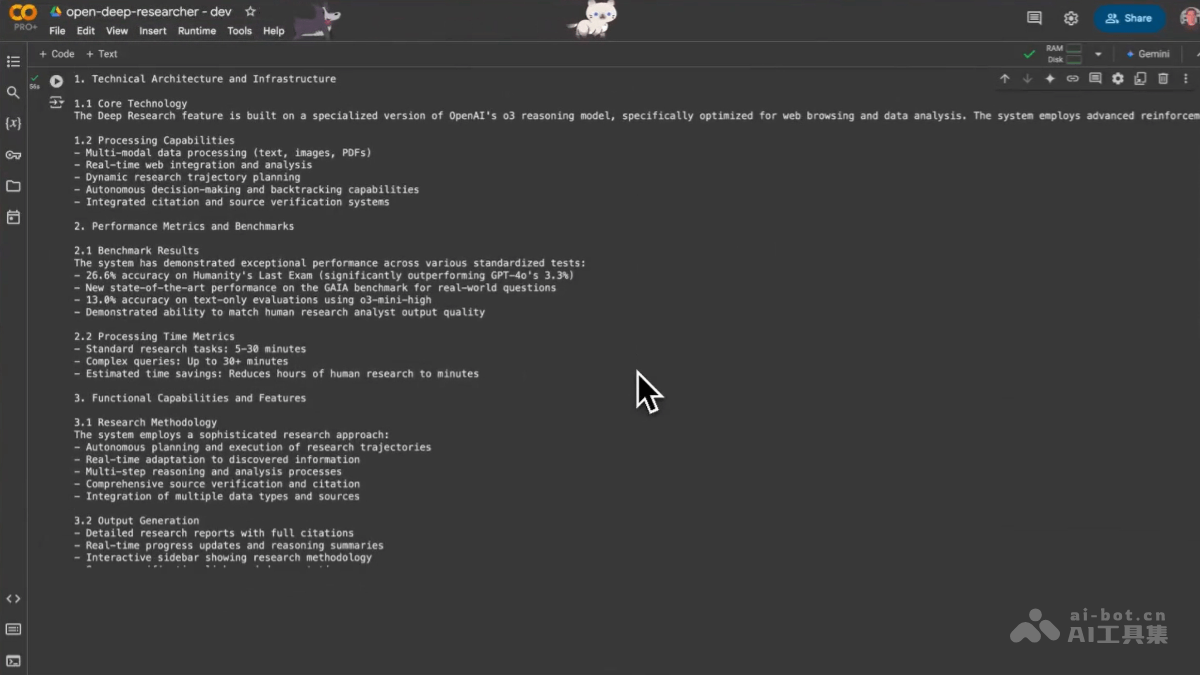
Main features of OpenDeepResearcher
- Iterative research loop: Based on the research topic entered by the user, the system generates an initial search query. In each iteration, the system generates new search queries based on the information already obtained, gradually refining the research scope until the research goal is met or the set number of iterations is reached.
- Asynchronous processing: Operations such as search, web scraping, page evaluation, and context extraction are executed in parallel, significantly improving processing speed and efficiency.
- Deduplication: The system automatically aggregates and deduplicates links, avoiding repeated processing of the same web content and saving time and resources.
- LLM-driven decision-making: Uses large language models (LLMs) to generate search queries, evaluate page relevance, extract key information, and generate the final comprehensive report.
Technical principles of OpenDeepResearcher
- Search and data acquisition: Uses SERPAPI for Google search to quickly obtain web links related to user queries. Based on Jina, extracts web content and converts HTML web pages into plain text format suitable for LLM processing.
- LLM-driven reasoning: Uses LLMs provided by OpenRouter (such as anthropic/claude-3.5-haiku) for natural language processing and reasoning. The LLM is responsible for generating search queries, evaluating the relevance of web pages, extracting key information, and deciding whether further searches are needed.
- Iterative optimization: The system feeds the information obtained in each iteration back to the LLM, generates new search queries based on the LLM's evaluation results, and gradually optimizes the research results.
- Asynchronous processing and deduplication: Uses asynchronous programming technologies such as nest_asyncio to achieve parallel processing of search, scraping, evaluation, and extraction. Based on a deduplication mechanism, it avoids repeatedly processing the same links and improves efficiency.
Project address of OpenDeepResearcher
- GitHub repository:https://github.com/mshumer/OpenDeepResearcher
Application scenarios of OpenDeepResearcher
- Literature review: Helps researchers quickly collect and organize literature materials in related fields and generate literature review reports.
- Industry analysis: Enterprises collect market dynamics, competitive situations, and trend information in specific industries and generate industry analysis reports.
- Company research: Analysts quickly collect target companies' financial data, news reports, and market evaluations and generate company research reports.
- Policy evaluation: Researchers collect data and cases related to specific policies and analyze the implementation effects and impacts of the policies.
- Technology trend analysis: Engineers collect and analyze the latest developments and trends in specific technology fields to provide direction for technology research and development.