
What is OpenAkita
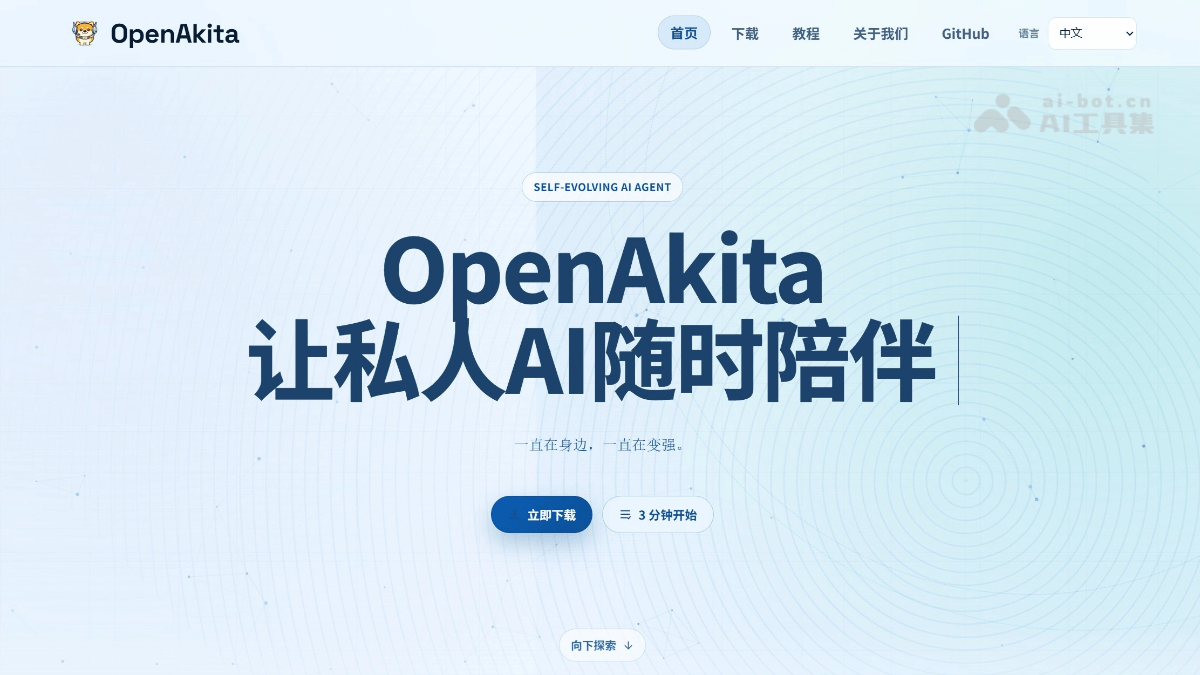
OpenAkita is an open-source self-evolving AI assistant framework. It can execute instructions like a traditional AI assistant and has a unique "self-evolution" capability that automatically performs memory consolidation, error repair, and task retrospectives. When it gets stuck, it can generate new skills on its own and install dependencies, truly becoming smarter the more it is used. The framework comes with 8 built-in personas (girlfriend, butler, Jarvis, etc.), supports proactive greetings and remembering user preferences, making interactions feel more "present." Technically, it supports dynamic hot-switching and automatic failover across 9+ LLM providers, covers 7 major IM platforms including Telegram, Feishu, DingTalk, and QQ, and may be the first AI Agent to support "meme battles."
Main features of OpenAkita
-
Self-learning and evolution: Automatically performs memory consolidation, error self-checking and repair, and task retrospectives every day. When it gets stuck, it automatically generates new skills and installs dependencies, becoming smarter the more it is used.
-
8 character personas: Provides 8 preset personas such as girlfriend, butler, and Jarvis, and supports "presence" features such as proactive greetings, remembering user preferences, and automatic nighttime muting.
-
Plan Mode: Automatically breaks down complex tasks into multi-step plans, tracks execution progress in real time, and forms a closed loop of "plan -> execute -> verify."
-
Dynamic multi-LLM support: Supports hot-switching across 9+ model providers, with priority routing and automatic failover, seamlessly switching to the next provider if one goes down.
-
Skill marketplace and MCP standard: Supports the Agent Skills / MCP open standards, allowing one-click skill installation from GitHub, plug and play.
-
Access to 7 major IM platforms: Supports Telegram, Feishu, WeCom, DingTalk, QQ official bot, OneBot, and CLI command line.
-
Meme feature: May be the first AI Agent to support "meme battles," with 5700+ built-in memes automatically matched according to mood and persona.
Technical principles of OpenAkita
-
Layered architecture design: Uses a four-layer architecture of desktop client (Tauri + React) + core layer (Brain/Memory/Ralph) + tool layer + evolution layer, decoupling the interface, logic, tools, and evolution.
-
Ralph never-give-up loop: The core execution engine, responsible for persistent task execution and error recovery, ensuring that when a task gets stuck it automatically retries or generates new skills to solve it.
-
Vector memory system: Stores long-term memory based on a vector database, supports contextual retrieval and memory consolidation, and enables cross-session memory of user preferences.
-
Prompt compiler: Dynamically compiles multi-turn dialogue context and tool invocation instructions to optimize LLM input/output efficiency.
-
Proactive engine mechanism: Triggers proactive behaviors based on time and events (such as scheduled greetings and nighttime muting), giving the Agent a "presence."
-
MCP protocol support: Follows the Model Context Protocol open standard to enable standardized integration with external tools.
-
Automatic skill generation: When encountering a task it cannot complete, it automatically generates Python skill code and installs dependencies, achieving self-expansion.
-
Multi-LLM routing strategy: Dynamically selects model providers based on priority and availability, and supports automatic failover and load balancing.
-
Daily Evolution Pipeline: Scheduled execution of tasks such as memory consolidation, error log analysis, and skill optimization, forming a "daily update" style of self-iteration.
OpenAkita's project address
- Project website:https://openakita.ai/
- Github repository:https://github.com/openakita/openakita
OpenAkita's application scenarios
-
Personal intelligent assistant: Acts as a daily AI assistant handling tasks such as schedule management, information queries, and file organization, supports multi-platform message synchronization, and understands the user's habits better the more it is used.
-
Multi-platform customer service bot: Deployed to platforms such as Telegram, Feishu, WeCom, DingTalk, and QQ, providing 24/7 automated replies and intelligent customer service.
-
Automated office assistant: Combined with planning mode to break down complex workflows and automatically execute repetitive office tasks such as email processing, report generation, and data organization.
-
Emotional companionship interaction: Through 8 persona settings such as girlfriend and butler, it provides emotionally companionable experiences such as proactive greetings, preference memory, and meme battles.
-
Development and testing tool: Developers can use its MCP standard and skill marketplace to quickly integrate custom tools, and use it as an AI Agent development framework for secondary development.
-
Smart home hub: Through tool capabilities such as Shell, browser, and desktop automation, it enables coordinated control of local devices and smart home systems.