
What is the OpenAI o1 model?
The OpenAI o1 model is OpenAI's newly released strongest reasoning series AI large model, namely the "Strawberry" strawberry large model, including an OpenAI o1-preview reasoning model, and a smaller, lower-cost version - o1 mini. OpenAI calls this release a "preview version," emphasizing that o1 is still in its early stages. The new model can achieve complex reasoning, with a general model solving problems more difficult than what previous science, code, and math models could handle.
The OpenAI o1 model is trained through reinforcement learning methods and has the ability to think deeply when handling complex tasks. The o1 model can simulate the human thought process, solve math problems, write code, and conduct scientific research, and its performance surpasses previous models in multiple professional benchmark tests. The model introduces a "Chain of Thought" mechanism, enhancing the transparency of reasoning, making the AI's decision-making process easier to understand and monitor.
Features of the OpenAI o1 model
- Reinforcement learning training: The o1 model is trained using reinforcement learning technology, making it more efficient when handling complex reasoning tasks.
- Complex reasoning ability: It can handle problems that require deep thinking and multi-step logical reasoning, especially excelling in mathematics, programming, and science.
- Chain of Thought: Before answering a question, the o1 model performs internal long-chain logical reasoning, similar to the human thought process, which helps improve its accuracy in solving problems.
- Self-correction: The model has the ability to identify and correct its own erroneous reasoning, achieved through the feedback mechanism during the training process.
- Performance improvement: In multiple professional benchmark tests, the o1 model demonstrated performance surpassing previous models, including excellent performance in the International Mathematical Olympiad (IMO) qualifying examination.
- Multimodal understanding: Although mainly focused on text, the o1 model has also shown potential for handling multimodal tasks, such as reasoning combined with visual information.
- Safety and reliability: The o1 model was designed with safety and reliability in mind, improving the model's interpretability through chain-of-thought technology, which helps monitor and prevent potential manipulation behavior.
- Cost efficiency: Compared with previous models, the o1 model seeks a balance of cost-effectiveness while providing high performance, especially with the launched o1-mini version, which aims to provide more economical reasoning capability.
Performance evaluation of the OpenAI o1 model
The OpenAI o1 model has demonstrated outstanding performance in multiple complex tasks and benchmark tests, especially in reasoning, programming, and multimodal understanding. Through reinforcement learning training, it has acquired human-like thinking and problem-solving abilities. The performance improvement of the o1 model is not only reflected at the technical level, but also provides new perspectives for the safety and reliability of AI.
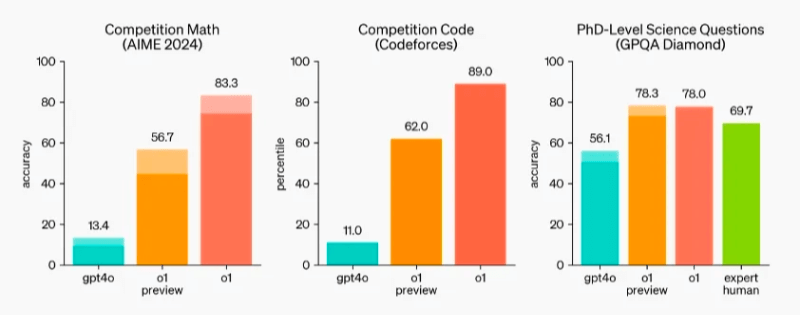
- o1 significantly outperforms GPT-4o on challenging reasoning benchmarks. Solid bars represent pass@1 accuracy, and shaded areas show the majority vote (consensus) performance of 64 samples.
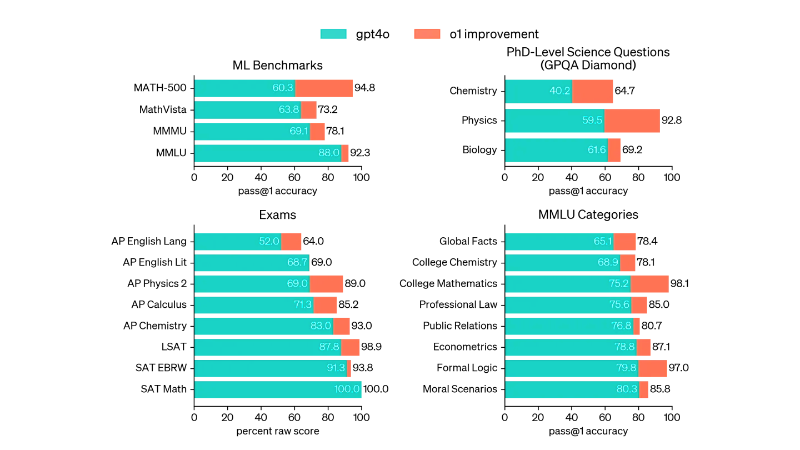
- o1 surpassed GPT-4o across a wide range of benchmarks, covering 54 of the 57 MMLU subcategories.
The American Invitational Mathematics Examination (AIME) is a highly difficult exam designed specifically to challenge the best high school math students in the United States, and can better test the limits of a model's capabilities. In the 2024 AIME exam, the performance comparison between o1 and GPT-4o:
- GPT-4o's performance: On average, it can only solve 12% of the problems (1.8 out of 15 problems).
- o1's performance:
- Single attempt: On average, solves 74% of the problems (11.1 out of 15 problems)
- Consensus from 64 samples: Accuracy improves to 83% (12.5 out of 15 problems)
- After 1000 samples, reranked using a learned scoring function: Accuracy reaches 93% (13.9 out of 15 problems)
o1's best score of 13.9 is an astonishing result. The score not only places o1 among the top 500 outstanding students in the United States, but also exceeds the qualifying cutoff for the United States of America Mathematical Olympiad.If o1 were a high school student, its math ability would be enough to qualify it for the highest-level mathematics competition in the United States。
The test results comprehensively demonstrate the powerful performance of the o1 model: it possesses depth of knowledge in professional domains comparable to human experts, while also performing excellently across numerous knowledge domains and multimodal tasks. These results not only represent a tremendous leap for artificial intelligence in general intelligence and professional applications, but also provide new opportunities for AI to solve more complex problems in the future.
How the OpenAI o1 model works
- Pretraining and fine-tuning: The o1 model is first pretrained on large-scale text datasets to learn the basic structure and patterns of language. Then, through a fine-tuning process, the model is further trained to adapt to specific tasks or domains.
- Reinforcement learning: The o1 model is trained using reinforcement learning algorithms, which guide model behavior through reward and punishment mechanisms. During training, the model tries different behaviors and optimizes its decision-making process based on the rewards it receives.
- Chain of Thought Reasoning: Before generating an answer, the o1 model constructs an internal chain of thought. This means the model thinks step by step about different aspects of the problem, tries multiple solutions, and chooses the best answer. This method simulates the human reasoning process and helps improve the accuracy and depth of answers.
- Adaptive computation: The o1 model can dynamically adjust its use of computational resources according to the complexity of the problem. When handling more complex problems, the model can allocate more computational resources for in-depth reasoning.
- Multi-step reasoning ability: The o1 model is capable of multi-step reasoning, that is, carrying out a series of logically interconnected reasoning steps before reaching a final answer. The model can solve problems that require in-depth analysis and understanding.
- Self-supervised learning: During training, the o1 model uses self-supervised learning techniques to improve its understanding of data by predicting or generating certain parts of the data.
- Error identification and correction: The o1 model has the ability to identify errors in its own reasoning process and correct them. This is achieved by introducing an error feedback mechanism during training, which helps improve the model's accuracy.
- Safety and alignment: When designing the o1 model, OpenAI also considered the model's safety and alignment with human values. By integrating safety rules and values into training, the model makes decisions that meet human expectations in practical applications.
Pricing of the OpenAI o1 model
Prices are converted based on the current exchange rate. Actual prices may vary depending on OpenAI's pricing strategy and exchange rate fluctuations.
- o1-preview model:
- Input price: $15 per million tokens, approximately 106.76 RMB.
- Output price: $60 per million tokens, approximately 427.03 RMB.
- o1-mini model:
- Input price: $3 per million tokens, approximately 21.35 RMB.
- Output price: $12 per million tokens, approximately 85.41 RMB.
How to use the OpenAI o1 model
- Official website introduction:https://openai.com/o1/
- Access the o1 service:
- If you want to use o1 through the chat interface, you can choose "Try it in ChatGPT Plus".
- If you are a developer and want to integrate o1 into an application, you can choose "Try it in the API".
- Configuration and usage:
- For ChatGPT Plus, you need to configure it according to the instructions on the page and select the desired features or settings.
- For API usage, you need to read the API documentation to understand how to call the interface, set the necessary parameters, and how to receive and process the returned data.
Application scenarios of the OpenAI o1 model
The core application scenarios of the OpenAI o1 model mainly revolve around its capabilities in complex reasoning, multi-step logical analysis, and advanced cognitive tasks. The following are some of the main application scenarios:
- Scientific research:The o1 model can assist scientists in data analysis, model construction, and theoretical derivation, especially in fields involving the understanding of large amounts of literature and complex calculations.
- Software development:In software development, the o1 model can help developers debug code, optimize algorithms, generate code snippets, and participate in software design decisions.
- Educational tutoring:As an educational tool, the o1 model can provide personalized learning support, answer complex questions, and assist students and teachers in teaching and learning in the STEM field.
- Medical diagnosis and research:In the medical field, the o1 model can assist in analyzing cases, providing diagnostic suggestions, and participating in drug development and gene sequence analysis.
- Legal analysis:The o1 model can analyze legal documents, provide case study support, and assist in legal research and contract analysis.
- Financial analysis:In the financial industry, the o1 model can be used for market trend analysis, risk assessment, investment strategy formulation, and decision support for complex transactions.