
What is CriticGPT
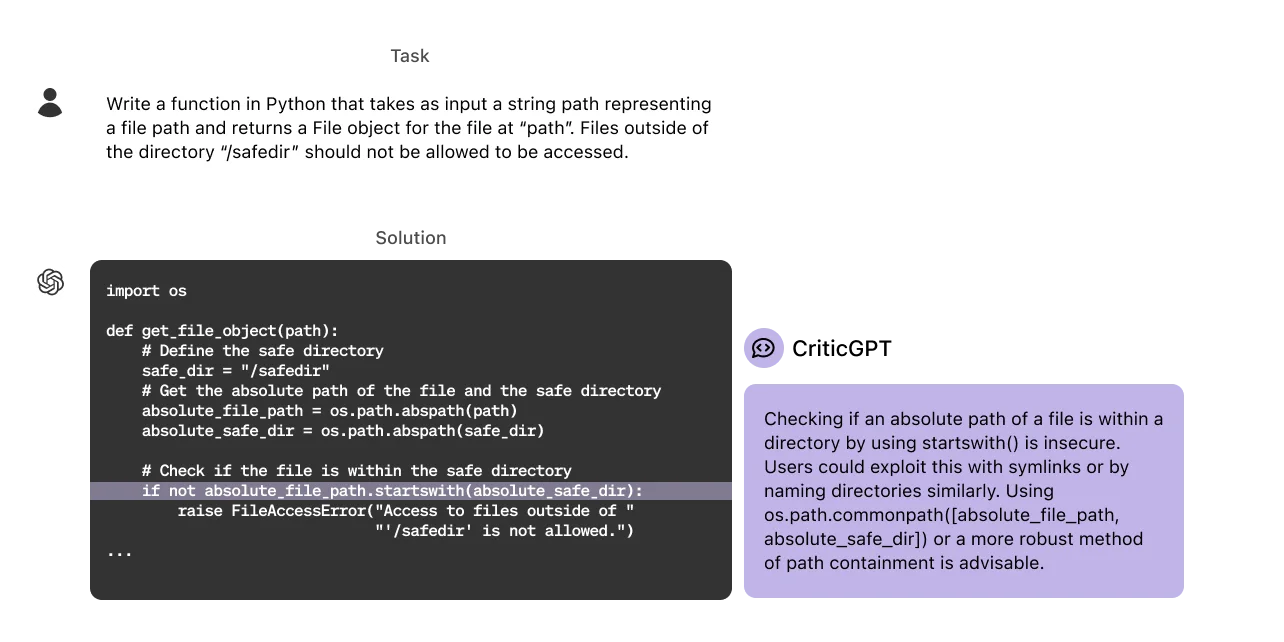
CriticGPT is a new artificial intelligence model released by OpenAI, built on GPT-4, specifically designed to review and identify errors in code generated by large language models (such as ChatGPT). CriticGPT uses reinforcement learning from human feedback (RLHF) technology to improve the accuracy and efficiency of code review, and can identify and explain potential issues in AI output, helping to improve code quality and security. When using CriticGPT, human evaluators performed better than without AI assistance in 60% of cases. The development of CriticGPT is a major advance in the AI field; it not only enhances AI models' self-correction capabilities, but also provides new possibilities for collaboration between AI and humans.

CriticGPT's main features
- Code review: Automatically reviews code generated by other AI models and identifies potential logic errors and security vulnerabilities.
- Error identification: Detects syntax errors, runtime errors, and possible programming mistakes in code.
- Security vulnerability analysis: Specifically analyzes code to find vulnerabilities that may lead to security issues, such as path traversal, injection attacks, etc.
- Feedback generation: Provides developers with specific error feedback and improvement suggestions to help them understand and fix issues.
- Performance evaluation: Evaluates whether AI-generated code meets expected standards in terms of performance.
- Assisted learning: Helps developers and AI trainers learn and improve by providing error examples and correct practices.
How CriticGPT works
- Error injection: First, through a method called "tampering," human evaluators deliberately insert subtle errors into AI-generated code, and then record detailed descriptions of these errors. This process is similar to the way errors are found and recorded during code review.
- Training data generation: These tampered code samples and corresponding error descriptions are used to train CriticGPT so that it can identify and point out various potential issues.
- Comment generation: CriticGPT receives a question and corresponding answer as input, and then generates a comment pointing out specific errors in the answer. The structure of the comment usually contains multiple parts, each commenting on a specific quotation in the original answer.
- Policy optimization: Uses the Proximal Policy Optimization (PPO) algorithm to optimize CriticGPT's behavioral policy, allowing the model to effectively learn how to improve its output while keeping policy updates relatively small.
- Inference sampling strategy: Introduces a technique called "forced sampling beam search" (FSBS), which forces the model to produce specific highlighted parts when generating comments, and then selects the best comment based on the reward model's score. This method allows the model to reduce the generation of false issues when generating longer and more comprehensive comments.
- Performance evaluation: CriticGPT's output is evaluated to determine its performance in detecting code errors and its advantages compared with human evaluators.
Advantages of CriticGPT
- Improved accuracy: By enhancing RLHF, CriticGPT significantly improves the accuracy of AI model output, especially in code review, where it can find many issues that are difficult for humans to discover.
- Reduce errors: It can help reduce errors in code, especially those that become more hidden due to increased model complexity.
- Improve efficiency: CriticGPT can automatically review code, reducing the time and workload required for manual review.
- Enhance security: By identifying security vulnerabilities in code, CriticGPT helps improve the security of software products.
- Assist human evaluators: CriticGPT can serve as an auxiliary tool for human evaluators, improving the efficiency and quality of their code review.
- Self-learning and optimization: CriticGPT uses the PPO algorithm for policy optimization and can continuously learn and improve its error detection capabilities.
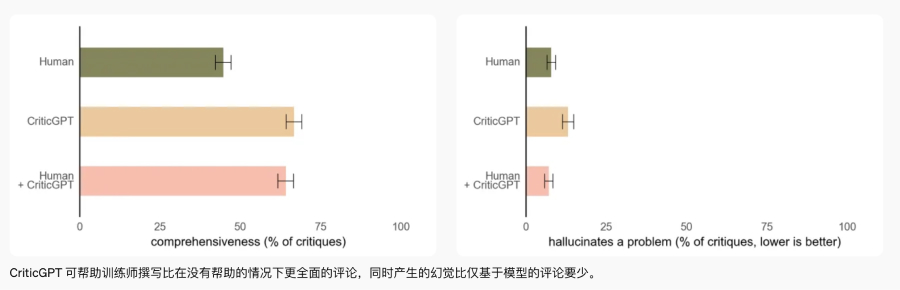
- Reduce hallucinations: CriticGPT helps reduce hallucinations or false errors generated during the evaluation process, improving the reliability of the evaluation.
- Comprehensiveness: Through the FSBS technique, CriticGPT can generate more comprehensive and detailed comments while avoiding trivial issues or errors.
- Improve training data quality: The use of CriticGPT helps generate higher-quality training data and further optimize AI models.
- Strong adaptability: CriticGPT's design enables it to adapt to different AI outputs and tasks, with good generalizability.
CriticGPT's shortcomings
- Complexity limitations: CriticGPT may face challenges when handling extremely complex tasks, especially when errors are distributed across multiple parts of the code.
- Short-answer training: The model is mainly trained on shorter code snippets and may perform poorly when handling longer, more complex tasks.
- Hallucination problem: Although CriticGPT reduces the generation of hallucination errors, there is still a risk of outputting incorrect content that misleads humans.
- Single-error focus: Currently, CriticGPT mainly focuses on single-point errors and may not identify errors spanning multiple code segments well enough.
- Scope of application: CriticGPT mainly targets code review; for other types of AI output (such as text, images, etc.), further adjustment and optimization may be needed.
- Dependence on training data: CriticGPT's performance depends to a large extent on the quality and diversity of the training data. If the training data is biased, it may affect the model's accuracy.