
What is OmniThink
OmniThink is an innovative machine writing framework jointly developed by Zhejiang University and Alibaba Tongyi Lab. It breaks through the knowledge boundaries of large language models in machine writing by simulating the human iterative expansion and reflection process. Through the structured organization of an information tree and concept pool, the framework gradually deepens understanding of the topic and generates high-quality long-form articles. The core advantage of OmniThink lies in its unique iterative expansion and reflection mechanism, which can effectively improve the knowledge density of generated articles, reduce redundant information, and maintain the coherence and depth of the articles. Experimental results show that OmniThink significantly outperforms traditional methods in terms of knowledge density, content richness, and novelty.
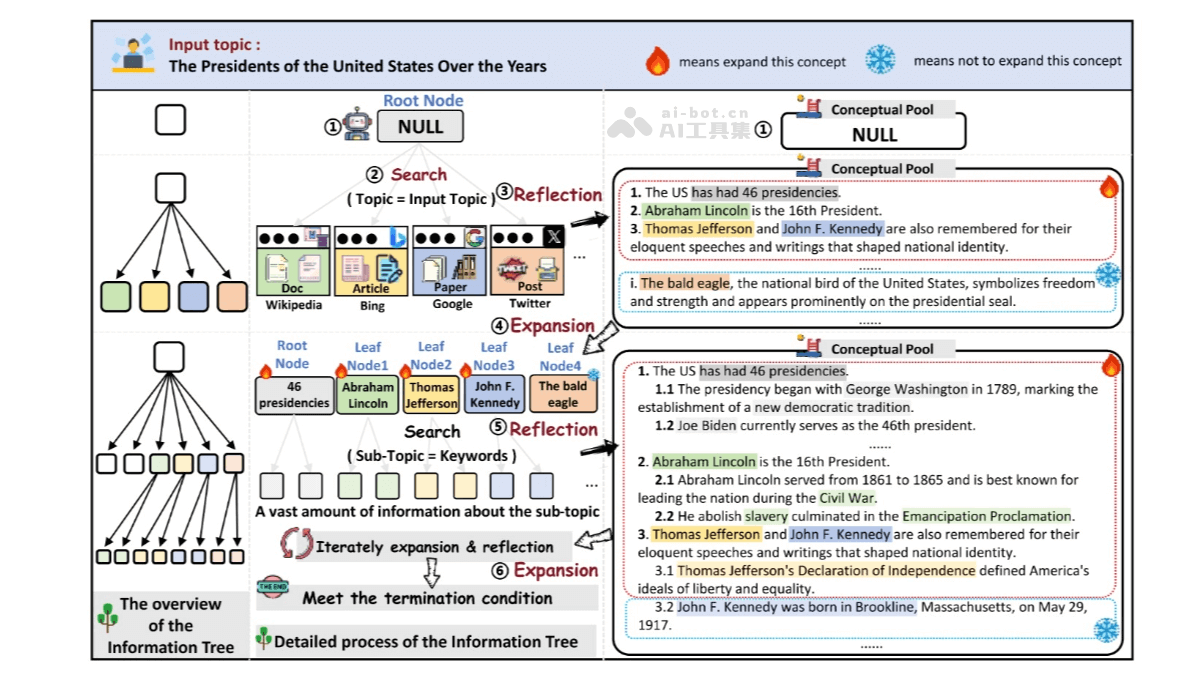
Main Features of OmniThink
- Knowledge Boundary Expansion: By simulating how human learners gradually deepen their understanding of a topic, OmniThink can go beyond the model's predefined knowledge scope and generate content that is richer in information and greater in depth.
- Improved Information Depth and Practicality: It addresses the problem of retrieved information lacking depth and practicality in traditional methods, and avoids generating articles that are shallow, repetitive, and lacking originality.
- High-Quality Long-Form Article Generation: While maintaining key indicators such as coherence and depth, it improves the knowledge density of articles and generates grounded, high-quality long documents.
- Knowledge Density Metric: It introduces the Knowledge Density metric to measure the information richness and uniqueness of generated articles, providing a new perspective for evaluating machine writing performance.
- Structured Information Management: It organizes knowledge through an information tree and concept pool, enabling structured information management, optimizing long-text generation, reducing redundancy, and improving knowledge transfer efficiency.
- Support for Multiple Language Models: OmniThink supports multiple language models as backends and can adjust parameters according to requirements, improving the diversity and adaptability of generated content.
Technical Principles of OmniThink
- Iterative Expansion and Reflection Mechanism: OmniThink simulates how human learners gradually deepen their understanding of a topic and adopts a "reflection-expansion" mechanism. In the information acquisition stage, the framework analyzes existing information tree nodes, determines the nodes that need further expansion, and retrieves relevant information for updating. Then, through the reflection process, it analyzes, filters, and synthesizes the newly retrieved information, distills core insights, and updates the concept pool to provide guidance for the next expansion step.
- Construction of Information Tree and Concept Pool: OmniThink constructs an information tree and concept pool during the information acquisition stage. The information tree is used to organize and expand the knowledge structure related to the topic, while the concept pool stores core concepts and insights. This makes the generated articles more logical and deeper.
- Knowledge Density Optimization: OmniThink introduces the "knowledge density" metric to optimize the quality and depth of content by measuring the proportion of unique and meaningful information in generated articles. Based on the combination of the Factscore tool and the GPT model, the framework performs atomic knowledge unit decomposition and deduplication on generated articles to improve their information richness.
- Model Agnosticism and Flexibility: The OmniThink framework does not depend on a specific language model and can be integrated with a variety of large language models (LLMs), offering good generality and extensibility.
- Multi-Stage Generation Process: OmniThink's generation process is divided into three stages: information acquisition, outline construction, and article writing. First, it builds a knowledge framework through iterative expansion and reflection, then generates an outline, and finally writes a coherent, high-quality article based on the outline.
StereoCrafter's project address
- Project website:https://zjunlp.github.io/project/OmniThink/
- GitHub repository:https://github.com/zjunlp/OmniThink
- arXiv technical paper:https://arxiv.org/pdf/2501.09751
OmniThink's application scenarios
- Academic writing: OmniThink can help researchers quickly generate high-quality academic papers, review articles, and research reports. Through its iterative expansion and reflection mechanism, it can deeply explore multiple aspects of a topic and generate content with greater depth and breadth.
- News reporting: In the news field, OmniThink can provide journalists with news articles that possess both depth and breadth. It can quickly integrate information, generate coherent and information-rich articles, and reduce the repetitive labor of manual writing.
- Educational content creation: OmniThink can be used to generate educational textbooks, course outlines, and study guides. By expanding the boundaries of knowledge, it can provide students with richer learning resources and help them better understand and master knowledge.
- Knowledge-intensive content creation: In industries such as technology, finance, and healthcare, OmniThink can generate analytical reports, industry white papers, and more that cover a large amount of knowledge and information.