
What is OmniTalker
OmniTalker is a real-time text-driven talking avatar generation technology released by Alibaba. It can simultaneously process multiple modal inputs such as text, images, audio, and video, and generate natural speech responses in a streaming manner. Its core architecture is the Thinker-Talker architecture. The Thinker is responsible for processing multimodal inputs and generating semantic representations and text content, while the Talker converts this information into fluent speech output. OmniTalker adopts TMRoPE (Time-aligned Multimodal Rotary Position Embedding) technology to ensure precise synchronization between video and audio inputs.
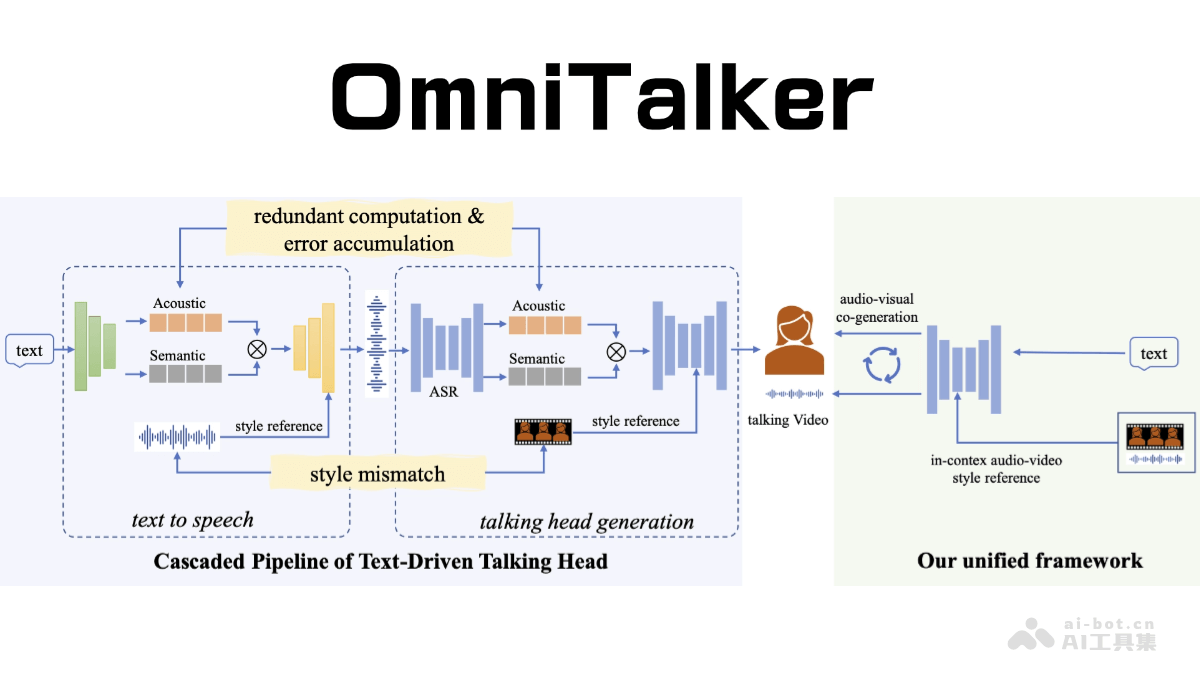
Main features of OmniTalker
- Multimodal input processing: It can perceive multiple modalities such as text, images, audio, and video.
- Streaming generation of text and speech responses: It generates text and natural speech responses in a streaming manner. The audio and video encoders use a chunk-based processing method, decoupling the processing of long-sequence multimodal data.
- Precise audio-video synchronization: By proposing TMRoPE (Time-aligned Multimodal RoPE) technology, it organizes audio and video sequentially in an interleaved manner, achieving precise synchronization of inputs.
- Real-time interaction: It supports chunked input and instant output, enabling fully real-time interaction.
- Natural and fluent speech generation: It performs excellently in the naturalness and stability of speech generation, surpassing many existing streaming and non-streaming alternatives.
- Performance advantages: It performs well in multimodal benchmarks, with audio capabilities superior to Qwen2-Audio of similar size and on par with Qwen2.5-VL-7B.
Technical principles of OmniTalker
- Thinker-Talker architecture: OmniTalker adopts the Thinker-Talker architecture, in which the Thinker is responsible for processing multimodal inputs (including text, images, audio, and video) and generating high-dimensional semantic representations and text content; the Talker, based on the semantic representations and text provided by the Thinker, generates natural speech responses in a streaming manner. This avoids interference between text generation and speech generation, ensuring consistency and real-time performance of semantic expression.
- Thinker: Based on the Transformer decoder architecture, equipped with audio and image encoders, responsible for the extraction and understanding of multimodal information.
- Talker: It adopts a dual-track autoregressive Transformer decoder structure and directly uses the Thinker's high-dimensional semantic representations to generate speech tokens, ensuring the naturalness and fluency of speech output.
- TMRoPE (Time-aligned Multimodal Rotary Position Embedding): To solve the problem of temporal synchronization of audio-video inputs, OmniTalker proposes TMRoPE technology. By interleaving audio and video frames in chronological order and performing position encoding, it ensures that information from different modalities seamlessly connects on the time axis. This enables the model to more accurately understand and generate audio-video content.
- Streaming processing: OmniTalker supports streaming input and output, and can process multimodal information in real time and respond quickly. The audio and visual encoders use a chunk-based processing method, decomposing long-sequence data into small chunks for processing, reducing latency and improving efficiency.
- Chunked prefill: The audio encoder uses a 2-second chunked attention mechanism, and the visual encoder uses flash attention with an added MLP layer to improve efficiency.
- Sliding window DiT model: Used for streaming generation of mel spectrograms, further supporting high-quality streaming speech generation.
- End-to-end training: The Thinker and Talker modules are jointly trained in an end-to-end manner, sharing historical context information. This avoids errors that may accumulate between separately trained modules, ensuring the model's overall performance and consistency.
- Efficient speech generation: OmniTalker's speech generation module uses an efficient speech codec (qwen-tts-tokenizer) to stream-generate audio tokens in an autoregressive manner. It reduces data requirements and inference difficulty, and improves the naturalness and robustness of speech generation.
OmniTalker's project address
- Project official website:https://humanaigc.github.io/omnitalker/
- arXiv technical paper:https://arxiv.org/pdf/2504.02433v1
OmniTalker's application scenarios
- Intelligent voice assistant: OmniTalker's real-time audio-video interaction capability and natural and fluent speech generation capability make it an ideal intelligent voice assistant. It can process users' voice commands and generate voice responses in real time, providing users with a more natural and convenient interaction experience.
- Multimodal content creation: In the field of content creation, OmniTalker can simultaneously process text, image, and video inputs and generate corresponding text or speech descriptions.
- Education and training: OmniTalker can be used in the fields of education and training to provide students with a richer and more personalized learning experience by processing inputs in multiple modalities.
- Intelligent customer service: In the field of intelligent customer service, OmniTalker can process customers' voice or text questions in real time and generate accurate responses. It can improve customer service efficiency and enhance the customer experience.
- Industrial quality inspection: In the manufacturing field, OmniTalker can detect defective parts on the assembly line in real time by simultaneously processing product appearance images and process parameter text.