
What Is OmniManip
OmniManip is a general robotic manipulation framework developed by the Joint Laboratory of Peking University and AGIBOT. By combining the high-level reasoning capabilities of vision-language models (VLMs) with precise 3D manipulation capabilities, it enables general-purpose manipulation by robots in unstructured environments. The core of the framework lies in an object-centric interaction primitive representation, which decomposes tasks into multiple structured stages and, based on the commonsense reasoning capabilities provided by VLMs, transforms natural language instructions into executable 3D spatial constraints.
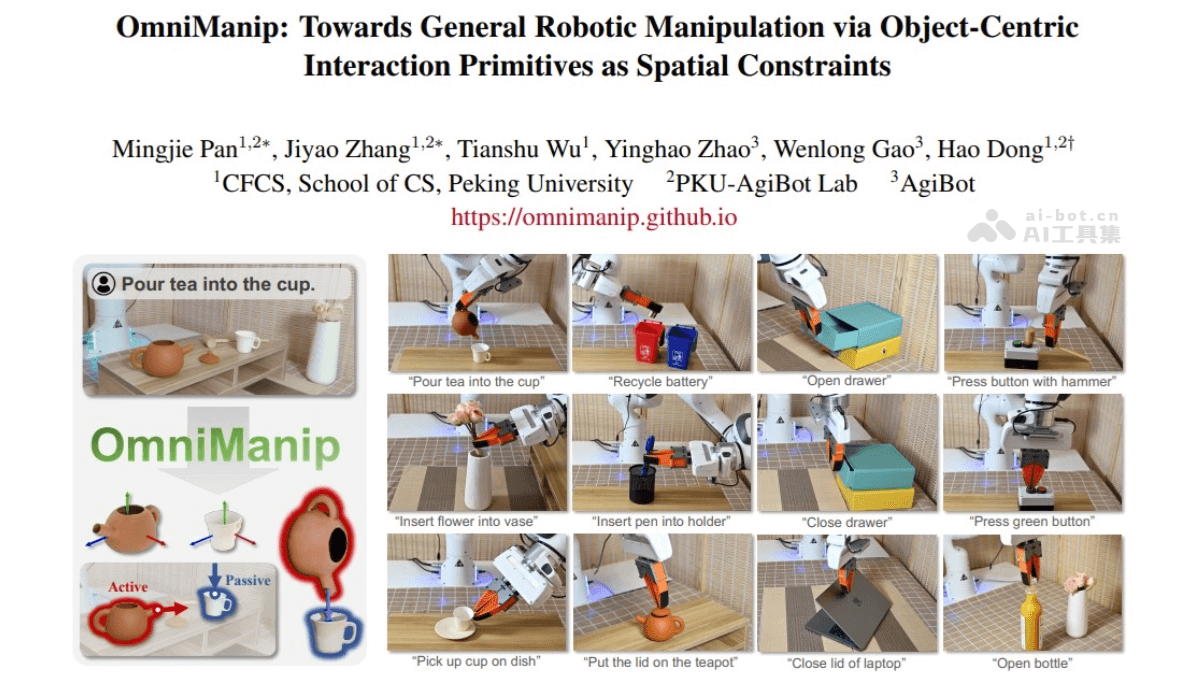
Main Features of OmniManip
- Zero-Shot Generalization Capability: OmniManip can handle diverse open-vocabulary instructions and objects, achieving strong generalization across a variety of robotic manipulation tasks without training.
- Cross-Robot Embodiment Capability: OmniManip is a hardware-agnostic method that can be easily deployed on different types of robot platforms, such as dual-arm humanoid robots.
- Large-Scale Simulation Data Generation: OmniManip is designed to automatically generate large-scale robotic manipulation simulation data, providing strong data support for future research.
Technical Principles of OmniManip
- Object-Centric Interaction Primitive Representation: OmniManip proposes an object-centric representation method that defines interaction primitives (such as interaction points and directions) through the object's functional canonical space, transforming the output of VLMs into executable 3D spatial constraints. These interaction primitives are defined in the object's canonical space and can remain consistent across different scenarios, enabling more general and reusable manipulation strategies.
- Dual Closed-Loop System Design: OmniManip adopts a dual closed-loop system, respectively used for high-level planning and low-level execution:
- Closed-Loop Planning: Through interactive rendering and interaction primitive resampling, OmniManip achieves closed-loop reasoning with VLMs. This mechanism can detect and correct errors in VLM reasoning (such as hallucination issues), ensuring the accuracy of planning results.
- Closed-Loop Execution: In the execution stage, OmniManip uses a 6D pose tracker to update the object's pose in real time and converts it into manipulation trajectories for the robotic arm's end effector, thereby achieving robust real-time control.
- Task Decomposition and Spatial Constraints: OmniManip decomposes complex tasks into multiple stages, with each stage defining spatial constraints through interaction primitives. For example, in the task of "pouring tea into a cup," the system decomposes it into two stages, "grasping the teapot" and "pouring the tea," and generates the corresponding interaction points and directions for each stage.
OmniManip Project Address
- Project Website:https://omnimanip.github.io/
- GitHub Repository:https://github.com/pmj110119/OmniManip
- arXiv Technical Paper:https://arxiv.org/pdf/2501.03841
Application Scenarios of OmniManip
- Object Manipulation in Daily Life: Such as pouring tea, flower arranging, tidying up a desktop, etc.
- Industrial Automation: Achieving automation of complex tasks through precise 3D manipulation capabilities.
- Service Robots: Executing tasks in unstructured environments, such as home services or medical assistance.