
What is OmniHuman
OmniHuman is an end-to-end multimodal conditional humanvideo generationframework launched by ByteDance, capable of generating realistic human videos based on a single human image and motion signals (such as audio, video, or a combination of both). OmniHuman is based on a multimodal motion condition hybrid training strategy, overcoming the performance bottleneck caused by the scarcity of high-quality data in previous methods. It supports image inputs of any aspect ratio (including portraits, half-body, and full-body images) and can adapt to various scenarios. OmniHuman performs excellently in singing, dialogue, gesture processing, etc., supports multiple visual and audio styles, and is compatible with audio, video, and combined driving, generating high-quality video content.
OmniHuman's main features
- Multimodal-driven video generation:
- Supports audio-driven (such as speaking, singing) and pose-driven (such as gestures, movements), and can combine both for hybrid driving, generating natural and smooth human motion videos.
- Supports multiple input forms, including facial close-ups, half-body portraits, and full-body portraits, compatible with images of different ratios and styles.
- High realism and diverse actions:
- The generated videos are highly realistic visually, with natural facial expressions, body movements, and smooth dynamic effects.
- Can handle complex actions and object interactions, such as playing an instrument while singing, natural interaction between gestures and objects, etc.
- Flexible video generation:
- Supports video generation with any aspect ratio and duration, generating video clips of different lengths based on input signals.
- Compatible with multiple image styles, including realistic, cartoon, and stylized characters.
- Multi-scenario adaptability: Generates high-quality videos in various scenarios, including different backgrounds, lighting conditions, and camera angles.
OmniHuman's technical principles
- Hybrid condition training strategy:
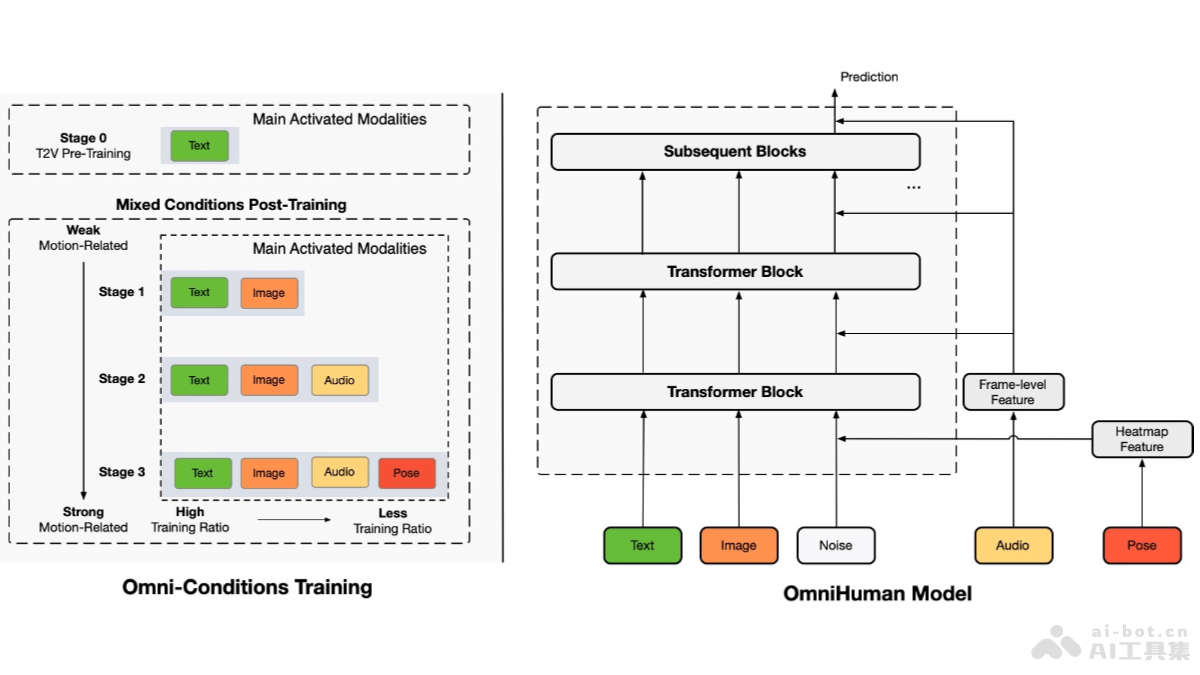
- Multi-condition fusion: Mixes multiple motion-related conditions such as text, audio, and pose into the training process, reducing waste caused by data filtering and utilizing the complementarity between different conditions.
- Staged training: Based on a three-stage training strategy, gradually introduces different conditions (text, audio, pose), adjusts the training ratio according to the strength of the conditions, and optimizes the model's generalization ability.
- Training principles: Tasks with stronger conditions use tasks with weaker conditions and their corresponding data to expand the data scale. The stronger the condition, the lower the training ratio should be, to avoid the model overly relying on strong conditions.
- Diffusion Transformer architecture:
- DiT-based model: OmniHuman is based on the advanced video generation model architecture DiT, using Causal 3DVAE (Causal 3DVAE) to project videos into latent space, and based on Flow Matching as the training objective.
- Condition injection:
- Audio condition: Uses the wav2vec model to extract audio features, combines them with video frame features, generates audio tokens (tokens), and injects them into the model based on the cross-attention mechanism.
- Pose condition: Uses a Pose Guider to process pose conditions, combines pose heatmap features with video frame features, generates pose tokens (tokens), and inputs them into the model together with the noisy latent representation.
- Text condition: retains the text branch in the DiT architecture, used to describe the content of the generated video.
- Reference condition processing: adopts an innovative reference condition strategy, based on a modified 3D rotary position embedding (RoPE), fusing reference image features with video features without the need for additional network modules.
- Inference strategy:
- Classifier-free guidance (CFG): during inference, a CFG strategy is applied to audio and text conditions, based on gradually reducing CFG strength, balancing expressiveness and computational efficiency, and reducing artifacts (such as wrinkles) in the generated video.
- Long video generation: uses the last few frames of the previous video segment as motion frames to ensure temporal coherence and identity consistency in long video generation.
OmniHuman project address
- Project website:https://omnihuman-lab.github.io/
- arXiv technical paper:https://arxiv.org/pdf/2502.01061
OmniHuman application scenarios
- Film, television, and entertainment: generates virtual character animations, virtual streamers, music videos, etc., improving content production efficiency and visual effects.
- Game development: generates natural movements for game characters and NPCs, enhancing game immersion and interactivity.
- Education and training: creates virtual teachers and simulated training videos to assist with language learning and vocational skills training.
- Advertising and marketing: generates personalized advertisements and brand promotion videos, improving user engagement and content appeal.
- Social media and content creation: helps creators quickly generate high-quality short videos, supports interactive video creation, and increases content interest.