
What Is OmniFlow
OmniFlow is a multimodal AI model jointly launched by Panasonic and the University of California, Los Angeles (UCLA). The model can perform any-to-any generation tasks among text, images, and audio, such as converting text into images or audio, or converting audio into images. OmniFlow extends the existing image generation flow matching framework, based on connecting and processing features from three different data types, learning complex data relationships, and avoiding the limitations of simply averaging features from different modalities. The model uses a modular design, supports independent pretraining and fine-tuning, and significantly improves training efficiency and model scalability. OmniFlow demonstrates strong performance and flexibility in the field of multimodal generation.
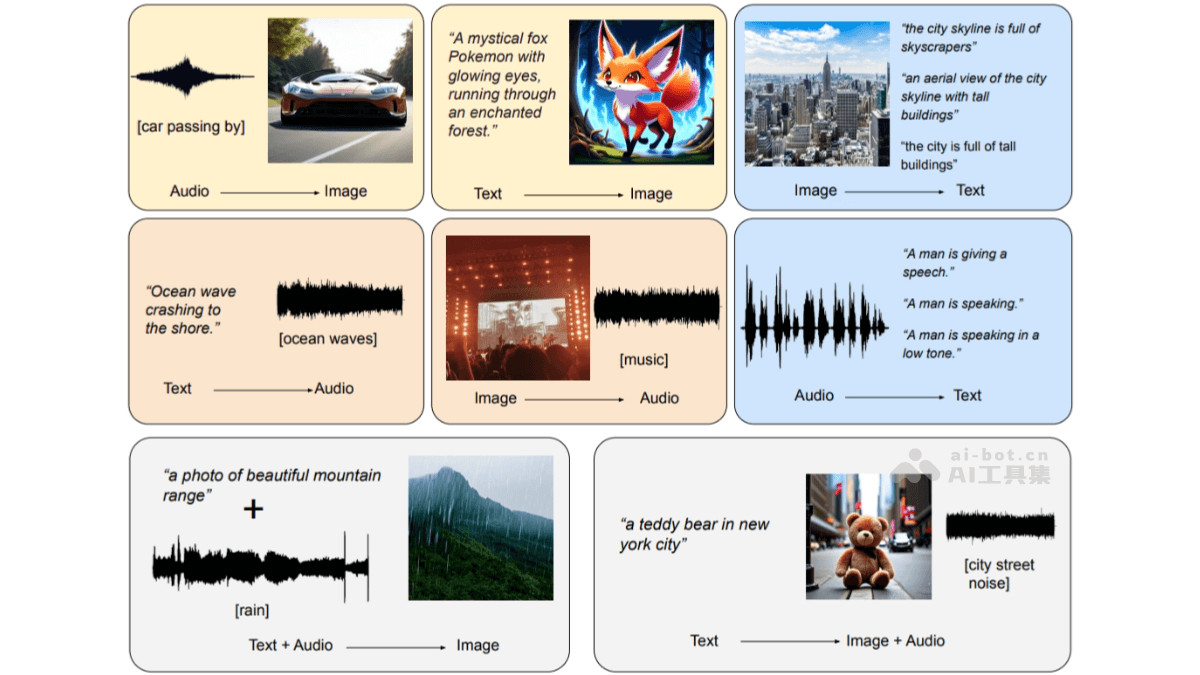
OmniFlow's Main Features
- Any-to-Any Generation: Supports mutual conversion and generation among text, images, and audio.
- Text-to-Image: Generates corresponding images based on text descriptions.
- Text-to-Audio: Converts text content into speech or music.
- Audio-to-Image: Generates related images based on audio content.
- Multimodal Input to Unimodal Output: Supports input combinations of multiple modalities, such as text + audio to generate images.
- Multimodal Data Processing: Can simultaneously process data from multiple modalities such as text, images, and audio, and supports complex multimodal generation tasks.
- Flexible Generation Control: Based on a multimodal guidance mechanism, users can flexibly control the alignment and interaction between different modalities during the generation process, such as emphasizing a certain element in an image or adjusting the tone of audio.
- Efficient Training and Scaling: Based on a modular design, supports independent pretraining of components for each modality, and merges them for fine-tuning when needed, significantly improving training efficiency and model scalability.
OmniFlow's Technical Principles
- Multi-Modal Rectified Flows: OmniFlow extends the Rectified Flow framework for handling the joint distribution of multimodal data. Based on connecting and processing features from three different data types (text, images, audio), OmniFlow can learn complex data relationships and avoid the limitations of simply averaging features from different modalities. The rectified flow framework supports the model in gradually reducing noise during the generation process to generate high-quality target modality data.
- Modular Design: Based on a modular architecture, the text, image, and audio processing modules are designed independently. After pretraining is completed, the modules can be flexibly merged and fine-tuned to adapt to specific multimodal generation tasks.
- Multimodal Guidance Mechanism: OmniFlow introduces a multimodal guidance mechanism that supports users in controlling the alignment and interaction between different modalities during the generation process by adjusting parameters.
- Joint Attention Mechanism: OmniFlow is based on a joint attention mechanism that supports direct interaction between features from different modalities. During the generation process, the model can dynamically focus on the correlations between different modalities to generate more consistent and high-quality results.
OmniFlow's Project Address
- Project Official Website:https://news.panasonic.com/global/press/en250604-4
- arXiv Technical Paper:https://arxiv.org/pdf/2412.01169
OmniFlow's Application Scenarios
- Creative Design: Generate images or design elements based on text descriptions, helping designers quickly gain inspiration, for example, generating advertising posters, artworks, etc.
- Video Production: Generate video content by combining text and audio, or generate related visual effects based on audio, for use in short video creation, animation production, etc.
- Writing Assistance: Generate text descriptions based on image or audio content, helping creators write articles, scripts, or stories.
- Game Development: Generate game scenes, character designs, or sound effects based on game story text, accelerating the game development process.
- Music Creation: Generate music based on text descriptions or images, creating soundtracks for movies, games, or advertisements.