
What is OmniEdit
OmniEdit is an advanced image editing technology that trains a general model by combining the supervision of multiple expert models to handle a variety of image editing tasks. It can process images of different aspect ratios and seven different image editing tasks, including object replacement, removal, addition, etc., and supports arbitrary aspect ratios and resolutions. Supervised training based on seven expert models ensures task coverage, and large multimodal model scoring is used to improve training data quality. It adopts the new EditNet architecture, improving editing success rates. OmniEdit significantly outperforms existing models (including InstructPix2Pix, MagicBrush, UltraEdit, etc.) in both automatic and human evaluations, accurately following instructions while maintaining the fidelity of the original image.
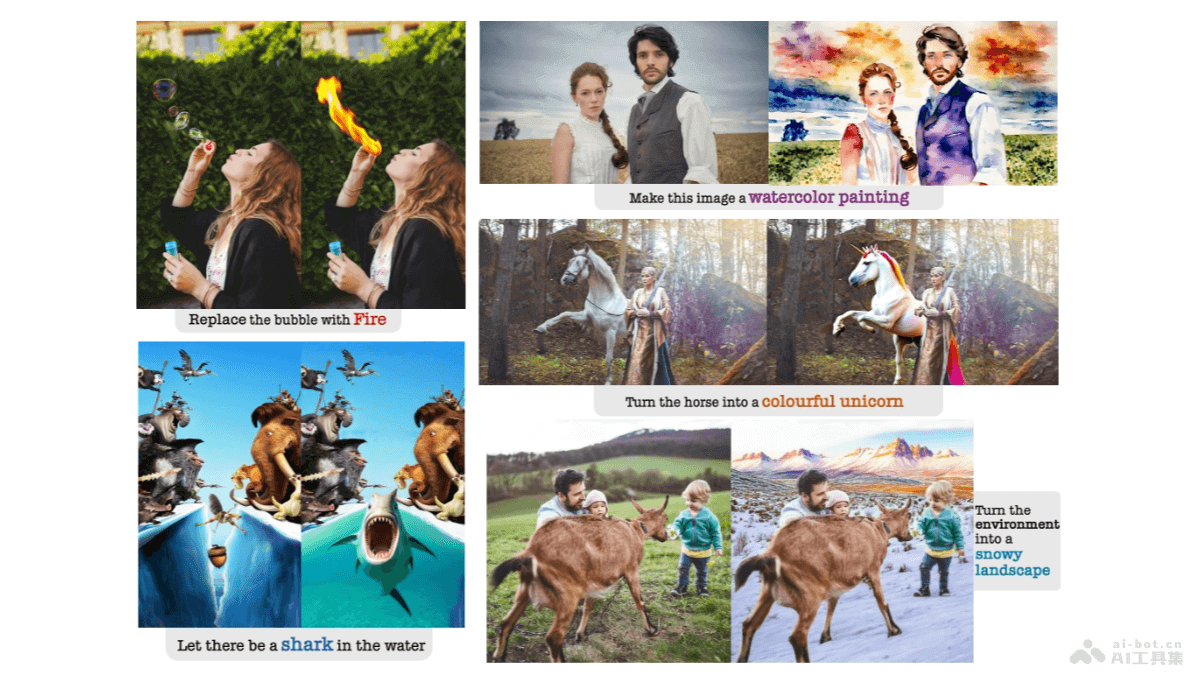
OmniEdit's Main Features
- Multi-Task Editing Capability: OmniEdit can perform seven different image editing tasks, including object replacement, object removal, object addition, attribute modification, background replacement, environment change, and style transfer.
- Expert Model Supervision: OmniEdit is trained based on the supervision of seven different expert models, ensuring task coverage.
- Support for Arbitrary Aspect Ratios and Resolutions: The model can process images of different aspect ratios and resolutions, making it suitable for various real-world scenarios.
- Instruction-Driven Editing: Users guide OmniEdit to perform specific image edits based on text instructions, improving editing flexibility and user control.
- High-Quality Image Output: During the editing process, OmniEdit can maintain the high fidelity of the original image, reducing noise and artifacts.
- Data Quality Control: Large multimodal models are used to score synthetic samples, improving the quality of training data.
OmniEdit's Technical Principles
- Supervised Learning from Experts to a General Model: The supervision signals of multiple expert models train a general editing model, with each expert model focusing on a specific editing task.
- Importance Sampling: Large multimodal models (such as GPT-4o) score the quality of synthetic samples and perform importance sampling to improve the quality of the training dataset.
- EditNet Architecture: Based on a diffusion-transformer architecture, it uses interaction of intermediate representations to support interaction between the control branch and the original branch, enhancing the model's understanding of editing tasks.
- Support for Arbitrary Aspect Ratios: During training, images with different aspect ratios are included to ensure that the model can adapt to the aspect ratio of any image.
OmniEdit's Project Address
- GitHub Repository:https://github.com/TIGER-AI-Lab/OmniEdit
- HuggingFace Model Library:https://huggingface.co/collections/TIGER-Lab/omniedit-6732d8e381c3e56b0a2106d5
- arXiv Technical Paper:https://arxiv.org/pdf/2411.07199
OmniEdit's Application Scenarios
- Professional Image Editing: Designers and artists carry out efficient image editing work, including advertising design, artistic creation, photo restoration, etc.
- Social Media Content Creation: Social media users quickly edit and beautify images, increasing the attractiveness of content.
- E-Commerce: Online merchants edit product images, such as changing backgrounds and adjusting styles, to improve the market appeal of products.
- News and Media: News organizations quickly adjust news images to adapt to different publishing needs and styles.
- Education and Training: In the field of education, as a teaching tool, it helps students learn image editing and visual design.