
What Is OmniCorpus
OmniCorpus is a large-scale multimodal dataset containing 8.6 billion images and 1.696 trillion text tokens, with Chinese-English bilingual support. It was jointly built by Shanghai AI Laboratory together with multiple well-known universities and research institutions. By integrating textual and visual content from websites and video platforms, OmniCorpus provides rich data diversity. Compared with existing datasets, OmniCorpus has significantly improved in both scale and quality, advancing research and applications of multimodal large language models. The dataset is publicly available on GitHub and is suitable for a variety of machine learning tasks.
Main Features of OmniCorpus
- Multimodal Learning Support: Combines image and text data to support the training and research of multimodal machine learning models, such as image recognition, visual question answering, and image captioning.
- Large-Scale Dataset: Provides a large amount of image and text data, helping train and test large multimodal models and improving their generalization ability and performance.
- Data Diversity: Covers data from multiple sources and types, including content in different languages and domains, increasing the diversity and application scope of the dataset.
- Flexible Data Formats: Supports streaming data formats and can adapt to different data structures, such as plain text corpora, image-text pairs, and interleaved data formats.
- High-Quality Data: Ensures the high quality of the dataset through an efficient data engine and human feedback filtering mechanisms, reducing noise and irrelevant content.
Technical Advantages of OmniCorpus
- Large-Scale Data Integration: Integrates 8.6 billion images and 1.696 trillion text tokens, making it one of the largest multimodal datasets currently available.
- Efficient Data Engine: Developed an efficient data pipeline that can process and filter large-scale multimodal data, ensuring fast processing and high-quality output.
- Rich Data Diversity: Data comes from multiple languages, different types of websites, and video platforms, providing broad data diversity.
- Flexible Data Formats: Uses streaming data formats and can easily adapt to different data structures and research needs.
- High-Quality Data Assurance: Improves the overall quality of the dataset through detailed preprocessing steps and human feedback mechanisms.
- Advanced Filtering Techniques: Uses the BERT model and human feedback to optimize text filtering and reduce irrelevant content and noise.
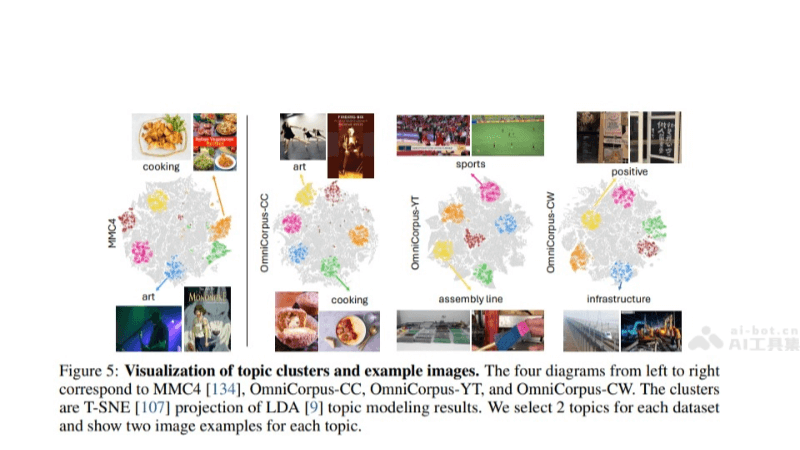
- Topic Modeling Analysis: Performs topic modeling based on technologies such as LDA, helping researchers understand the content distribution and topic diversity of the dataset.
OmniCorpus Project Address
- GitHub Repository:https://github.com/OpenGVLab/OmniCorpus
- arXiv Technical Paper:https://arxiv.org/pdf/2406.08418
How to Use OmniCorpus
- Obtain the Dataset:Visit the OmniCorpusGitHubpage,download the contents of the dataset.
- Understand the Data Format:Familiarize yourself with the dataset's organizational structure and file formats, which may include image files, text tokens, and metadata.
- Data Preprocessing:According to research or application needs, further preprocessing of the data may be required, such as data cleaning, format conversion, or data splitting.
- Model Training:Use the dataset to train multimodal machine learning models, such as image recognition, visual question answering, or image captioning models.Adjust model parameters to adapt to the characteristics of the dataset.
- Model Evaluation:Evaluate model performance on the dataset, using appropriate evaluation metrics such as accuracy, recall, or F1 score.
Application Scenarios of OmniCorpus
- Multimodal Learning: Used to train machine learning models that can simultaneously process images and text, improving the model's ability to understand and process visual and linguistic information.
- Visual Question Answering (VQA): Build systems that can understand image content and answer related questions, for example, for a given image, answer questions about the image content.
- Image Captioning: Develop systems that automatically generate descriptive text for images, which is very useful in social media, image search engines, and assistive technologies.
- Content Recommendation Systems: Combine image and text data to provide more accurate personalized content recommendations, such as e-commerce product recommendations, news article recommendations, etc.