
What is OmniAvatar
OmniAvatar is an audio-driven full-body video generation model jointly launched by Zhejiang University and Alibaba Groupvideo generationmodel. The model generates natural and realistic full-body animation videos based on input audio and text prompts, with character movements perfectly synchronized with the audio and rich expressions. The model is based on a pixel-level multi-level audio embedding strategy and LoRA training method, effectively improving lip synchronization accuracy and the naturalness of full-body movements, supporting functions such as character-object interaction, background control, and emotion control, and is widely used in podcasts, interactive videos, virtual scenes, and many other fields.
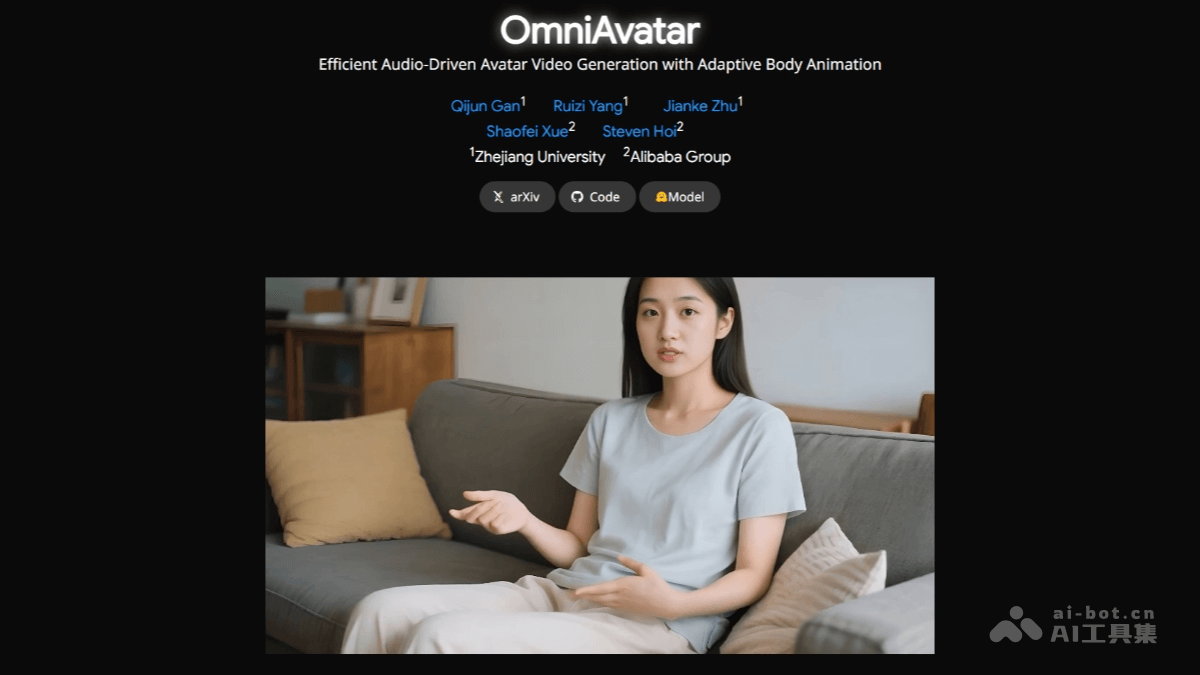
Main features of OmniAvatar
- Natural lip synchronization: Can generate lip movements perfectly synchronized with audio, maintaining high accuracy in complex scenes.
- Full-body animation generation: Supports generating natural and smooth full-body movements, making the animation more vivid and realistic.
- Text control: Precisely controls video content based on text prompts, including character movements, background, emotions, etc., enabling highly customized video generation.
- Character-object interaction: Supports generating scenes where characters interact with surrounding objects, such as picking up items, operating devices, etc., expanding the scope of applications.
- Background control: Changes the background based on text prompts, adapting to various different scene requirements.
- Emotion control: Controls the character's emotional expressions based on text prompts, such as happiness, sadness, anger, etc., enhancing the expressiveness of the video.
Technical principles of OmniAvatar
- Pixel-level multi-level audio embedding strategy: Maps audio features to the model's latent space and performs embedding at the pixel level, allowing audio features to more naturally influence the generation of full-body movements, improving the accuracy of lip synchronization and the naturalness of full-body movements.
- LoRA training method: Fine-tunes the pre-trained model based on Low-Rank Adaptation (LoRA) technology. By introducing low-rank decomposition into the model's weight matrices, it reduces the number of training parameters while preserving the model's original capabilities, improving training efficiency and generation quality.
- Long video generation strategy: To generate long videos, OmniAvatar is based on reference image embedding and frame overlap strategies. Reference image embedding ensures the consistency of character identity in the video, and frame overlap ensures temporal coherence in the video, avoiding abrupt changes in movements.
- Diffusion model-based video generation: Uses Diffusion Models as the underlying architecture to gradually remove noise and generate videos. This model can generate high-quality video content and performs excellently when processing long sequence data.
- Transformer architecture: On the basis of the diffusion model, the Transformer architecture is introduced to better capture long-term dependencies and semantic consistency in videos, further improving the quality and coherence of generated videos.
OmniAvatar project address
- Project official website:https://omni-avatar.github.io/
- GitHub repository:https://github.com/Omni-Avatar/OmniAvatar
- HuggingFace model library:https://huggingface.co/OmniAvatar/OmniAvatar-14B
- arXiv technical paper:https://arxiv.org/pdf/2506.18866
Application scenarios of OmniAvatar
- Virtual content production: Used to generate virtual avatars for podcasts, video bloggers, etc., reducing production costs and enriching content presentation forms.
- Interactive social platforms: In virtual social scenarios, provide users with personalized virtual avatars, enabling natural movements and facial expression interactions.
- Education and Training: Generate virtual teacher avatars, deliver instructional content based on audio input, and enhance the fun and appeal of teaching.
- Advertising and Marketing: Generate virtual spokesperson avatars, customize appearances and movements according to brand needs, and achieve precise advertising promotion.
- Gaming and Virtual Reality: Quickly generate virtual game characters with natural movements and expressions, enrich game content, and improve the realism of virtual reality experiences.