
What is OminiControl
OminiControl is a highly versatile and parameter-efficient image generation framework, designed for diffusion transformer models such as FLUX.1, enabling fine-grained control over the image generation process. OminiControl supports subject-driven control and spatial control, such as edge guidance andpainting generation, requiring only an additional 0.1% of parameters in the base model. OminiControl can seamlessly integrate the main subject of the provided material into newly generated images while maintaining high image quality and subject consistency. OminiControl provides a Subjects200K dataset of over 200,000 images, supporting research on subject-consistent generation tasks.
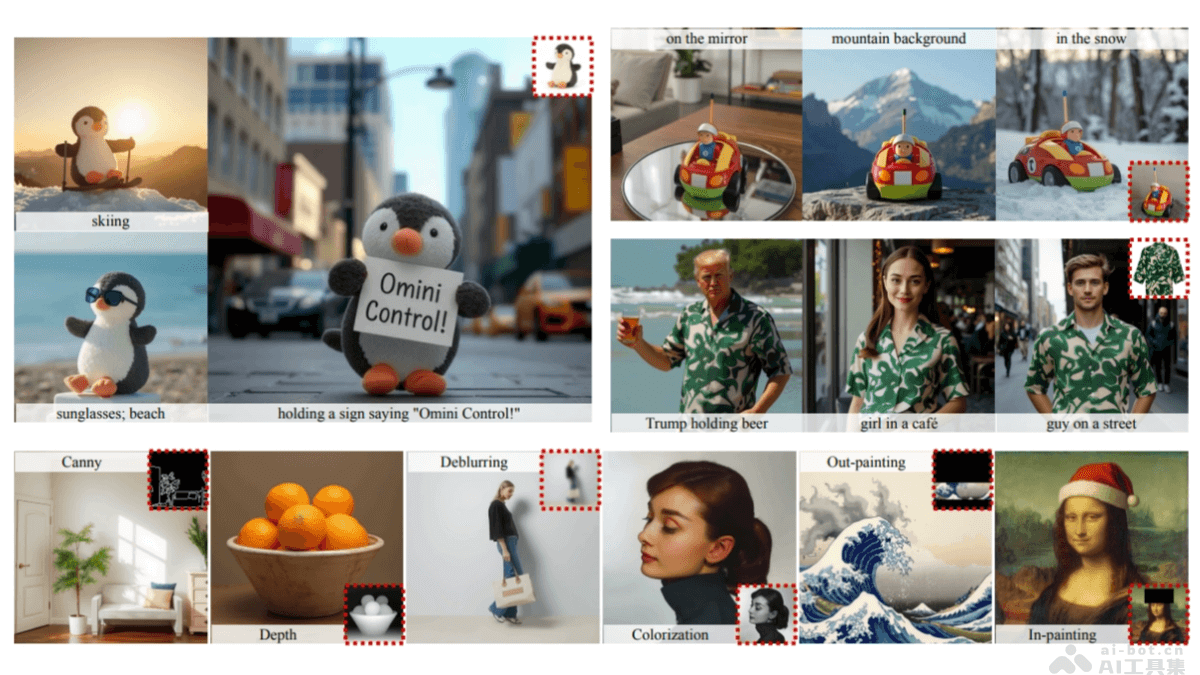
Main Features of OminiControl
- Subject-Driven Control: Generates new images based on the subject image and text prompt provided by the user, preserving the subject's features while modifying the background or scene according to the text description.
- Spatially Aligned Control: The framework supports image generation tasks that require precise spatial correspondence, such as edge guidance and painting generation.
- Multimodal Attention Interaction: By processing conditional images, noisy images, and text condition tokens in a unified manner, OminiControl achieves direct multimodal attention interaction, improving the efficiency of information exchange and control signal propagation.
- Parameter Efficiency: Compared with other methods, OminiControl introduces a very small proportion of additional parameters (0.1%), achieving efficient image condition control.
- Flexibility and Unification: Provides a unified architecture to handle both spatially aligned and non-spatially aligned control tasks, increasing the flexibility of the system.
Technical Principles of OminiControl
- Parameter Reuse Mechanism: Uses the model's existing VAE encoder to process the conditional image, encoding it into tokens in the same latent space as the noisy image tokens.
- Unified Sequence Design: Merges noisy image tokens, text tokens, and conditional image tokens into a unified sequence, allowing the conditional image to directly participate in the multimodal attention mechanism.
- Adaptive Position Embedding: Assigns position indices to conditional image tokens, ensuring effective interaction with noisy image tokens, which is crucial for both spatially aligned and non-spatially aligned tasks.
- Condition Strength Factor: Introduces a bias term to adjust attention weights, supporting manual adjustment of the influence strength of the conditional image during inference.
- Multimodal Attention Operation: In each Transformer block of the DiT, interaction between image and text condition tokens is achieved based on the attention mechanism.
Project Addresses of OminiControl
- GitHub Repository:https://github.com/Yuanshi9815/OminiControl
- HuggingFace Model Library:https://huggingface.co/Yuanshi/OminiControl
- arXiv Technical Paper:https://arxiv.org/pdf/2411.15098
- Online Experience Demo:https://huggingface.co/spaces/Yuanshi/OminiControl
Application Scenarios of OminiControl
- Art Creation and Design: Artists and designers generate images according to specific styles or themes, or incorporate existing design elements into new creations.
- Game Development: Game developers quickly generate concept art for game environments, characters, or props, or customize in-game items based on player choices.
- Film and Entertainment Industry: In film production, create or modify scenes, such as integrating specific objects or characters into different backgrounds.
- Advertising and Marketing: Marketers generate attractive advertising images, seamlessly integrating products into various scenes, enhancing the appeal of advertisements.
- Virtual Reality (VR) and Augmented Reality (AR): In VR and AR applications, generate realistic virtual environments and objects to enhance the user experience.