
What Is Omages
Omages is an open-source 3D model generation project that encodes the geometry and texture information of 3D shapes into 64×64 pixel 2D images based on image diffusion technology, simplifying the 3D modeling process. It not only improves the efficiency of 3D object generation, but also preserves rich details at low resolution, opening up new possibilities for 3D vision technology.
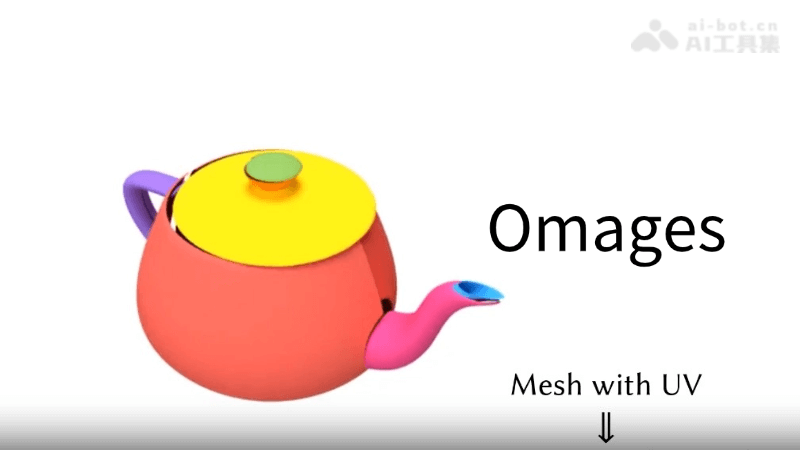
Main Features of Omages
- 3D Object Generation: Use an image diffusion model to generate 3D objects from 64×64 pixel images.
- Geometry and Texture Encoding: Encode the geometric information and texture details of 3D shapes into 2D images.
- Multi-Chart Representation: Adopt a multi-chart approach to automatically encode geometry and texture information.
- Detail Preservation: Generate 3D objects with rich details even at low resolution.
- Automatic Material Generation: Automatically generate physically based rendering materials through an image diffusion model.
Technical Principles of Omages
- Image Diffusion Model: Generate images based on a diffusion process, reconstructing clear images by gradually adding noise and removing noise in the reverse process.
- 3D-to-2D Encoding: Map the geometry and surface attributes of 3D objects (such as normals, albedo, metalness, and roughness) onto 2D images, known as encoding.
- Multi-Chart Representation: Omages uses multiple 2D images (charts) to represent different aspects of a 3D object, such as position maps, segmentation maps, normal maps, etc.
- Self-Encoding: Through self-encoding, Omages integrates the geometry and texture information of 3D objects into a unified image representation.
- Denoising Process: In the process of generating 3D objects, the model needs to remove noise from images containing noise to restore clear 3D shapes and textures.
Omages Project Address
- GitHub Repository:https://github.com/3dlg-hcvc/omages
Application Scenarios of Omages
- 3D Printing and Manufacturing: Quickly generate 3D models. Omages can be used for 3D printing, accelerating prototyping and small-batch production.
- Virtual Reality (VR) and Augmented Reality (AR): In VR and AR applications, Omages can quickly generate virtual environments and objects.
- Game Development: Game designers can use Omages to quickly create 3D game assets and improve development efficiency.
- Film and Animation Production: In film and television production, Omages can be used to quickly generate 3D scenes and characters, reducing pre-production time.
- Interior Design: Interior designers can use Omages technology to quickly generate 3D interior models based on images provided by clients, helping clients preview design results.