
What is OLMo?
OLMo (Open Language Model) is a fully open-source and open large language model (LLM) framework developed by Allen AI (AI2, Allen Institute for Artificial Intelligence). It was designed to promote collaborative research on the science of language models among academia and researchers through open research. The OLMo framework provides a series of resources, including data, training code, model weights, and evaluation tools, so that researchers can understand and improve language models more deeply.

OLMo official website entry
- Official project homepage:https://allenai.org/olmo
- GitHub repository:https://github.com/allenai/olmo
- Hugging Face address:https://huggingface.co/allenai/OLMo-7B
- Research paper:https://allenai.org/olmo/olmo-paper.pdf
Main features of OLMo
- Large-scale pretraining data: Based on AI2's Dolma dataset, which is a large-scale open corpus containing 3 trillion tokens, providing the model with rich language learning materials.
- Diverse model variants: The OLMo framework includes four model variants of different scales, each trained on at least 2 trillion tokens, which provides researchers with multiple choices to adapt to different research needs.
- Detailed training and evaluation resources: In addition to model weights, OLMo also provides complete training logs, training metrics, and more than 500 checkpoints. These resources can help researchers better understand the model's training process and performance.
- Openness and transparency: All of OLMo's code, weights, and intermediate checkpoints are released under the Apache 2.0 license, which means researchers can freely use, modify, and distribute these resources to promote knowledge sharing and innovation.
OLMo's model performance
According to OLMo's paper report, the performance of the OLMo-7B model in zero-shot evaluation was compared with several other models, including Falcon-7B, LLaMA-7B, MPT-7B, Pythia-6.9B, RPJ-INCITE-7B, and LLaMA-7B.
The following are the comparison results of OLMo-7B on some core tasks:
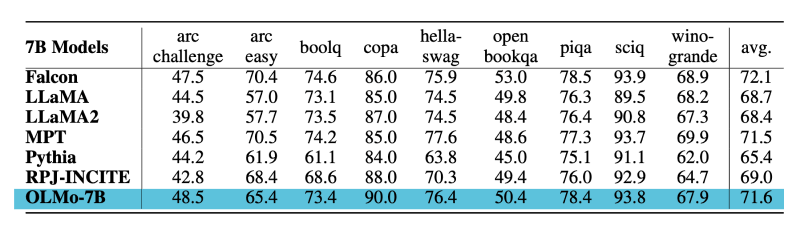
- Downstream task evaluation: In zero-shot evaluation on 9 core tasks, OLMo-7B performed best on 2 tasks (science questions and causal reasoning) and remained in the top three on 8 tasks. This shows that OLMo-7B has strong competitiveness on these tasks.
- Perplexity-based evaluation: In the Paloma evaluation framework, OLMo-7B's perplexity (bits per byte) performance on multiple data sources is also competitive. Especially on code-related data sources (such as Dolma 100 Programming Languages), OLMo-7B performs significantly better than other models.
- Additional task evaluation: On an additional 6 tasks (headqa en, logiqa, mrpcw, qnli, wic, wnli), OLMo-7B's performance in zero-shot evaluation is also better than or close to other models.